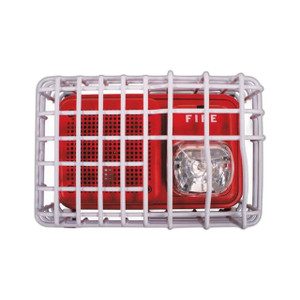
STI STI-9760 Horn/Strobe Damage Stopper Ceiling Mount
Overview
The STI STI-9760 is a protective ceiling mount engineered to shield L Series horn and strobe alarm devices from impact, vandalism, and environmental exposure. In facilities where audible and visual notification appliances are mounted overhead in high-traffic areas—warehouses, manufacturing floors, transit stations, emergency command centers—accidental or intentional damage to these devices can disable critical alarm coverage and trigger costly service calls or full device replacement. The STI-9760 extends device service life by absorbing and deflecting impact without compromising signal output or visibility. This is a straightforward cost-containment solution for integrators managing fire alarm, emergency notification, and security system deployments across multiple properties.
Key Features
- L Series Compatibility: Designed specifically for STI L Series horn and strobe units, ensuring a precise mechanical fit and full protection without interference to sounder or strobe lens output.
- Impact and Vandalism Protection: Absorbs direct hits and blunt-force impacts that would otherwise crack housings or disable internal components—particularly valuable in areas subject to forklift traffic, equipment movement, or environments where tampering is a concern.
- Ceiling-Mount Configuration: Supports installation in standard drop-ceiling and drywall applications, with straightforward fastening appropriate for both new builds and retrofit installations.
- Preserves Audible and Visual Coverage: Protective housing design does not suppress horn output or obscure strobe flash—critical for life safety and emergency response protocols.
- Cost-Effective Extended Lifecycle: Eliminates recurring replacement costs from damage-related downtime; a single protective mount often pays for itself after one or two avoided device failures in high-risk locations.
- Field-Installable: Requires no modification to the alarm device itself; integrators can retrofit existing installations or specify during new system commissioning.
Integration and Deployment Context
The STI-9760 fits into standard fire alarm and security system architectures where L Series notification devices are already integrated into a larger control panel or distributed signaling network. No special wiring, power conditioning, or software integration is required—the mount is purely mechanical. Use it in warehouse and logistics environments where overhead coverage is essential but infrastructure vibration and mobile equipment pose a risk; in manufacturing and industrial settings with aggressive cleaning cycles or high-velocity dust; in multi-tenant or publicly accessible facilities where equipment security concerns exist. Consider this mount for any location where device accessibility or visibility makes it a target, or where the cost of service calls or emergency repairs would exceed the cost of protective hardware.
When to Choose a Different Approach
If your facility requires strobe or horn coverage in a fully enclosed, climate-controlled, low-traffic environment with no vandalism history, a protective mount may be unnecessary overhead. Similarly, if your mounting strategy includes wall or pendant positions rather than ceiling installation, you may require a different protective form factor from the STI product family—contact a systems engineer to evaluate alternative placements.
Installation and Specification Notes
Standard ceiling fasteners (not included—site-supplied anchors appropriate to drywall, concrete, or suspended grid systems) are required. Installation time is typically under 30 minutes per device. Confirm local fire alarm code permits protective housings on notification appliances before final installation; most jurisdictions allow protection as long as audible and visual signals remain unobstructed and compliant with NFPA 72.
Frequently Asked Questions
Q: Will the STI-9760 reduce the volume or brightness of my L Series horn and strobe?
A: No. The mount is designed to protect without attenuating audible output or strobe visibility. However, if the protective housing is mounted directly in front of the strobe lens, it may partially obscure visual coverage in that specific direction—proper positioning during installation is critical.
Q: Can I install the STI-9760 on an existing L Series device without disabling the alarm?
A: Yes. The mount is retrofittable and requires no electrical disconnection or system reconfiguration. The device remains powered and operational during installation.
Q: What fasteners do I need to mount the STI-9760 to my ceiling?
A: The STI-9760 does not include fasteners. You will need ceiling-appropriate anchors (toggle bolts for drywall, expansion anchors for concrete, or grid clips for suspended ceilings) supplied by the installing contractor based on local building materials.
Q: Is the STI-9760 suitable for outdoor or wet-environment mounting?
A: This product is designed for indoor ceiling installation. For outdoor or wet-environment notification appliances, consult your integrator about weatherproofed housing options within the STI product line.
Q: Will the protective mount interfere with my fire alarm system's sounder verification or test procedures?
A: No. The mount does not modify electrical signals or alarm logic. Standard testing and maintenance procedures remain unchanged.
Q: How much weight does the STI-9760 add to the ceiling installation?
A: Exact weight specifications are detailed in the product datasheet. Your integrator should verify ceiling load capacity before final installation, particularly on older suspended grid systems.
Ted PerryPerspective based on aggregated IPSD and affiliated engineering team experience.
The STI STI-9760 addresses a real operational problem I see repeatedly in warehouse and manufacturing environments: notification devices mounted overhead get dinged, cracked, or disabled by forklifts, pallet jacks, and equipment movement—then the facility is left with either a dead zone in alarm coverage or an emergency service call at 2 AM. The STI-9760 is a straightforward prophylactic: it absorbs impact without muting the horn or obscuring the strobe, and it costs a fraction of emergency device replacement.
Deployment Considerations:
- Positioning matters: A protective housing mounted directly in front of a strobe lens can reduce visual coverage in that direction. Plan mounting angles carefully so the strobe flash reaches key sight lines—this is a mechanical, not electrical, issue.
- Ceiling load capacity is a real gotcha: On older suspended grid ceilings in particular, you need to verify that the combined weight of the device plus the protective mount doesn't exceed local load limits. This falls on the integrator and the facility manager, not the equipment itself.
- No fasteners included: Budget for site-supplied anchors appropriate to your ceiling material. This is cheap ($20–50 worth of hardware) but easy to overlook in the quote phase.
Best fit: any facility with overhead alarm coverage in a high-traffic or vandalism-prone zone. Warehouse, logistics, manufacturing, and transit environments see the highest ROI. If your facility has pristine, low-traffic indoor coverage with no history of damage, this is probably not necessary.