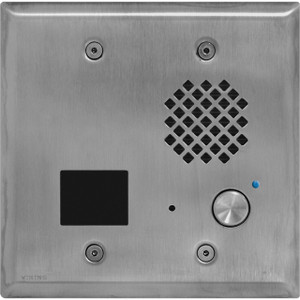
Viking Electronics E-65-SS Stainless Steel Video Entry Phone with Proximity Card Reader
The Viking Electronics E-65-SS is a compact, weather and vandal-resistant flush-mount entry phone that combines two-way handsfree audio, a 420-line color video camera, and a 125KHz proximity card reader into a single 304 stainless steel faceplate — a practical choice for commercial entry points where you need audio, video, and access control without running separate devices. Telephone-line powered, it eliminates the need for a dedicated power supply at the door, which simplifies rough-in considerably on retrofit jobs. The E-65-SS fits a standard double gang box or can be surface-mounted with the optional VE-5x5 enclosure.
Key Features
- 420-Line Color Video Camera with Wide FOV: The built-in color camera delivers 420 horizontal lines of resolution with an 80° horizontal, 60° vertical, and 100° diagonal field of view — wide enough to capture a full upper-body shot at a standard door approach without a fisheye distortion that makes facial detail useless. Camera power is 6–22V DC at 150mA, separate from the phone circuit, so you can run it from a nearby access control panel supply. Wire runs up to 1,000 ft on RG59/RG6 coax, giving you real flexibility on camera head-end placement.
- Integrated 125KHz Proximity Card Reader: The embedded 26-bit Wiegand reader handles standard HID-compatible 125KHz credentials and outputs directly to your access control panel over a standard Wiegand interface. Read range of 1.25" to 2.0" keeps credential swipes deliberate — appropriate for controlled entries where tailgating is a concern. Max cable run of 500 ft to the panel covers most multi-story commercial installs without repeaters. Reader draws 5–14V DC at 60mA, easy to tap from the access panel's auxiliary power.
- Telephone-Line Powered Audio Circuit: The phone section derives power from the telephone line itself — no local transformer or power supply required for the audio side. Ring voltage requires a minimum of 25V AC RMS, which standard PBX and VoIP ATA ring generators meet without issue. Auto-disconnect engages after a 300ms CPC (current path control) signal, ensuring the call terminates cleanly after entry is granted rather than leaving a live line open at the door. Speaker output is rated 62dB maximum at 1 meter — loud enough to be heard in a moderate lobby without adding external amplification.
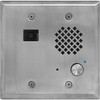
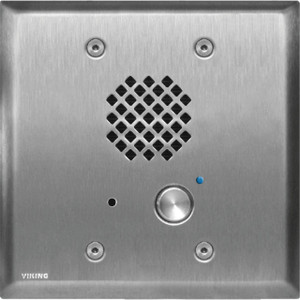
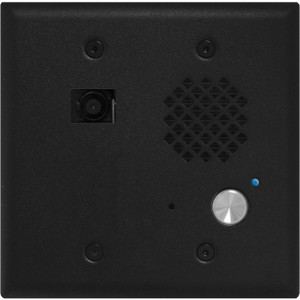
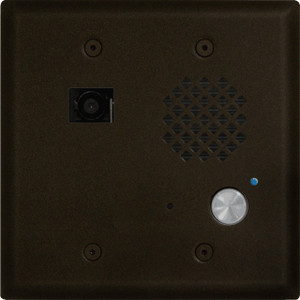
- 304 and 316 Stainless Steel Construction: The faceplate is 304 stainless steel; the push button itself is 316 stainless steel — the marine-grade alloy with higher chloride resistance. That distinction matters on coastal properties and in food-processing or chemical environments where surface corrosion on a 304 button would appear within months. The faceplate is available in brushed stainless, oil rubbed bronze, satin black, and satin white finishes to match architectural hardware standards.
- IP67-Rated Push Button: The push button switch carries an IP67 rating, meaning it is sealed against complete temporary immersion. In practice this translates to reliable operation in rain, car-wash overspray, and pressure-wash cleaning scenarios common in loading dock and exterior corridor applications. The operating temperature range of -30°F to 150°F covers unheated vestibules, parking garages, and rooftop access points across essentially all North American climate zones.
- Blue LED Call Indicator: The integrated blue LED provides a visible call-in-progress indicator to the person at the door — a small but operationally significant feature that eliminates repeated button presses when the inside party is slow to answer, reducing nuisance call stacking at the panel or PBX.
- Flexible Mounting Options: The faceplate dimensions of 4.875" x 4.938" x 0.17" are designed for flush installation in a standard double gang electrical box (minimum 2.25" deep x 3.65" wide x 2.84" tall — Carlon BH234R or equivalent). For surface mount applications without a box, the optional VE-5x5 enclosure brings the installation up to a clean finished look. Phone body dimensions are 2.84" x 1.8" x 1.65".
Integration and Compatibility
The E-65-SS integrates with any access control panel that accepts 26-bit Wiegand input — the de facto standard for 125KHz proximity systems, covering the broad majority of commercial panels from major access control manufacturers. The analog composite video output connects to standard CCTV DVRs, video intercoms, or standalone monitors; at 420 lines over RG59/RG6, it is a standard CVBS signal compatible with any composite video input. The audio circuit works with traditional analog PBX systems, standard POTS lines, and VoIP ATAs that provide a regulated ring voltage of 25V AC RMS minimum — verify this spec against your ATA's ring output before commissioning.
Frequently Asked Questions
Q: Does the E-65-SS require a separate power supply?
A: The telephone audio circuit is powered by the phone line itself — no local supply needed for that function. However, the camera (6–22V DC at 150mA) and the proximity card reader (5–14V DC at 60mA) each require their own DC supply, typically sourced from your access control panel's auxiliary output or a dedicated 12V power supply.
Q: What proximity card format does the E-65-SS support?
A: The built-in reader operates at 125KHz and outputs 26-bit Wiegand — the standard format used by HID Prox, EM4100, and most compatible 125KHz credentials. It does not support 13.56MHz smart card formats (MIFARE, DESFire, SEOS) or 37-bit Corporate 1000 out of the box.
Q: What is the IP rating on the E-65-SS?
A: The push button switch is rated IP67, which covers temporary immersion. The overall enclosure is weather and vandal-resistant per Viking's product documentation, though the full unit IP rating beyond the push button is not separately specified in the available documentation.
Q: Can the E-65-SS be surface mounted without cutting into a wall?
A: Yes. The E-65-SS is designed for flush mounting in a standard double gang box, but Viking offers the optional VE-5x5 surface mount enclosure that allows installation directly onto a flat surface without a recessed box — useful for concrete block, brick, or finished wall surfaces where cutting is not practical.
Q: What is the maximum cable run for the camera and card reader?
A: The camera supports up to 1,000 ft of RG59 or RG6 coaxial cable. The proximity card reader's Wiegand interface supports cable runs up to 500 ft to the access control panel. Both figures come from Viking's product documentation.
Q: What finish options are available for the E-65-SS faceplate?
A: The faceplate is available in four finishes: brushed stainless steel, oil rubbed bronze, satin black, and satin white — allowing the unit to coordinate with architectural door hardware and ADA signage at the entry point.
The E-65-SS is one of those products that earns its place on a project because it genuinely reduces the head count of devices at the door — and in my experience, that matters most on retrofit jobs where you're working with a single gang rough-in or a tight vestibule with no room for a separate intercom panel, reader, and camera. The telephone-line-powered audio circuit is the key spec here: it means you're pulling phone wire and low-voltage DC to the door, not a separate 120V circuit, which keeps you out of the electrician's scope on most commercial projects.
Technical Highlights:
- 316 Stainless Push Button: Most entry phones use 304 stainless throughout, but the E-65-SS steps up the push button itself to 316 — the alloy with measurably better chloride and salt spray resistance. If you're speccing for a coastal facility, a food-processing plant, or a car wash entry, that's not a marketing distinction; it's the difference between a button that looks right in 18 months and one that's surface-pitting.
- 1,000 ft Coax Camera Run: On RG59/RG6, the camera signal holds to 1,000 ft — enough to reach a head-end DVR or video intercom master station several floors away without a distribution amplifier. That's a real project cost reduction compared to IP-based alternatives that require a network drop or a PoE extender at every door.
- -30°F to 150°F Operating Range: This isn't a spec that shows up on most entry phone data sheets. It covers unheated parking garages in Minnesota winters and rooftop equipment room doors in Phoenix summers — environments where a narrower-rated device fails within the first season.
Deployment Considerations:
- The camera and reader each need independent DC supplies — don't assume the phone line covers them. Budget a 12V aux output from your access panel or a small dedicated supply near the door rough-in. The camera draws 150mA at 6–22V DC and the reader draws 60mA at 5–14V DC, so a single 12V/500mA supply covers both comfortably.
- The 26-bit Wiegand output is standard, but confirm your access control panel's Wiegand input length matches. Some newer panels default to 34-bit or 37-bit mode; a configuration mismatch will result in failed reads that are easy to misdiagnose as a wiring problem.
This unit is well-matched to controlled-access building entries, secure parking garage pedestals, and school exterior doors where the facility wants a single stainless faceplate handling call, credential, and camera in one rough-in — and where the budget doesn't support pulling IP network infrastructure to every exterior entry point.