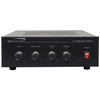
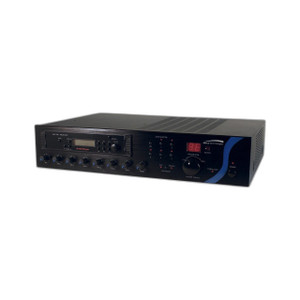
Speco Technologies PBM30 30W Contractor PA Amplifier
Overview
The Speco PBM30 is a 30-watt contractor-grade power amplifier purpose-built for security paging, emergency communication, and commercial audio distribution in institutional and enterprise environments. Designed to handle continuous operation in control rooms, security stations, and networked audio deployments, the PBM30 delivers reliable amplification where consistent audio coverage is non-negotiable. UL listing means it meets the electrical and fire-safety standards required for healthcare, education, and government facilities—a real requirement when audio amplification ties into life-safety systems.
Key Features
- 30-Watt Continuous Output: Delivers 30W of amplification, adequate for medium-zone paging in single or multi-zone security and commercial audio networks. This power level covers typical institutional spaces—control rooms, hallways, common areas—without requiring parallel amplifier configurations for basic coverage.
- UL Listed for Life-Safety Compliance: Certified to UL standards for electrical safety and fire protection. This certification is mandatory (not optional) in most regulated facilities. If your jurisdiction or facility accreditation requires UL-listed audio equipment, the PBM30 clears that box directly.
- Contractor-Grade Construction: Built for professional integration into distributed audio systems and paging networks. Robust internal design supports continuous operation without thermal throttling—important because security paging and emergency notification systems run 24/7, and occasional audio dropouts during peak demand are unacceptable.
- Compact, Space-Efficient Design: Footprint is small enough for wall mounting in control rooms or standard equipment racks near central audio controllers. This proximity to your switching equipment reduces analog line-level cable runs, which matters because longer unshielded analog runs pick up hum and RF noise.
- Standard Analog Audio Interfaces: Accepts line-level audio inputs (typical from security system controllers or emergency notification systems) and delivers speaker-level outputs to distributed ceiling or wall-mounted paging speakers. No proprietary connectors or exotic impedances—straightforward integration with legacy and modern commercial AV infrastructure.
- Reliable Thermal Management: Engineered for uninterrupted operation in climate-controlled indoor commercial spaces. No active cooling means no fan noise—important in quiet environments like hospitals, libraries, and office environments where audio amplifier fan hum becomes an irritant.
Integration & Compatibility
The PBM30 integrates directly into analog audio systems commonly found in security paging networks, emergency communication controllers, and distributed commercial AV installations. It pairs with standard security system microphones, call stations, and emergency notification platforms that output line-level audio. Speaker outputs connect to 8Ω or 16Ω distributed speaker arrays—typical for commercial ceiling or wall-mounted speaker networks. For networked audio environments, the PBM30 sits downstream of a network audio interface or codec, accepting analog output from that device and amplifying to speaker level. This two-stage approach (network interface → analog amplifier → speakers) is common in large campuses, hospitals, and multi-building enterprises where audio must be distributed across IP networks but final amplification remains analog for reliability and simplicity.
Deployment Considerations
Install the PBM30 indoors in climate-controlled environments—control rooms, server closets, mechanical rooms near speaker distribution points, or standard equipment racks. Mount it on a wall or in a standard 19-inch rack frame. Position it near your central audio controller or network audio interface to keep analog line-level cables short and reduce susceptibility to hum. Verify that your speaker load matches the amplifier's rated impedance (typically 8Ω or 16Ω); mismatched impedances reduce power delivery and can damage the output stage. For campus-wide or multi-building paging, you may need multiple PBM30 units—one per major audio zone—to provide adequate coverage without excessive speaker damping due to impedance loading. Ensure adequate ventilation around the amplifier; even compact units generate heat during continuous operation.
Frequently Asked Questions
Q: Is the PBM30 suitable for outdoor paging?
A: No. The PBM30 is designed for indoor commercial and institutional environments. Outdoor paging requires weatherproof amplifiers with IP66 or IP67 ratings and environmental hardening for temperature and humidity extremes.
Q: What speaker impedance does the PBM30 support?
A: The PBM30 delivers speaker-level output compatible with standard commercial distributed audio systems, typically 8Ω or 16Ω loads. Verify your speaker array impedance matches the amplifier's rated output before installation.
Q: Can I use the PBM30 in a healthcare facility?
A: Yes. The PBM30 is UL-listed, meeting the electrical safety and fire-protection standards required for hospitals, clinics, and other healthcare environments where audio amplification ties into emergency notification and life-safety systems.
Q: Does the PBM30 include networked audio capability (IP-based)?
A: No. The PBM30 is a pure analog amplifier. For networked audio distribution, deploy a separate network audio interface or codec upstream of the PBM30; the codec handles IP transport, and the amplifier provides final speaker-level amplification.
Q: What's the typical wall-mount installation process?
A: The PBM30 features a compact form factor suitable for wall mounting in control rooms or near audio distribution points. Standard wall-mount brackets are used; consult the mounting template (included with the unit) for hole spacing and stud placement. Ensure access to a standard AC power outlet and route analog audio cables from your controller to the amplifier's line-level inputs.
Ted PerryPerspective based on aggregated IP Security Depot and affiliated engineering team experience.
The PBM30 is a straightforward, unadorned choice for integrators who need UL-listed amplification in contractor-grade security and commercial audio systems. I've specified this amplifier multiple times in institutional deployments where 30 watts of continuous power handles medium-zone paging without requiring multi-unit architectures or complex impedance matching. It's not a high-end studio amplifier—it's built for reliability and standards compliance, which is exactly what a control room or emergency notification system needs.
Technical Highlights:
- UL Certification: Meets electrical safety and fire-protection standards mandated in healthcare, K–12 education, higher education, and government facilities. If your system touches life-safety audio, this certification is non-negotiable, and the PBM30 includes it without upsells.
- 30-Watt Continuous Output: Adequate for typical commercial paging zones—control rooms, hallways, common areas, smaller departments. Covers most institutional deployments without requiring parallel amplifiers or complicated zone management.
- Compact Wall- or Rack-Mount Form Factor: Proximity to your audio controller reduces cable runs and hum susceptibility. In a multi-building campus, deploying one PBM30 per major zone keeps cabling simple and troubleshooting straightforward.
Deployment Considerations:
- Confirm your speaker impedance (8Ω or 16Ω) before wiring. Mismatched impedance reduces power and can damage the output stage—not a field-discoverable problem.
- The PBM30 is analog-only. If you're building a networked audio system, budget a separate network audio interface or codec upstream; this amplifier does not handle IP audio transport.
- Indoor-only. No weatherproofing for outdoor speaker arrays or uncontrolled environments.
Deploy the PBM30 in healthcare, education, and government facilities where UL-listed audio amplification is a requirement, not a nice-to-have. Its compact footprint and continuous-duty design make it a reliable workhorse for institutional paging and emergency notification—the kind of component that runs quietly in the background and never becomes a support headache.