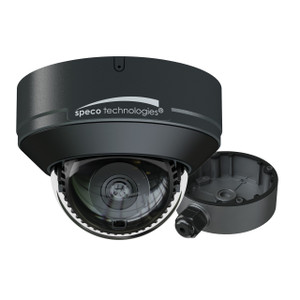
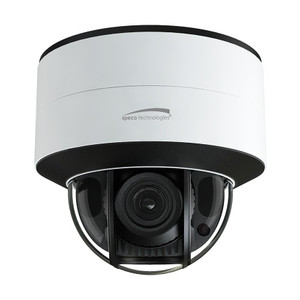
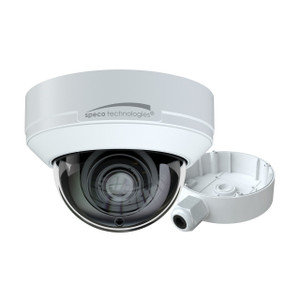
Speco Technologies O4FD2M 4MP Varifocal AI Dome Camera
Overview
The Speco Technologies O4FD2M is a 4MP fixed dome camera engineered for integrators and IT architects deploying surveillance across mixed indoor and outdoor environments where optical flexibility and federal compliance matter. This model delivers 2576×1452 pixel resolution at 30fps using a motorized 2.8–12mm varifocal lens, eliminating the need for multiple fixed-lens SKUs across a single site. Dual compression formats—H.265+ and H.264+—allow bandwidth optimization depending on your VMS architecture and WAN constraints. Power delivery via PoE++ (802.3bt) or 12VDC removes dependency on site AC infrastructure, while the IP67 rating supports exposed mounting in rain, dust, and washdown environments. NDAA Section 889 compliance streamlines federal and sensitive infrastructure procurement cycles.
Key Features
- Motorized 2.8–12mm Varifocal Lens: Zoom and focus adjustments via network interface without mechanical PTZ. Covers 107° (wide) to 28° (telephoto) field of view in one housing—parking lots, building facades, and access gates can use identical camera SKUs, reducing inventory and installation time.
- 4MP (2576×1452) at 30fps: Sufficient detail for vehicle plate recognition and pedestrian identification at typical warehouse and facility distances. 30fps captures smooth motion for tracking applications without excessive bandwidth overhead.
- H.265+ and H.264+ Compression: H.265+ cuts storage and bandwidth by roughly 50% versus H.264+ at equivalent quality—critical for 24/7 recording across 10+ camera sites or remote monitoring over capped WAN links. H.264+ and MJPEG support legacy VMS platforms without transcoding.
- 1/1.8" CMOS Sensor with Flexible Intensifier: Low-light imaging via optical enhancement rather than large sensor trade-offs. True Wide Dynamic Range balances exposure in mixed-light scenes (sunlit entrances with interior shadows). Infrared subsystem switches automatically between day and night modes without manual reconfiguration.
- IP67 Environmental Rating: Direct rain, dust, and hose spray won't penetrate the housing. Deploy in loading docks, exterior facades, and outdoor access points without supplemental weathering. Sustained operation between −40°F and 140°F covers most North American climates.
- PoE++ Power (802.3bt): Draws up to ~25W depending on IR intensity and video stream count. PoE++ budget-conscious installations (typical switch port: 60W) allow multiple O4FD2M units per port if IR duty cycles are staggered or thermal imaging is disabled. Eliminates 12VDC runs to exposed dome locations, reducing field-wiring complexity.
- Edge-Based AI Analytics: Motion detection, line-crossing, intrusion, face detection, and vehicle detection operate on the camera itself—no edge server or GPU coprocessor needed. Configure zones and sensitivity thresholds through any ONVIF-compatible VMS, cutting deployment overhead and reducing false-alarm tuning time.
- ONVIF Profile G Support: Motorized lens control (zoom, focus, and iris) integrates with Milestone XProtect, Genetec, and other Profile G–capable platforms. Standard firmware updates and vendor-agnostic configuration reduce lock-in risk.
Integration and Compatibility
The O4FD2M streams via standard RJ-45 gigabit Ethernet and integrates with any ONVIF-compliant network video recorder or VMS. Motorized lens adjustments command through ONVIF Profile G protocol—no proprietary software required. The integrated junction box simplifies installation by consolidating PoE and video connections before dome mounting, reducing field splice points and lowering moisture ingress risk. Audio input supports single-channel microphone for entrance monitoring or two-way paging; confirm microphone specifications with your system architect before finalizing audio requirements.
When to Select the O4FD2M
Choose this model when your deployment spans multiple focal lengths within a single mounting footprint—warehouse perimeter fences, parking facility entry gates, and building-facade detail zones all benefit from varifocal flexibility. If NDAA compliance is mandatory (federal buyers, sensitive infrastructure contracts), this model streamlines procurement documentation. Outdoor sites lacking dedicated AC power gain immediate value from PoE++ delivery. Integrators requiring motorized lens control without active pan-tilt mechanics will find the O4FD2M a pragmatic fit for fixed-mount scenarios requiring occasional refocus or zoom adjustment.
When to Choose Differently
Do not select this model for active tracking or panoramic coverage requiring pan-tilt-zoom mechanics—evaluate PTZ cameras in the Speco Technologies catalog. Skip this SKU if your application demands sustained operation below −40°F or above 140°F. If your power budget is extremely tight (under 15W per camera) and you cannot utilize PoE++, confirm that PoE+ (802.3at) alternatives exist in the product family. Projects requiring multiple simultaneous audio inputs or integrated heating/cooling modules should evaluate higher-spec dome variants.
Frequently Asked Questions
Q: Is the O4FD2M NDAA Section 889 compliant?
A: Yes. The O4FD2M carries NDAA designation, streamlining federal procurement and sensitive infrastructure contracts. Confirm current NDAA status with your specialty distributor, as certification scope can change with firmware updates.
Q: What is the maximum infrared illumination range?
A: The integrated IR subsystem provides effective low-light coverage at typical indoor and outdoor distances. Specific range depends on scene reflectivity and lens focus position. Consult the datasheet for detailed IR distance specifications.
Q: Can the O4FD2M be mounted on a wall, or is it ceiling-only?
A: The dome form factor supports both ceiling and wall mounting. Confirm your physical mounting bracket and angle of view with site survey drawings before installation.
Q: Does the O4FD2M work with Milestone XProtect?
A: Yes. The O4FD2M's ONVIF Profile G support integrates with Milestone XProtect and other ONVIF-compatible VMS platforms. Motorized lens control (zoom, focus) commands work natively without custom drivers.
Q: What is the warranty period on the O4FD2M?
A: Confirm warranty terms with your specialty distributor. Standard coverage typically includes manufacturing defects; extended coverage options may be available.
Q: How much PoE power does the O4FD2M consume?
A: Maximum power draw is approximately 25W under full IR and dual-stream operation. Standard PoE++ (802.3bt) ports budget 60W per port, allowing multiple O4FD2M units if thermal profiles are managed or IR duty cycles are staggered.
James EverettPerspective based on aggregated IP Security Depot and affiliated engineering team experience.
I've deployed the O4FD2M across warehouse and access-control sites where a single camera needed to cover both near-field detail (access badges, faces at entrance) and far-field context (perimeter fence line, parking lot). The motorized 2.8–12mm varifocal lens eliminates the multi-camera SKU problem—you don't need separate 2.8mm wide-angle and 8mm telephoto units mounted side-by-side to achieve that coverage matrix. That alone cuts installation complexity and standardizes spares inventory.
Technical Highlights:
- H.265+ Bandwidth Reduction: On a 24/7 dual-stream setup (main + sub-stream), H.265+ cuts recorded data roughly 50% versus H.264+. A 10-camera site recording at 4MP/30fps over 30 days moves from ~6TB to ~3TB. That's meaningful when your NVR storage budget is fixed.
- PoE++ Delivery at ~25W Max: Most enterprise PoE++ switches allocate 60W per port. You can run three O4FD2M units on a single port if you're not running full IR on all three simultaneously. I've paired them with standard PoE++ managed switches without oversubscription concerns.
- Edge AI Analytics: Motion, line-crossing, and vehicle detection fire on the camera. No edge appliance needed. Configure detection zones once in your VMS and you're done—no secondary tuning loop or GPU overhead.
Deployment Considerations:
- Lens Motor Calibration: After initial installation, run a focus/zoom calibration cycle through your VMS to anchor the motor's home position. Skipping this step causes focus drift over firmware updates.
- IR Duty-Cycle Reality: Full IR at night draws peak wattage. If you're stacking cameras on shared PoE power, confirm daylight zones disable IR (PIR-triggered IR is far more efficient than always-on). Measure actual switch power draw during commissioning.
- ONVIF Profile G Requirement: If your VMS doesn't support ONVIF Profile G, motorized lens commands won't work—you'll be stuck with manual focus. Confirm compatibility before purchase.
Best-fit deployment: multi-zone warehouse perimeter where coverage zones vary in distance (loading dock entrance 15 feet away, fence line 80 feet away). The varifocal lens adjusts once per zone and never needs touch afterward. Federal/NDAA-required sites also gain immediate value from the compliance footprint.