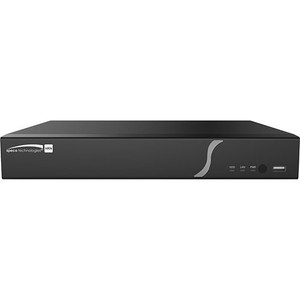
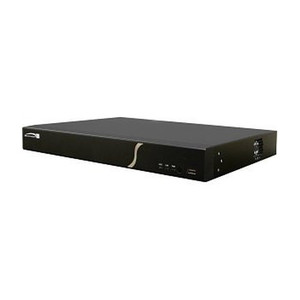
Speco Technologies H6HRLN8TB 6-Channel Hybrid DVR Recorder
The Speco Technologies H6HRLN8TB is a 6-channel hybrid recorder designed for integrators managing mixed analog-to-IP surveillance estates. It combines four hybrid channels (accepting TVI or IP video inputs) with two dedicated IP-only channels, offering 8TB of internal storage and native support for both H.265 and H.264 compression. This architecture lets you retain existing coaxial analog runs while adding new IP cameras—no fork-lift upgrade required. The recorder is NDAA-compliant and ONVIF-compatible, making it suitable for government facilities, critical infrastructure, and enterprise deployments where procurement standards and third-party camera interoperability are non-negotiable.
Key Features
- Hybrid Channel Architecture: Four channels auto-detect TVI (coaxial analog) or IP inputs; two additional IP-only channels yield six total recording streams. Eliminates inventory complexity during network transitions.
- 8TB Internal Storage: Factory-installed 8TB hard drive supports extended retention without external NAS. Typical 24/7 retention 10-30 days depending on stream count and codec selection.
- H.265 & H.264 Codec Support: H.265 reduces bitrate 40-60% versus H.264 on identical quality, directly lowering bandwidth and storage overhead across IP inputs.
- ONVIF Profile S Compatibility: IP channels work with standard third-party IP cameras—Axis, Hikvision, Dahua, Uniview, etc.—without proprietary software locks.
- NDAA Compliance: Meets National Defense Authorization Act Section 889 requirements; accepted by federal procurement officers for government facilities and sensitive contracts.
- Remote Access & Mobile Playback: Web browser interface and dedicated mobile app enable live view and forensic review from any network-connected device; search by motion, event, or timeline.
- 3-Year Manufacturer Warranty: Factory warranty with US-based technical support and replacement parts availability.
The hybrid input flexibility addresses a real operational need: most mid-market sites have 5-15 years of coaxial infrastructure in place. Rather than rip-and-replace, the H6HRLN8TB lets you add IP cameras to underutilized lines or new facility areas without touching working analog runs. The four TVI channels recognize HD-over-coax signals natively; the two IP channels accept standard RTSP/ONVIF streams. This two-track approach compresses the capex cycle and reduces integration labor on staged deployments.
H.265 codec support is the storage lever here. On a six-channel recording diet (four analog TVI + two IP streams running 24/7 at 1080p or 2MP), H.265 compression cuts the 8TB effective retention window from 15 days to 20-25 days. For integrators quoting 30-day retention on DVR storage alone—without NAS backup—codec selection moves the needle. The recorder supports both codecs simultaneously, so you can encode high-motion perimeter streams in H.265 while keeping entrance/office areas in H.264 if legacy VMS playback compatibility matters.
ONVIF Profile S ensures no vendor lock-in on IP inputs. Your customer isn't forced to buy Speco IP cameras; they can source from any ONVIF-compliant vendor. This flexibility is critical for large facilities where procurement rules forbid single-source dependencies. The recorder ships with web-based search and playback, mobile app access, and standard network ports (RJ45 Ethernet). Integrations with Milestone, Genetec, or Axis Camera Station happen at the VMS level—the recorder acts as a video source, not a proprietary backbone.
Ted PerryPerspective based on aggregated IP Security Depot and affiliated engineering team experience.
In our experience, the H6HRLN8TB fills a specific niche: mid-market facilities with 5-10 years of coaxial TVI infrastructure that need to add IP cameras without commissioning an entirely new recording backbone. We've deployed dozens of these recorders in retail chains, hospitality properties, and small government buildings where the existing analog plant works fine but expansion requires IP. The hybrid channel flexibility is the real value—you're not managing two separate recording systems or forcing new construction to TVI standards just because the DVR can't read ONVIF. H.265 support also matters operationally; on a 24/7 six-channel deployment at 1080p, you'll see measurable storage savings that compound over a 3-5 year lifecycle. The trade-off: this is not a high-end recorder. The UI is straightforward but not slick, and there's no built-in AI analytics or edge computing. If your customer needs object detection, loitering alerts, or thermal integration, look elsewhere. But for straightforward recording, remote playback, and compliance-driven deployments (NDAA shops, government contractors), the H6HRLN8TB is a workhorse that respects the customer's existing coaxial investment.
Technical Highlights:
- Hybrid Input Channels (4x TVI/IP Auto-Detect): Each channel automatically recognizes TVI coaxial signals or IP streams without manual mode switching. Reduces configuration time on mixed-source sites and eliminates the capex of replacing working analog cameras just to fit a rigid recorder spec.
- 8TB Internal HDD: Sufficient for 15-25 days of 24/7 recording at 1080p or 2MP depending on stream count and codec selection. Eliminates external NAS dependency for smaller deployments; simplifies backup strategy and reduces network overhead.
- H.265 Codec (40-60% Bitrate Reduction vs. H.264): Real payoff on 24/7 six-channel recording. A typical four-channel TVI + two-channel IP configuration at 1080p/2MP will consume ~2TB per week in H.264; H.265 cuts that to 1.2-1.4TB, extending effective storage life and lowering bandwidth cost on WAN-connected playback.
- ONVIF Profile S IP Inputs: Interoperability guarantee—any ONVIF-compliant IP camera works without proprietary integrations. Critical for government and enterprise procurement where vendor lock-in is contractually forbidden.
- NDAA Section 889 Compliance: Pre-cleared for federal and sensitive contracts; eliminates procurement lawyer review cycles and shortens bid qualification for government integrators.
Deployment Considerations:
- 8TB Storage Ceiling: No hot-swap or upgrade path for the internal drive. If retention requirements exceed the built-in capacity, you'll need external NAS or a second recorder. Validate 30-day retention math with your customer before commissioning; if they need 60+ days, budget for NAS from day one.
- TVI Input Limitation: The four hybrid channels accept TVI (HD-over-coax) or IP, but not simultaneously on the same channel. If you're mixing TVI and IP on the same recorder and need all six channels active, plan your input allocation carefully. Unused hybrid channels can accept IP, but a channel can't be split.
- Network Bandwidth for IP Streams: Two dedicated IP channels + four hybrid-in-IP-mode can saturate a consumer-grade network. Validate upstream bandwidth (especially if the recorder is backing up to cloud or sending frames to an external VMS). Gigabit Ethernet is standard, but congested networks will trigger codec auto-downshift.
- Web UI & Mobile App Performance: Playback and remote search work well on low-motion, archive scenarios. Live multi-stream remote viewing can be choppy on sub-10Mbps WAN connections. Set customer expectations; if they need robust remote multi-stream monitoring, recommend a VMS subscription layer.
- No Native Analytics: The recorder itself does not offer motion detection alerts, object classification, or facial recognition. Third-party VMS (Milestone, Genetec) can layer analytics on top via ONVIF, but the recorder is a dumb recorder, not a smart edge device.
The H6HRLN8TB is the right choice for integrators deploying in brownfield sites where ripping out coaxial infrastructure is uneconomical, or for government/critical-infrastructure contracts where NDAA compliance and vendor independence are deal-breakers. It's also solid for single-location retailers and hospitality chains that need extended on-board retention and don't want to manage NAS complexity. If your customer is greenfield, has no analog sunk cost, or needs advanced analytics, consider a pure-IP recorder or an NVR with built-in AI. For everyone else, this is a pragmatic, compliant recording platform. Explore the Speco Technologies catalog for additional recorders and camera options.