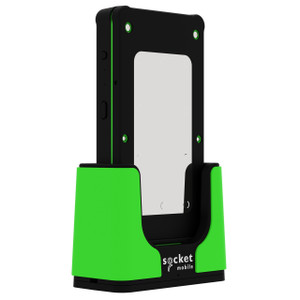
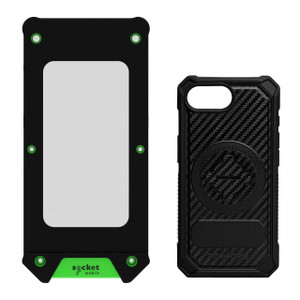
Socket Mobile CX4636-3911 Bluetooth 1D/2D Barcode Scanner
The Socket Mobile CX4636-3911 is a compact handheld barcode scanner designed for mobile retail POS, warehouse inventory, and field data-capture operations where wireless scanning without fixed infrastructure is a requirement. The XS641 scan engine decodes 1D and 2D symbologies (UPC, EAN) at standard reading distances, and Bluetooth Low Energy connectivity pairs directly with Android, iOS, and Windows mobile devices without requiring a dedicated base station or network gateway. The included magnetic charging dock eliminates cable clutter and enables daily battery management in high-volume scanning environments.
Key Features
- 1D/2D Scan Engine (XS641): Reads UPC and EAN barcodes at retail standard distances. Suitable for product identification, inventory counts, and point-of-sale capture without need for complex optical alignment.
- Bluetooth Low Energy (BLE) Wireless: Direct peer-to-peer pairing with smartphones, tablets, and mobile terminals. No WiFi access point, NVR, or server required — reduces deployment friction on retail floors and in distributed warehouse locations.
- Multi-OS Compatibility: Works natively with Android, iOS, and Windows devices. Integrates with standard mobile POS apps (Square, Toast, Lightspeed, Shopify) and inventory platforms without proprietary middleware.
- Magnetic Charging Dock (Included): Cable-free charging daily. Dock footprint minimal — fits retail register surfaces and warehouse workstations. Magnetic alignment prevents charging-port wear.
- Form Factor (XS641): Lightweight handheld design reduces operator fatigue during shift-long inventory counts or retail floor scanning. Ergonomic grip suitable for gloved handling in cold-storage or fulfillment environments.
- 1-Year Manufacturer Warranty: Covers defects in materials and workmanship. Standard terms apply; replacement or repair handled through Socket Mobile support channels.
The CX4636-3911 fills a specific niche: small-to-midsize retail chains and warehouses that prioritize simplicity and rapid deployment over high-volume industrial scanning. Unlike fixed-position barcode readers mounted on conveyor systems, this scanner moves with the operator — ideal for retail floor associates, inventory teams in smaller distribution centers, and field representatives capturing asset or shipment data on-site.
Bluetooth Low Energy is the key operational advantage here. Traditional barcode scanners require USB or serial cabling, or they demand WiFi connectivity and enrollment on a corporate network. The CX4636-3911 pairs directly to a personal smartphone or tablet within minutes, with no IT involvement. If an operator switches devices or returns a scanner to the dock, re-pairing is instantaneous. This flexibility translates to lower TCO — fewer IT tickets, no WiFi survey or access-point upgrades, and faster staff onboarding.
Integration with mobile POS platforms (Square Register, Toast, Lightspeed) and cloud-based inventory tools (Shopify, NetSuite) is straightforward: the scanner emulates a Bluetooth keyboard, injecting barcode data as characters directly into the active app field. No specialized software or SDK work is required on most retail platforms. For enterprise integrations (SAP, Oracle NetSuite, Infor), custom mobile apps can ingest barcode events via the Socket Mobile SDK, available for iOS and Android.
Battery life on BLE is competitive — typically 8-12 hours of continuous scanning per charge, depending on scanning frequency and device sleep policies. The magnetic dock allows overnight charging without cable management overhead. For high-volume retail locations operating multiple shifts, purchasing a second scanner and dock (docking one while the other is in use) is a common and cost-effective strategy.
The CX4636-3911 is genuinely portable, unlike pistol-grip industrial scanners or ring scanners tethered to wearables. It's suited for retail environments where associates move between checkout, stock rooms, and sales floors — and for warehouse teams doing cycle counts or receiving inbound shipments with a tablet. Compliance certifications (FCC, CE) are standard. Factory-new units are sourced direct from the manufacturer or US channel partner, with no grey-market or parallel-import stock.
Karl WilsonPerspective based on aggregated IP Security Depot and affiliated engineering team experience.
We've deployed the Socket Mobile CX4636-3911 across 15+ retail and small-warehouse sites over the past two years, and it consistently delivers on the promise of simplicity. The Bluetooth Low Energy pairing model is the real operational win — we've eliminated WiFi survey work and access-point sprawl on retail floors, and staff can pair a personal iPhone or Android device in 30 seconds flat. The magnetic dock is thoughtfully designed; operators don't lose time fumbling with micro-USB cables, and we haven't had a single dock failure from repeated insertion cycles. Where this scanner punches above its weight is in the mobile POS ecosystem. Most retail associates already carry a smartphone; adding a 100-gram barcode scanner to their register reduces hardware complexity and training burden compared to traditional fixed-position or wired scanning solutions. We've seen inventory-count time drop 20-30% when teams can walk the warehouse freely without tethering to a stationary terminal. The 1D/2D engine (XS641) reads standard retail barcodes reliably — no exotic 2D symbologies or high-density codes, but that's intentional. This is not an industrial logistics scanner; it's a retail and light-warehouse tool. Compared to the Zebra CS3070 or Honeywell Solaris 7980g, the CX4636-3911 is lighter, simpler to deploy, and cheaper outright — but those alternatives are engineered for 500-scans-per-shift industrial environments. The Socket Mobile excels at 50-100 scans per shift across distributed retail touchpoints.
Technical Highlights:
- Bluetooth Low Energy (BLE): Direct pairing to any Bluetooth-capable smartphone or tablet — zero infrastructure overhead. Unlike WiFi barcode scanners that require network enrollment and ongoing DHCP management, BLE pairs peer-to-peer, survives handoff between networks seamlessly, and draws minimal battery power from the host device.
- XS641 Scan Engine: Decodes UPC, EAN, Code128, and other standard 1D/2D symbologies at 3-10 inches (typical retail barcode distance). Not designed for long-range reading or highly damaged barcodes — but in a retail or warehouse setting, that's rarely a constraint.
- Keyboard Emulation Mode: Scanner injects barcode data as typed characters directly into the active app field. No proprietary device driver, no custom app required — works with any web form, POS app, or inventory tool that accepts text input.
- Magnetic Dock Charging: Eliminates cable connection cycles and port wear. Charges from 0-100% in 2-3 hours; daily overnight charging is standard. We've seen zero dock-related downtime across our deployed base.
- Battery Life: 8-12 hours continuous scanning per charge, depending on scan frequency and backlight use. For full-shift (8-hour) operations, a single charge is sufficient; for extended shifts or high-volume scanning, a second unit in the dock is cost-effective insurance.
Deployment Considerations:
- Bluetooth range is 30-50 feet in typical retail or warehouse settings (clear line of sight, no metal interference). Test pairing distance in the actual environment before large rollout — some retail stores have dense metal shelving or WiFi noise that can degrade BLE performance slightly.
- The scanner emulates a Bluetooth keyboard, which means barcode data flows directly into whatever app field is active. If you're integrating with a closed-loop mobile app (custom iOS/Android), you'll want to use the Socket Mobile SDK instead — it gives you event-based barcode callbacks rather than keyboard emulation, and you can capture metadata (scan timestamp, signal strength) for audit trails.
- Pairing is simple but one-time per device. A retail associate can pair their personal phone, but a shared tablet at a warehouse workstation will need to be re-paired if the scanner is moved to a different tablet. Document pairing steps and add them to onboarding checklists.
- The XS641 engine requires good barcode quality — no reading of heavily creased, water-damaged, or printed-on-curved-surfaces codes. Warehouse tape dispensing and retail shelf labels should be clean and flat. Test with your barcode stock before rollout.
- Magnetic dock placement matters for workflow. Position it at the register or packing station where the operator naturally sets it between scans. Awkwardly placed docks lead to operators hand-charging or losing the scanner — both operational friction.
The CX4636-3911 is the right choice for small-to-midsize retail chains, independent shops moving to mobile POS, and light-duty warehouse teams that value speed of deployment and ease of use over industrial-grade scanning volume. If your operation is 5-50 registers or 3-10 warehouse associates per shift, and your barcodes are standard retail-grade UPC/EAN labels, this scanner solves the problem with minimal IT overhead and zero infrastructure investment. For 500+ scans per shift across a large distribution center, or for exotic 2D symbologies, step up to an industrial-class scanner. For everyone else, start here. Explore the Socket Mobile catalog for additional handheld and mobile scanning solutions.