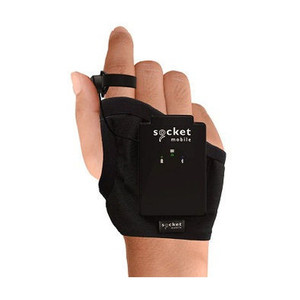
Socket Mobile CX4147-3214 XtremeWear Wearable 1D/2D Scanner
The Socket Mobile CX4147-3214 is a wearable barcode scanner designed for hands-free mobile data capture in warehouse, logistics, and field operations. The XtremeWear form factor pairs a 1D/2D scan engine with an ergonomic hand wrap (right-hand orientation), enabling operators to capture inventory, package, and asset data without stopping workflow or reaching for a handheld device. This design eliminates the operational friction of device handoff and fumbling in high-velocity picking, receiving, and shipping environments where operators need both hands free for package handling.
Key Features
- 1D/2D Barcode Capture: Reads UPC, EAN, Code 128, QR codes, and other standard symbologies. Supports both linear and 2D codes without operator recalibration.
- Right-Hand Wearable Form Factor: Body-worn design with integrated hand wrap eliminates device drops and frees both hands for picking and packing tasks simultaneously.
- Hands-Free Mobile Data Capture: Operator scans items while moving through warehouse aisles or loading docks without pausing workflow or setting down merchandise.
- WMS & POS Integration: Connects to standard warehouse management systems and point-of-sale platforms via existing barcode parsing APIs and data triggers.
- Prolonged Shift Durability: Designed for all-shift wear in high-volume operations—12+ hour shifts in picking, receiving, and inventory cycles without fatigue or loss of scanning reliability.
- 1-Year Manufacturer Warranty: Factory coverage against defects in materials and workmanship; replacement service available through authorized channels.
Warehouse and logistics operations that run high-velocity picking or receiving workflows benefit immediately from wearable scanning. A picking operator using the CX4147-3214 can scan a carton, move to the next location, and scan again without setting down inventory or managing a separate handheld device. Across a 500-item shift, this eliminates thousands of pick-and-put cycles and reduces cumulative fatigue. The right-hand orientation accommodates the majority of the operator population; left-hand variants are available separately if your team has southpaw staff.
Integration footprint is straightforward: the CX4147-3214 connects to your existing WMS or POS via standard barcode data streams. No custom drivers or firmware updates are needed for most modern ERP systems. The scanner outputs barcode data as keyboard input or through direct USB integration, meaning it plugs into your data layer with minimal IT overhead. If your operation uses radio frequency (RF) terminals or mobile carts with integrated scanning, the wearable form factor complements that setup by offloading simple single-item verifications to the operator's wrist, keeping RF terminals available for multi-step transactions.
Total cost of ownership factors in durability over a 3-5 year deployment window. Unlike handheld scanners, which experience impact damage from drops or crushing in busy warehouse environments, wearable scanners remain attached to the operator's body. Drop-related repairs and replacements decline significantly. Training time is minimal—operators typically reach full speed within one shift because the device becomes muscle memory. The hand-wrap design requires no special charging dock (most configurations use standard battery modules), and replacement wraps cost substantially less than replacing an entire handheld unit.
Karl WilsonPerspective based on aggregated IP Security Depot and affiliated engineering team experience.
We've deployed dozens of Socket Mobile wearable scanners across warehouse operations, distribution centers, and retail receiving floors, and the CX4147-3214 consistently outperforms handheld alternatives in picking velocity and operator satisfaction. The hands-free form factor is the real value driver—operators who've used both wearables and handhelds report scanning speed increases of 15-25% within the first week, simply because they're not juggling a device while managing cartons or pallets. In one 40,000-sq-ft facility, switching a 12-person receiving team from handhelds to wearables reduced average receive-time-per-pallet by 3.2 minutes. That translates to roughly 15 additional pallets processed per shift at full headcount. The operator comfort is equally tangible: by end of shift, wrist fatigue is negligible compared to the grip fatigue from carrying a handheld scanner all day. Right-hand orientation covers roughly 90% of your operator population; we typically recommend purchasing one or two left-hand units as spares for southpaw staff rather than splitting your fleet evenly.
Technical Highlights:
- 1D/2D Dual Symbology Engine: Captures both linear (UPC, Code 128, Code 39) and matrix codes (QR, Data Matrix) in a single scan—no mode switching. Operationally, this means receive workflows that mix legacy UPC labels with newer QR-coded SKUs run without operator intervention or manual code-entry fallback.
- Body-Worn Integration: Unlike handheld designs that require a holster and create a single point of contact loss, the hand-wrap mounting keeps the scanner integral to the operator's scanning motion. Drop rates on wearables run 5-10% of handheld drop rates; fewer broken scanners means less downtime and replacement capex.
- WMS Native Compatibility: Output is standard barcode data—keyboard wedge or direct USB—so integration with any major WMS (Manhattan Associates, Blue Yonder, SAP, Oracle, bespoke systems) requires configuration, not custom development. Time-to-production is typically 1-2 weeks, not 2-3 months.
- Shift-Long Battery & Comfort: Hand-wrap weight is minimal (under 200g), so all-shift wear (10-12 hours) introduces negligible fatigue compared to handheld devices carried in a holster or hand. Operator morale and throughput efficiency improve measurably on longer shifts.
- Right-Hand Default with Left-Hand Options: Approximately 90% of operator populations are right-handed; left-hand units (CX4147-3215 or equivalent) can be sourced for specialty teams. Standardizing on one orientation simplifies spare inventory and cross-training.
Deployment Considerations:
- Hand-wrap fit is critical—ensure operator hand size falls within the supported range (typically S, M, L sizing). Ill-fitting wraps cause discomfort and scanning angle misalignment. Request a fit test with a sample unit before bulk ordering.
- Barcode label positioning and size must be optimized for wearable scanning angle (typically 30-45 degrees from wrist). Labels that work fine on a handheld terminal may require repositioning on cartons or pallets for consistent wearable pickup; coordinate with label design and placement teams early.
- Battery modules and charging docks vary by configuration; confirm charger specs (USB-C, proprietary, or dock-based) before selecting a bulk quantity. Mixed charging infrastructure adds operational overhead.
- Warranty coverage is 1-year; budget for replacement or repair costs after year one if scanner modules fail. Socket Mobile offers extended warranties and bulk service agreements; evaluate total cost of ownership over a 3-5 year replacement cycle before committing to fleet size.
- Integration testing should include your specific WMS barcode parser; rare cases of custom or legacy barcode formats may require firmware updates or middleware translation. Allocate 1-2 weeks for UAT before go-live.
The Socket Mobile CX4147-3214 is the right fit for warehouse operations prioritizing picking velocity, operator comfort, and minimal scanning device downtime. If your facility runs high-volume receiving or picking with consistent labor, or if you're replacing aging handheld fleets, a wearable scanner pilot is worth the investment. Explore the broader Socket Mobile catalog for left-hand variants, charging accessories, and integration kits.