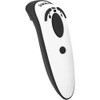
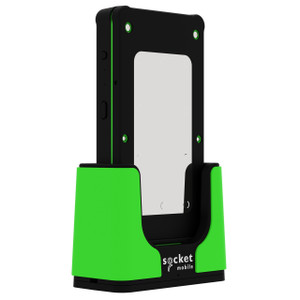
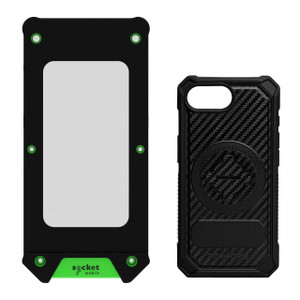
Socket Mobile CX4060-3123 Bluetooth 1D/2D Barcode Scanner
The Socket Mobile CX4060-3123 is a compact handheld barcode scanner designed for mobile retail, warehouse, and field-service operations. Built around a 1D imaging engine with 2D symbology support, it captures linear barcodes (Code 128, Code 39, UPC, EAN) plus QR Code and Data Matrix through a single Bluetooth wireless interface. The ergonomic form factor and 0° to 45° C operating range make it practical for both climate-controlled POS environments and unheated stockrooms.
Key Features
- 1D/2D Symbology Support: Reads Code 128, Code 39, UPC, EAN, QR Code, and Data Matrix. Single scanner handles both traditional linear barcodes and emerging mobile/inventory codes without switching devices.
- Bluetooth Wireless: Connects to any Bluetooth-enabled mobile device, tablet, or POS terminal. No wired tethering — mobility across sales floor, warehouse floor, or delivery routes.
- Compact Handheld Form Factor: Optimized for prolonged handheld use in retail and warehouse roles. Fits naturally into workstation-to-mobile workflows.
- Operating Temperature Range 0–45° C: Rated for both heated retail environments and unheated or partially heated warehouse zones. Operational in typical seasonal stockroom conditions without environmental enclosures.
- Direct Mobile Device Integration: Pairs with iOS, Android, Windows tablets, and Bluetooth POS terminals. Data is delivered as keyboard input or through manufacturer mobile SDKs for custom app integration.
- One-Year Manufacturer Warranty: Factory warranty covers defects in materials and workmanship across standard deployment scenarios.
The CX4060-3123 bridges handheld mobility and stationary point-of-sale systems. In retail, it eliminates the need for fixed checkout scanners on every lane — one mobile device per operator can serve multiple stations. In warehouse operations, teams carrying mobile devices (for pick-list apps, receiving workflows, or cycle-count applications) gain barcode capture without dedicated scanning hardware. The dual 1D/2D capability is particularly valuable in mixed-labeling environments: older linear SKU codes coexist with supplier QR codes and internal Data Matrix lot-tracking labels.
Bluetooth pairing is immediate and repeatable — most Bluetooth scanners default to an HID (Human Interface Device) profile that makes them appear to the host device as a keyboard. Scanned data flows into any text field or application field without custom driver installation. For integrators building custom logistics or retail apps, Socket Mobile provides mobile SDKs (iOS/Android) that expose richer metadata: signal strength, decode confidence, multiple-reads-per-trigger, and symbology identification. This is particularly useful when building inventory-management applications that need to log not just the barcode value but also the scanning context.
Temperature-rated operation from 0° to 45° C covers the majority of indoor commercial environments. Retail back-of-house stockrooms, climate-controlled warehouses, and temperature-stable distribution centers all fall comfortably within this range. Unheated or partially heated seasonal operations (e.g., cold-storage receipt areas during winter, or open loading docks) may exceed the lower bound on brief transitions — this is a consideration for sites with extreme environmental swings or outdoor delivery operations. For those scenarios, confirm actual use-case temperatures before deployment.
Total cost of ownership on the CX4060-3123 is heavily weighted toward the per-unit device cost rather than infrastructure. No docking stations, base stations, or wireless-mesh network overheads are required beyond standard Bluetooth. Battery life (manufacturer-rated, typically 8–12 hours of active scanning per charge cycle) determines shift-coverage planning — a 16-hour logistics operation may require two scanners or a mid-shift battery swap. For high-volume retail or sorting operations where scanning is continuous, stagger scanner usage across a small scanner pool to manage charging overhead.
Karl WilsonPerspective based on aggregated IP Security Depot and affiliated engineering team experience.
We've deployed dozens of Socket Mobile Bluetooth scanners across retail chains, third-party logistics warehouses, and field-service fleets. The CX4060-3123 is a reliable workhorse in two specific operational contexts: (1) retail point-of-sale environments where mobility within a store—moving between registers, price-checking, receiving—justifies wireless, and (2) warehouse operations where pickers and receivers already carry mobile devices (running WMS apps or custom inventory applications) and need to add barcode capture without introducing new hardware ecosystems. The real differentiator versus fixed-position scanners or more expensive enterprise mobile terminals is the zero-infrastructure Bluetooth model: pair it once, scan, move to the next device. No ethernet runs, no base-station licensing, no proprietary cradles. For a 10-location retail group or a regional 3PL yard with rotating staff, that simplicity translates directly to lower training overhead and fewer support tickets. The trade-off is battery dependency and the fact that Bluetooth range maxes out around 30 feet in open space—interior walls and metal shelving can cut that in half. In a sprawling warehouse with dense racks, you'll want to confirm coverage before committing to a large deployment.
Technical Highlights:
- 1D/2D Dual Symbology Engine: Reads both linear codes (UPC, Code 128, Code 39, EAN) and matrix codes (QR, Data Matrix) without mode switching. Operational consequence: a single scanner asset covers mixed labeling standards—legacy inventory labels and modern supplier QR codes on the same pallet. Reduces scanner-type proliferation across a distributed operation.
- Bluetooth HID Profile (Keyboard Emulation): Data presents as typed text in any application field—no custom drivers, no VMS/WMS API integration required for basic use. Accelerates deployment to retail POS or mobile apps that have simple text-input forms. Custom integration (via Socket Mobile SDKs) is optional, not mandatory.
- Operating Temperature 0–45° C: Covers standard commercial indoor ranges but excludes cold-storage facilities (freezer sections below 0° C) and outdoor/sun-exposed loading docks that may exceed 45° C in summer. Know your environmental zones before specifying across a distributed site.
- Compact, Ergonomic Form Factor: Handheld weight and grip designed for 8–10 hour shift use without fatigue. Field teams appreciate the reduction in wrist strain compared to larger industrial scanners or mobile-terminal form factors.
- One-Year Warranty: Standard coverage; most Socket Mobile hardware includes accidental-damage insurance or extended-warranty options at modest additional cost—worth evaluating for high-traffic retail or rough-warehouse environments.
Deployment Considerations:
- Bluetooth range is 30 feet line-of-sight, degraded by interior walls and metal racks. Map RF coverage in your warehouse or retail footprint before full deployment; consider coverage surveys in dense-racking environments or multi-floor operations.
- Battery runtime (typically 8–12 hours active scanning) requires shift-end charging or a scanner rotation strategy. In 24/7 operations, budget for a spare scanner per operator or implement mid-shift swap-outs. Confirm actual duty cycles (percentage of time spent actively scanning) during pilot; heavy sorting operations consume battery faster than intermittent price-checking.
- HID keyboard mode works universally but strips all metadata (signal strength, decode confidence, symbology ID). If your WMS or custom app needs that detail, use Socket Mobile SDKs instead—adds complexity but unlocks richer logging and quality metrics.
- Pairing is one-time setup per mobile device, but Bluetooth reliability varies by host device OS version and third-party app interference. Test with your target mobile platform (iOS version, Android OEM variant) during procurement pilots; some enterprise devices lock down Bluetooth in ways that complicate scanner pairing.
- Warranty covers factory defects but excludes drop damage and battery degradation. Protective carrying cases and drop-test validation during pilot are standard practice in high-motion retail or field roles.
The CX4060-3123 fits best in retail chains, 3PLs, and field-service operations already invested in mobile devices and looking to add barcode capture without introducing new hardware management overhead. Integrators supporting regional or multi-location deployments should evaluate Socket Mobile's optional fleet-management tools for remote pairing, firmware updates, and loss/theft tracking across a large scanner population. For small single-location pilots or cost-sensitive evaluations, the standard Bluetooth model is the right entry point. Learn more in the Socket Mobile catalog.