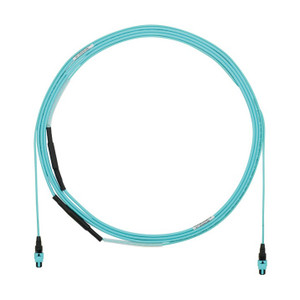
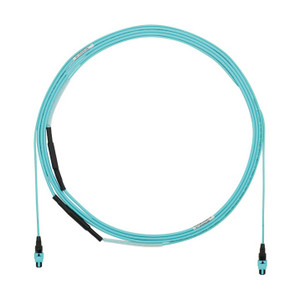
Panduit FY9TP77Y005F050 12-Fiber Singlemode Pre-Terminated Trunk Cable
Overview
The Panduit FY9TP77Y005F050 is a 50-foot (15.2m) pre-terminated singlemode fiber trunk assembly from the Panduit QuickNet HD Flex line — engineered for structured cabling deployments where installation speed, density, and repeatability are non-negotiable. Pre-terminated trunks like this one eliminate on-site termination labor and the associated testing overhead; the assembly arrives factory-tested, ready to plug in, reducing commissioning time in high-bay or raised-floor environments down to minutes rather than hours per run.
This product is aimed squarely at data centers, telecommunications rooms, entrance facilities, and equipment distribution areas where infrastructure needs to go live fast without sacrificing optical performance. The QuickNet HD Flex platform is Panduit's high-density flexible trunk system, designed to integrate cleanly with modular cassette-based patching architectures — reducing per-port footprint while maintaining clean cable management.
Key Features
- 50-foot (15.2m) pre-terminated run: Covers the typical intra-row and inter-row distances inside a data center without splicing or field termination. You get a factory-guaranteed optical assembly on both ends — no polishing, no testing delay, no risk of a technician-introduced insertion loss event under deadline pressure.
- Singlemode fiber (SM12FB): Singlemode supports longer reach and higher bandwidth density than multimode, making it the right choice when your backbone runs span multiple zones, floors, or buildings. If your architecture calls for 10G, 40G, or 100G over distances beyond OM4's limits, singlemode is the tier to be on.
- 12-fiber count: A 12-fiber trunk maps cleanly onto standard MPO-12 cassette systems — one trunk = one cassette port = one managed connection point. That alignment simplifies documentation and makes moves/adds/changes predictable instead of chaotic.
- QuickNet HD Flex sub-brand platform: HD Flex trunks are designed for tight-radius routing and high-density patching bays. The flex jacket construction handles the bending stresses of overhead cable trays and conduit transitions without inducing microbending losses that would degrade link budgets in high-count deployments.
- Rapid deployment design: Factory-terminated assemblies remove the need for splice enclosures, fusion equipment, and per-fiber OTDR verification on-site. In a phased data center build or a time-sensitive migration, that translates directly to faster rack-up and earlier cutover.
- Application-matched for structured cabling environments: Built for data centers, telecom rooms, entrance facilities, and equipment distribution areas — the environments where fiber density is high, change frequency is real, and a termination failure has downstream consequences for live services.
Integration & Compatibility
The FY9TP77Y005F050 is designed to work within Panduit's fiber optic structured cabling ecosystem, specifically pairing with QuickNet HD Flex cassettes and enclosures. The 12-fiber singlemode configuration is compatible with MPO-12 interface cassettes — pair these with the appropriate adapter cassette (OS2 singlemode) to break out to LC or SC duplex ports at the patch panel face. Verify connector type (pull-proof, OPT, ISDT designation) against your enclosure's keying requirements before ordering; the ISDT/OPT designations on this SKU indicate a specific internal push-pull connector style that must match the cassette interface on both ends.
For environments building out patch panel infrastructure, this trunk integrates with standard 1U and 2U enclosures that accept QuickNet cassettes. Plan trunk routing early — 15.2m (50ft) is a fixed length, so confirm your cable tray routing distance between endpoints before specifying; cutting a pre-terminated trunk to length is not an option.
When designing your structured cabling backbone, match the OS2 singlemode fiber type against your transceiver specifications. Most modern 10GBASE-LR, 40GBASE-LR4, and 100GBASE-LR4 transceivers support OS2 singlemode — verify your switch/transceiver vendor spec sheets for wavelength and loss budget before finalizing your fiber tier selection.
Frequently Asked Questions
Q: What is the fiber type and count for the FY9TP77Y005F050?
A: The FY9TP77Y005F050 is a 12-fiber singlemode (OS2) pre-terminated trunk assembly. Singlemode fiber is appropriate for long-reach, high-bandwidth backbone runs in data centers and campus environments.
Q: What is the cable length on this trunk?
A: The overall length is 50 feet (15.2 meters). This is a factory-fixed length — pre-terminated trunks cannot be field-shortened without destroying the factory terminations.
Q: What platform does the FY9TP77Y005F050 belong to, and what cassettes does it pair with?
A: It is part of the Panduit QuickNet HD Flex platform. This trunk is designed to mate with QuickNet HD Flex cassettes and enclosures using compatible ISDT/OPT push-pull connectors. Confirm your cassette interface keying (OS2 singlemode) matches before specifying.
Q: What applications is this trunk assembly designed for?
A: Per Panduit's application data, the FY9TP77Y005F050 is specified for data centers, telecommunications rooms, entrance facilities, and equipment distribution areas requiring pre-terminated fiber infrastructure for rapid deployment.
Q: Can I use this trunk for multimode applications?
A: No. This is a singlemode fiber assembly (SM designation in the part number). Mixing singlemode trunks with multimode transceivers or cassettes will result in significant insertion loss and link failures. Ensure your end-to-end fiber tier — transceiver, cassette, and trunk — is consistent on fiber type.
Q: Does this trunk ship factory-tested?
A: Pre-terminated assemblies in the QuickNet HD Flex line are factory-terminated and tested, which eliminates on-site fusion splicing, polishing, and per-fiber OTDR validation. This is the primary installation-speed advantage of trunk-based architecture versus field-terminated runs.
The FY9TP77Y005F050 is a straightforward specification decision once you know your run length — at 50 feet (15.2m) it lands in the sweet spot for intra-room and short inter-row backbone runs. Where this assembly earns its cost over field termination is in environments with tight commissioning windows: no fusion splicer on-site, no per-fiber OTDR trace, no waiting on a technician to polish connectors. You plug it in, verify link, and move to the next run.
Technical Highlights:
- Singlemode 12-fiber count: Maps directly to MPO-12 cassette architecture — one trunk, one cassette port, clean documentation. No partial-trunk confusion in the patch schedule.
- 50ft (15.2m) fixed length: Right-sized for most raised-floor spine-to-leaf or ToR-to-aggregation runs without excess slack piling up in the cable tray. Over-length slack is a real cable management problem in dense builds.
- QuickNet HD Flex platform: The flex jacket handles tight-radius routing without inducing microbend loss — relevant when you're routing through a crowded overhead tray at a 90-degree bend to a wall-mount enclosure.
Deployment Considerations:
- Confirm ISDT/OPT connector keying against your target cassette before ordering — QuickNet HD Flex uses a push-pull internal connector, and a keying mismatch means the trunk won't seat, not just a bad link budget.
- 50ft is fixed — map your cable tray route carefully before specifying. A common mistake is measuring point-to-point horizontal distance and forgetting to add vertical drops at both ends; that can turn a 40ft straight shot into a 52ft routed run.
This assembly is well-suited for a phased data center build where new rows are added incrementally and the team needs to bring up backbone connectivity fast without staging fusion splicing equipment between phases. The QuickNet HD Flex platform lets you pre-stage cassette enclosures and drop trunks in as rows come online — a practical fit for colocation operators handling tenant onboarding under SLA pressure.