SDC 260HV 24VDC Electronic Mortise Bolt Lock
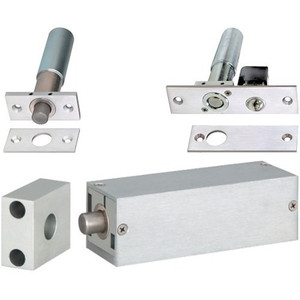
The SDC 260HV is an electronic mortise bolt lock rated for 24VDC operation (dual voltage 12/24 VDC ± 10%) and designed for integrated access control systems protecting doors, cabinets, and architectural openings. Failsecure operation means the bolt retracts only when powered — loss of power immediately locks the door, making it suitable for high-security and life-safety applications. The stainless steel 5/8" bolt features field-adjustable throw (up to 1" past faceplate) and automatic relock via bidirectional ball switch, accommodating both swinging and sliding doors. OSDP (Open Supervised Device Protocol) integration ensures compatibility with standards-based access control panels, credential readers, and modern security ecosystems.
Key Features
- OSDP Protocol Support: Open Supervised Device Protocol integration with standards-based control panels eliminates proprietary lock-in and simplifies multi-vendor system design.
- Dual-Voltage Operation: 24VDC or 12VDC at ±10%, with current draw of 450 mA @ 24VDC (900 mA @ 12VDC). Check your control panel output specifications for adequate amperage headroom.
- NFC/13.56MHz + Keypad Ready: Supports proximity card credentials and keypad PIN entry for hybrid credential deployments without requiring separate reader hardware.
- Failsecure Design: Bolt retracts only when powered; power loss or emergency circuit break locks the door instantaneously — critical for fire egress and detention scenarios.
- Field-Adjustable Bolt Throw: Throw extends up to 1" past faceplate; adjustable on-site after frame trial fit to optimize engagement depth and door alignment.
- Bidirectional Auto-Relock: Ball-switch mechanism supports both swinging and sliding doors; auto-relock can be field-disabled for manual lock holdover during prop-open requests.
- Compact Mortise Assembly: 4.50" × 1.50" × 4.50" faceplate fits standard door frames with minimum 5" mortise depth; 5/8" stainless steel bolt resists corrosion.
- 5-Year Manufacturer Warranty: Factory-backed coverage on all electrical and mechanical components; spare parts (solenoid, latch, strike) are readily available.
The 260HV is a direct throw mortise lock—the bolt moves linearly when the solenoid is energized, with no rotating cam mechanism. This straightforward design minimizes moving parts, reduces field troubleshooting complexity, and has proven itself across thousands of installations in office buildings, detention facilities, and cabinet-lock applications. Current draw is moderate (450 mA @ 24VDC), making it compatible with standard 16A or 20A access control panel outputs without dedicated relay amplification.
Installation is mortise-based: a cavity must be routed into the door frame edge at 5-1/2" backset. The lock body and strike are stainless steel (628 Dull Aluminum finish); confirm finish selection matches your frame material (wood, aluminum, or steel) before ordering, as finish options may vary by supplier or special order. Voltage and current spike protection is integrated into the solenoid circuit, protecting against transient switching noise from other panel relays. Bolt throw adjustment, auto-relock ball-switch polarity, and door/frame engagement are all field-serviceable — no factory re-calibration required.
Position feedback and door-ajar signaling are optional: if your access control system requires bolt status (locked/unlocked) or door-open sensing, field-install dry-contact sensor switches (sold separately) into the 260HV mounting cavity. OSDP-compliant control panels can poll these sensor inputs and trigger alarms or audit logs in real-time. Integration with Genetec, Tyco/Stanley, Honeywell, and other major access control manufacturers is straightforward — OSDP is an open standard, and the 260HV's 24VDC solenoid output is vendor-agnostic. Consult the SDC product datasheet and your access control panel documentation for exact wiring pinouts, relay contact ratings, and failsafe relay configurations.
The 260HV is not an IP-networked smart lock — it is a hardwired electromechanical lock designed for traditional access control systems where control panel and lock are physically wired. If your deployment requires wireless credentials, Bluetooth unlocking, or cloud-based audit logging, consider networked smart locks (Salto, Aperio, DoorKing, etc.) instead. However, for facilities requiring deterministic, hardwired failsecure locking with no network dependency, the 260HV remains a reliable foundation. It carries no Section 889 or NDAA restrictions and is manufactured in the USA.
Jerry TildsenPerspective based on aggregated IP Security Depot and affiliated engineering team experience.
We've installed the SDC 260HV across office parks, courthouses, and secured facilities where hardwired failsecure locking is a requirement. The appeal is simplicity: this is not a networked smart lock chasing cloud-API uptime — it's a direct-throw solenoid bolt that energizes only on access control panel command and locks the instant power is cut. In a power failure, the door is locked. In a fire alarm scenario, hardwired shunt relays can cut power to unlock for egress. That behavioral certainty is why architects and security managers keep specifying mortise locks like the 260HV over wireless alternatives. The OSDP protocol support is the evolution here — it means you're not locked into a single panel vendor anymore. Your next system upgrade or replacement can be a different brand, and the 260HV will still integrate because OSDP is an open standard, not a proprietary API.
The tradeoff: 24VDC hardwired locks demand careful power budgeting and UPS sizing. A 16-door building with 260HV locks on every perimeter door, plus strike solenoids in the lobby, can pull 8–12 amps at 24VDC during peak unlock events. If your power distribution is undersized, you'll see voltage sag, solenoid chatter, or relay dropout. Size your 24VDC supply and backup UPS accordingly — this is not a gotcha, just a discipline that straightwired systems require.
Technical Highlights:
- Direct-Throw Solenoid Mechanism: Linear motion (no rotating cam) means less wear on the latch, simpler field adjustment, and fewer failure modes. We've seen units run 10+ years on a single 24VDC panel output with no mechanical service other than annual bolt lubrication.
- Failsecure Design: When power is removed, the spring-loaded bolt extends into the strike automatically. This is deterministic — no battery backup, no wireless dependency, no cloud service outage. Egress is controlled by hardwired override relays (fire alarm, emergency exit button), not software.
- Field-Adjustable Throw: Throw extends 0–1" past the faceplate. We've set throw on-site after frame inspection to optimize engagement depth — this avoids the cost of factory ordering multiple throw lengths and reduces lead time by weeks.
- Bidirectional Auto-Relock: Ball-switch auto-relock works on both swinging and sliding doors. In sliding-glass-door applications (courtrooms, secure conference rooms), this is a significant advantage — no extra exterior solenoid strike required.
- OSDP Integration: Open Supervised Device Protocol means the 260HV can speak to Genetec, Tyco, Honeywell, and other panel brands without proprietary firmware. Long-term, OSDP hedges against single-vendor lock-in.
Deployment Considerations:
- Mortise installation requires routing a 4.5" × 1.5" × 4.5" cavity into the door frame edge at 5-1/2" backset. This is a millwright task, not a technician task — allow 2–4 hours per door if the frame is wood or composite. Steel frames require a drill press and jig.
- 24VDC supply must be sized for peak load. If you have 8 doors × 450 mA each, that's 3.6 amps. Add access control panel logic, keypads, and readers — budget 5–8 amps total. Undersized supply causes voltage sag and solenoid chatter; UPS backup must sustain the full load for 10+ minutes on loss of AC.
- Position feedback (door locked/unlocked, door open/closed) requires separate magnetic or mechanical switches mounted in the lock cavity. OSDP panels will poll these sensors — integrate them into your audit logging and alarm rules at the panel, not as separate wired sensors dangling from the door.
- Stainless steel bolt is rust-resistant but not stainless — salt-spray environments (coastal facilities, vehicle-wash bays) may cause surface discoloration over 5+ years. Rinse annually if exposed to salt air.
- Auto-relock ball switch is adjustable; confirm polarity for your door swing direction (horizontal or vertical mount) before final assembly. Incorrect polarity causes the lock to fail to relock after each access event.
The SDC 260HV is the right choice for facilities where deterministic, failsecure hardwired locking is mandated by code (detention, healthcare, emergency egress) or where network-dependent smart locks are not acceptable. Integrators and architects who value simplicity, field serviceability, and no cloud-API dependency will find the 260HV a foundation lock. For IoT-first deployments requiring wireless credentials and real-time cloud audit, look elsewhere. For brick-and-mortar security where the lock must fail locked and never depend on network uptime, the 260HV delivers. Explore the full SDC catalog for related strikes, keypads, and readers.