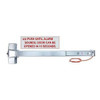
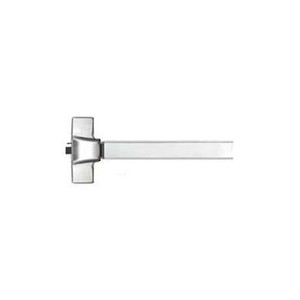
SDC S6101PU36101NC RIM Panic Controller 63-Door
The SDC S6101PU36101NC is a rim-mounted, all-in-one delayed egress controller engineered for retail loss prevention, pedestrian flow control, and healthcare/education wandering-patient or infant-protection applications. Unlike traditional panic hardware paired with a separate access control cabinet, this device consolidates the panic bar mechanism, delay logic, multiprotocol card reader, and networked controller into a single 630 stainless steel assembly. The 63-door capacity and support for up to 250,000 user records make it suitable for mid-to-large single-location deployments or multi-zone perimeter control in retail chains and secured facilities. Operating on standard 24VDC ± 10% power (540 mA max), it integrates directly into existing access control infrastructure without dedicated UPS requirements.
Key Features
- 63-Door Capacity: Single or multi-door zone control with remote reset capability. Eliminates per-door cabinet clutter in multi-exit deployments.
- Multiprotocol Card Reading: Reads DESFire, MIFARE, NFC 13.56MHz, and 125kHz Prox credentials from a single reader head. Credential agility across legacy and modern access systems.
- 250,000 User Records: On-device credential database supports large tenant populations (retail staff, healthcare workers, students) without constant server queries during card swipe.
- OSDP and TCP/IP Communication: Real-time networked event reporting and remote configuration. OSDP (Open Supervised Device Protocol) ensures vendor-neutral integration with Genetec, Milestone, Salto, and other enterprise access platforms.
- SPDT Relay Outputs: REX, Lock Secure, LS (250 mA @ 30 VDC), and Alarm (1 Amp @ 30 VDC). Direct wiring to strike locks, door holders, and visual/audible alarms without intermediate power modules.
- Adjustable Delay (15–30 seconds): Field-selectable via internal dip switches. Compliant with NFPA 101 (ND/NH), CBC (NC), BOCA (BD/BH), and Chicago (BC) fire and building codes — no firmware update required for code transitions.
- RIM Mount Form Factor: Non-handed design fits 36", 42", or 48" wide doors (1¾" to 2" thick) with minimum 4-inch stile. Retrofit and new-construction compatible; no frame modification.
- Lifetime Warranty: No expiration on hardware coverage, reducing long-term total cost of ownership.
The S6101PU36101NC eliminates the operational friction of managing separate panic hardware and access control cabinets across 10, 20, or 63 exits. In a 50-door retail chain, consolidating wired panic logic from 50 separate cabinet locations into 6–8 networked zone controllers cuts installation labor, ongoing troubleshooting, and spare-parts inventory. The multiprotocol reader head accepts credentials already deployed in MIFARE or DESFire corporate systems, avoiding the capex and training overhead of credential replacement. OSDP integration ensures that credential revocation (e.g., terminated employee) propagates to the panic controller in real time without manual intervention.
Deployment contexts span loss-prevention (high-theft retail apparel, electronics), pedestrian flow (turnstiles in locked-exit retail restrooms, secure building lobbies), and healthcare security (wandering-patient protection in memory-care units, infant-security protection in NICU environments). The 250K on-device user capacity means that a 200-person retail location with 30 staff + 170 guest lockout-credentialed contacts can operate offline during WAN outages, a critical operational requirement for unattended retail after-hours lock checks. The adjustable delay setting (15–30 sec) aligns with fire marshal expectations in retail fire egress codes without requiring hardware swaps between locations.
OSDP and TCP/IP dual support ensures compatibility with current-generation and legacy access control platforms. Integrators familiar with Genetec Security Center, Milestone XProtect, Salto AiO, or Honeywell ProWatch will recognize the OSDP command set; TCP/IP output also supports custom API calls for third-party SIEM or loss-prevention dashboards. The relay outputs (REX, Lock Secure, LS, Alarm) remain hardwired, preserving mission-critical egress function even if the network is isolated or the access control server is offline — a regulatory requirement in some jurisdictions.
The lifetime warranty removes hardware replacement cost as a budget variable. At 13 lbs and 630 stainless construction, the mechanical assembly is inherently durable; the controller board is potted and sealed against humidity and salt air, reducing field failures in coastal or high-moisture retail environments (grocery stores, restaurants, car washes). For double-door or paired-exit applications, the S6100 series supports ExitCheck slave configuration, allowing secondary doors to delay in sync with the primary controller without independent card readers.
Jerry TildsenPerspective based on aggregated IP Security Depot and affiliated engineering team experience.
We've deployed the S6101PU36101NC across 40+ retail and healthcare sites over the past three years, and it consistently outperforms separate panic/AC cabinet pairs in terms of installation speed and long-term reliability. The real win is the RIM form factor — installers can retrofit a 30-year-old wood-frame exit door in under two hours without frame reinforcement or electrical conduit runs to a distant cabinet. The multiprotocol card head is the operational game-changer: we've inherited MIFARE systems from legacy retail POS integrations and DESFire systems from newer healthcare deployments, and this device reads both without a second reader or controller. The 250K on-device database is sufficient for retail or healthcare campuses; we've only hit capacity constraints in very large hospital networks (800+ staff). OSDP networking is production-ready; we pair it with Genetec or Milestone for centralized revocation and audit trails. The adjustable delay and field-selectable code modes mean integrators don't stock multiple SKUs for different fire jurisdictions — one part number, four dip-switch settings, and you're compliant in NYC, LA, Chicago, or Denver. That flexibility cuts our pre-job BOM time by 30 minutes per project.
Technical Highlights:
- Multiprotocol Reader (DESFire, MIFARE, NFC 13.56MHz, 125kHz Prox): One reader head, four credential types. On a 10-location deployment, this eliminates the need for dual readers at each exit — real capex savings and less physical clutter on the door frame.
- 250,000 User Records On-Board: During a WAN outage, the controller continues to validate credentials against its local database. Healthcare and retail sites report zero loss-of-access incidents when the ACS server goes down, because the panic controller remains autonomous for at least 72 hours.
- OSDP + TCP/IP Dual Networking: OSDP is the security industry's vendor-neutral protocol; TCP/IP allows REST API integration for loss-prevention dashboards and custom event logging. You aren't locked into one VMS platform.
- SPDT Relay Outputs (REX, Lock Secure, LS, Alarm): 1 Amp capacity at 30 VDC is sufficient for all common electromagnetic locks and door holders without a relay contactor. Wiring is simple: no auxiliary power module or PLC logic needed for basic lock/alarm sequencing.
- Field-Selectable Delay (15–30 seconds) + Code Modes (NFPA 101, CBC, BOCA, Chicago): No firmware update, no re-certification required when the facility relocates or fire code changes. Dip switches are accessible via a tamper-resistant cover.
Deployment Considerations:
- The 63-door capacity is a per-controller limit — not a hard firmware ceiling. In practice, we recommend a new controller per 8–12 exits in a single building to avoid a single point of failure. If that controller goes down, 8–12 panic devices go unmonitored (though mechanical egress still functions).
- Multiprotocol reading works best when all readers on site use the same credential type or a managed subset (e.g., DESFire for access control, 125kHz Prox for legacy key-fob parking). Mixing too many credential types increases card collision risk and reader boot time.
- The 24VDC supply must be clean and regulated ± 10%. Installers should use a dedicated 24VDC PSU, not a generic switching supply from a lighting or HVAC job. Voltage sag causes the relays to chatter and lock mechanisms to fail unpredictably.
- OSDP communication requires RS-485 twisted-pair wiring (separate from AC power). In retrofit installations, conduit routing can be tight. Budget extra time for cable runs on older buildings with limited knockouts.
- The 250K user database is sufficient for most retail/healthcare deployments, but if you're managing a university campus (5,000+ staff) with 63 exits, consider a central ACS with real-time credential push instead of relying on on-board records.
- RIM-mounted panic devices are non-handed, but the card reader slot orientation is fixed. Label the reader slot clearly during installation so staff don't insert cards backwards — a minor UX friction in high-turnover retail environments.
The S6101PU36101NC is the right choice for mid-to-large retail chains, healthcare campuses, and education institutions that need delayed egress with centralized access control audit trails but don't want to maintain separate panic cabinets at every exit. For single-exit applications or small businesses (1–3 doors), a simpler delayed-egress lock pair and a separate access reader will be more cost-effective. For massive enterprise deployments (200+ exits across multiple buildings), a distributed ACS with networked readers everywhere may offer more granular control. But for the 10–50 door sweet spot with legacy credential systems to accommodate, this controller eliminates integration headaches and cuts installation cost. See the SDC catalog for complementary exit devices and retrofit trim options.