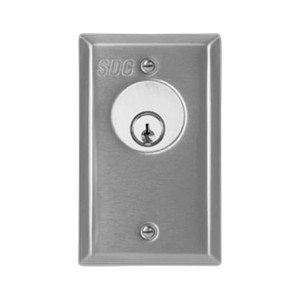
SDC DTMA-2 Two Maintained Switches Door Control Module
Overview
The SDC DTMA-2 is a two maintained switch door control module engineered for integration with credential-based access systems. Operating at 30VDC, this switch assembly provides reliable control of electronic locks and strike hardware in security door installations. The DTMA-2 is built for professional security integrators and access control system installers who need to control dual lock points or activate redundant strike mechanisms from a single control signal — common in high-traffic entry points, secure server rooms, or multi-door access control deployments where maintained switch output is required.
Key Features
- Two Maintained Switches: Independent switch outputs allow control of two separate electromechanical locks or strikes. This redundancy means if one lock fails, the second can still secure the door — or you can control two separate access points (e.g., main strike and deadbolt) from a single reader.
- 30VDC Operating Voltage: Runs on 30 volts DC, a standard low-voltage supply in access control cabinets. Check your existing power rail capacity before installation; a 30VDC supply feeding multiple door control modules must be sized accordingly.
- Maintained Switch Output: Energized when a valid credential is presented, the switches remain activated for the duration of the unlock command. This contrasts with momentary switches, which pulse briefly — maintained output is essential for electric strike hardware that must remain de-energized for the full unlock cycle.
- HID Credential System Compatibility: Designed to integrate directly with HID reader and credential platforms. Before ordering, confirm your HID reader outputs match the DTMA-2's input voltage and control signal type (typically 12V or 24V logic signal from the reader).
- Standard Door Frame Integration: Mounts into standard door frame and frame reinforcement applications without custom fabrication. Verify your strike hardware is mechanically compatible with your selected lock type (electric strike, electromagnetic lock, or solenoid-controlled deadbolt).
- Professional Installer Focus: No end-user configuration required — this is a hardwired control device, not a networked appliance. Plan wiring runs from your access control panel to the DTMA-2 and from the DTMA-2 to your lock hardware during design phase.
Integration & Compatibility
The DTMA-2 integrates with HID reader and credential systems. The two maintained switches enable control of dual lock points or redundant strike activation. Because this is a low-voltage control device, integration requires direct wiring from your access control panel's output terminals to the DTMA-2's inputs, and from the DTMA-2's relay outputs to your strike or lock hardware. If your access control system is networked (IP-based), ensure your system architecture includes a conventional wired door control subsystem — the DTMA-2 does not bridge networked credentials to physical locks on its own. Work with your integrator to confirm signal voltage levels, relay rating (amperage and voltage tolerances), and wiring termination standards before commissioning.
When to Choose a Different Model
If you need networked door control with IP-addressable lock status feedback, or if your deployment uses a non-HID credential system, evaluate whether a networked access control module or a different SDC product family would be more appropriate. Consult the SDC catalog or your integrator to compare options.
Frequently Asked Questions
Q: Is the DTMA-2 suitable for outdoor door hardware?
A: The DTMA-2 itself is a low-voltage control module typically installed inside a cabinet or behind a door frame. Your electric strike or lock hardware must be rated for outdoor exposure (weatherproof solenoid, outdoor-rated strike, etc.). Check your lock manufacturer's IP rating and operating temperature range.
Q: Can the DTMA-2 control a magnetic lock (mag lock) and an electric strike at the same time?
A: Yes. Each of the two maintained switches can control a separate load — one switch for a mag lock, one for an electric strike, provided each load's power draw and voltage match the relay specifications. Confirm relay amperage rating with the datasheet before wiring high-current loads.
Q: What's the minimum hold time for the maintained switch output?
A: The DTMA-2 energizes the switches for as long as the unlock command signal is present. The specific hold duration is determined by your access control panel's output timing. Check your reader or panel documentation for minimum unlock dwell time.
Q: Does the DTMA-2 provide door position feedback or tamper detection?
A: The DTMA-2 is a control switch module without built-in sensors. If you need door-open or tamper feedback, integrate a separate magnetic switch or contact sensor in your system design and wire it back to your access control panel's input terminals.
Q: Is the DTMA-2 compatible with cloud-based or mobile credential systems?
A: The DTMA-2 is a wired control device and does not communicate over IP or mobile networks directly. Your mobile credential system must integrate with your HID reader (which may support HID Mobile Access or similar). The reader outputs a control signal to the DTMA-2, which then activates the switches. Ensure your chosen HID reader supports mobile credentials if that's a requirement.
Ted PerryPerspective based on aggregated IP Security Depot and affiliated engineering team experience.
The SDC DTMA-2 is a straightforward, field-proven door control module — no surprises, no networked complexity. If your access control system is built on HID credentials and you're wiring lock hardware the traditional way (low-voltage relay outputs to strike or mag lock solenoids), the DTMA-2 does exactly what it promises: two independent maintained switch outputs at 30VDC.
Technical Highlights:
- Two Independent Relay Outputs: Allows control of dual lock points without stacking additional control modules. This reduces wiring complexity when you need to unlock both a main strike and a deadbolt, or when redundancy is required.
- 30VDC Standard Voltage: Aligns with most access control cabinet power supplies; verify your cabinet's 30VDC capacity can support all downstream control modules before commissioning.
- Maintained Switch Logic: Switch remains energized for the entire unlock dwell period — essential for electric strike hardware that cannot tolerate momentary pulses.
Deployment Considerations:
- Confirm relay amperage rating matches your lock hardware's peak inrush current. Solenoid locks can draw high current at activation; undersizing the relay leads to nuisance failures.
- Plan your wiring termination and labeling early. The DTMA-2 is a dumb control module — all logic (dwell time, credential validation, audit logging) lives in your access control panel or reader. If your panel doesn't output a proper unlock signal, the DTMA-2 won't unlock the door.
- If you need real-time door status (open/closed, forced-open tamper) back to your access control system, add a separate magnetic door sensor; the DTMA-2 provides no feedback.
The DTMA-2 is the right choice for traditional hard-wired HID deployments where you need dual-output control and don't require IP-based feedback or remote monitoring. Install it, wire it once, and expect years of silent operation. Not glamorous, but that's the point — control modules should disappear once commissioned.