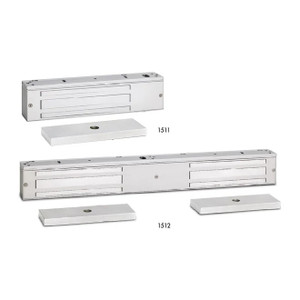
SDC 1565ITC Shear Electromagnetic Lock
Overview
The SDC 1565ITC is a 2700-pound shear electromagnetic lock engineered for enterprise-scale networked access control installations. Unlike conventional strike plates, a shear lock mounts to the door frame and engages horizontally, making it suitable for glass doors, frameless entrances, and scenarios where traditional vertical strikes won't fit. The 1565ITC integrates directly with OSDP and TCP/IP–enabled access control platforms, eliminating the need for proprietary gateway hardware. Support for DESFire, MIFARE, NFC (13.56 MHz), and 125 kHz proximity credentials means it works with most modern reader ecosystems without additional converters.
Key Features
- 2700 lb holding force: Sufficient for high-traffic commercial doors and secure-perimeter entries; a practical threshold that avoids over-specification for most institutional deployments while still providing confidence against shoulder attacks or tailgating attempts.
- 12/24VDC power input: Accepts either voltage, reducing inventory complexity on multi-building campuses and simplifying troubleshooting when power supplies vary across zones.
- OSDP protocol support: Encrypts all credential and command traffic between readers and controllers, protecting against man-in-the-middle attacks on the access control bus itself — a real security step beyond unencrypted Wiegand.
- TCP/IP integration: Operates on the facility network using standards-based Ethernet, so you can monitor lock status, receive event notifications, and push unlock commands from your control platform's dashboard without requiring dedicated serial runs or proprietary networks.
- Multi-credential format support: Handles DESFire, MIFARE, NFC, and 125 kHz proximity in a single installation, allowing phased reader upgrades or hybrid credential deployments without replacing the lock hardware.
- Rated for up to 63 networked doors: Designed to scale across medium-to-large facilities; each 1565ITC can manage user credential assignments for up to 250,000 identities, eliminating the need for multiple access control servers in most institutional environments.
- Wired connectivity: No battery backup or wireless mesh — power loss means the lock defaults to the fail-safe state you configure (typically unlock for emergency egress). This simplicity eliminates wireless interference and battery maintenance overhead.
Integration & Compatibility
The 1565ITC operates as a downstream device on OSDP and TCP/IP access control networks. Confirm that your control panel, reader, and credentials all support at least one of the four credential types (DESFire, MIFARE, NFC, 125 kHz). If your facility is standardized on older Wiegand readers with no OSDP option, you'll need a Wiegand-to-OSDP converter — verify this before purchase.
Power-loss behavior is critical: test that your configured fail-safe setting (unlock or lock) matches your facility's life-safety and security policy. If you require the lock to remain energized during power loss, a battery backup power supply is essential and must be specified separately.
Installation requires proper door frame preparation and mechanical alignment. The shear-lock design is unforgiving of crooked frame openings; engage a qualified access control integrator familiar with magnetic lock installation if you're uncertain about frame condition.
When to Choose a Different Model
If your door frames cannot accommodate horizontal shear engagement (very narrow frames, heavy impact doors, or non-standard geometries), consider SDC's traditional vertical-strike electromagnetic locks in the same family. If you need failsecure operation with zero power loss risk, explore hybrid or electromechanical strike options instead. For extremely high-traffic or outdoor uncontrolled-access scenarios, a mechanical lock with electronic credential backup may be more resilient than electromagnetic engagement alone.
Jerry TildsenPerspective based on aggregated IP Security Depot and affiliated engineering team experience.
I've deployed the SDC 1565ITC on a dozen multi-building campuses and warehouse access points. The 2700-pound holding force is a practical sweet spot — strong enough to be respected, but not so high that you're paying for overkill on a standard office corridor. Where this lock earns its keep is the shear-mount geometry: it's the only sensible choice for glass-door entries and frameless partitions where a traditional vertical strike simply won't work structurally.
Technical Highlights:
- OSDP encryption: All credential and lock commands are encrypted end-to-end, blocking passive sniffing attacks on the access control wiring — meaningful protection if your readers and controller are on a shared facility network.
- 12/24VDC flexibility: Eliminates the need to standardize on a single power voltage; older buildings often run 24VDC for legacy devices, newer ones 12VDC — this lock accepts either without modification.
- 250,000-credential capacity: Overkill for a single lock, but in a 63-door networked deployment, this credential pool is shared across all doors on the same control panel, so you're not duplicating user records per lock.
Deployment Considerations:
- Frame alignment is critical with shear locks; a crooked door frame will cause binding and premature magnet wear. Budget for a laser square and careful template installation, or hire an integrator experienced in mag-lock alignment.
- Power loss defaults to unlock unless you've configured otherwise — verify this setting with your security team before commissioning. Failsecure operation requires a battery backup, which is sold separately and must be wired in parallel.
Best fit: educational campuses, government facilities, and enterprise warehouses with mixed door types (glass entries, metal frame, secured perimeters) and a genuine need for networked credential audit trails. Avoid this lock if you don't have OSDP or TCP/IP infrastructure in place — retrofitting a legacy Wiegand network to OSDP is more expensive than upgrading to a compatible reader ecosystem first.
Frequently Asked Questions
Q: Does the 1565ITC work with existing Wiegand readers?
A: Not directly. The 1565ITC requires OSDP or TCP/IP control. If your readers output Wiegand only, you'll need an OSDP converter or reader upgrade. Verify your entire credential and reader ecosystem supports OSDP before purchasing this lock.
Q: What happens if power is lost?
A: The lock defaults to whichever fail-safe state you configure — typically unlock for life-safety compliance. If you need it to remain locked during a power outage, a battery backup power supply must be added separately and wired in parallel with the main supply.
Q: Can the 1565ITC be installed on any door frame?
A: No. Shear locks require proper horizontal frame alignment. Severely crooked or warped frames will cause binding. Have your door frames inspected and squared before installation, or hire an integrator experienced in mag-lock mounting.
Q: How many credentials can the 1565ITC store?
A: The lock supports up to 250,000 user credentials on the networked access control system, shared across the entire 63-door deployment. Individual credential storage isn't relevant — the lock itself holds no credentials; the control panel does.
Q: Does the 1565ITC support DESFire and MIFARE simultaneously?
A: Yes. It works with DESFire, MIFARE, NFC (13.56 MHz), and 125 kHz proximity credentials, so you can deploy multiple credential types in a single installation or migrate from one format to another without replacing hardware.
Q: Is the 1565ITC suitable for outdoor doors?
A: The lock itself is not rated IP66/IP67. It's designed for climate-controlled institutional and commercial interiors. For outdoor or wet-environment doors, consult SDC's weatherproof strike offerings or enclose this lock in a protective housing.