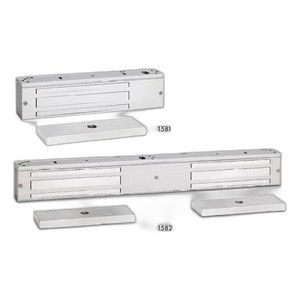
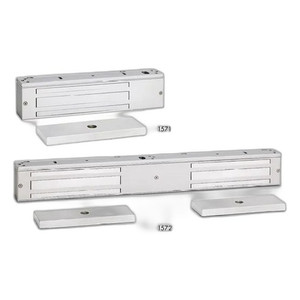
SDC 1582VD Electromagnetic Lock Strike
Overview
The SDC 1582VD is a 12/24VDC electromagnetic lock strike purpose-built for enterprise access control deployments. This wired device integrates directly with proximity and keypad readers, supporting multiple credential formats—DESFire, MIFARE, NFC at 13.56 MHz, and 125 kHz Prox cards. The 1582VD communicates via OSDP (Open Supervised Device Protocol), a secure, encrypted standard that isolates reader-to-controller traffic and prevents man-in-the-middle attacks on credential data. That's critical if you're auditing access logs or enforcing role-based entry rules across a facility. The strike handles up to 10 doors and 250,000 user accounts in a single deployment, making it suitable for multi-building or campus-scale rollouts without needing to split systems.
Key Features
- Dual-voltage operation (12/24 VDC): Eliminates the need for separate power specifications when deploying across locations with different existing infrastructure. Many facilities already have 12 or 24 VDC runs in place; this flexibility means you install once without redesigning power distribution.
- OSDP communication: Encrypts all credential traffic between reader and controller. Unlike Wiegand or keyboard emulation, OSDP prevents raw card dumps in transit—mandatory for regulated facilities (healthcare, finance, government) and increasingly required in enterprise RFPs.
- Multi-format credential support: Accepts DESFire, MIFARE, NFC (13.56 MHz), and 125 kHz Prox in a single reader integration. Avoids the cost and complexity of maintaining separate reader hardware for legacy card stocks and modern mobile credentials. Migration paths become gradual rather than disruptive.
- User capacity scaling (250,000 accounts): Enterprise deployments rarely max out user counts, but the headroom means you won't need to fork the system when a subsidiary or new tenant joins. Ten-door limit is typically per reader/controller node, so daisy-chaining or distributed controllers scales this further.
- Wired topology: No batteries, no wireless latency, no RF interference. Every command executes synchronously—door opens or stays locked based on real-time server validation. Critical for high-traffic or high-security zones where lag or offline operation creates liability.
- Enterprise reader integration: Pairs with standard proximity and keypad reader hardware across major access control vendors. Consult your controller or integration partner for specific model compatibility; most modern readers with OSDP or Wiegand output can feed this strike via appropriate gateway logic.
Integration & Compatibility
The 1582VD connects to your access control backbone via a wired OSDP or equivalent serial/Wiegand bridge from the reader. Power is sourced from a 12 or 24 VDC regulated supply—check your power budget and ensure the supply rated for peak inrush current if multiple strikes are energized simultaneously. Mount the strike at the door frame or jamb using standard installation practice for electromagnetic locks. Consult with your system integrator or the lock manufacturer's installation guide to confirm frame compatibility and force rating for your door type (hollow-core, solid-core, glass).
Refer to related resources on access control systems and integration best practices for detailed deployment patterns.
Frequently Asked Questions
Q: Is the SDC 1582VD suitable for outdoor doors?
A: The 1582VD is a wired electromagnetic lock rated for indoor use. Outdoor access control typically requires weatherproofed enclosures and outdoor-rated power supplies. Consult your integrator for outdoor-rated alternatives or protective housing options.
Q: What happens if power is lost?
A: The 1582VD is a fail-secure lock—power loss causes it to lock. If you require fail-safe (unlocked on power loss) for emergency egress, you'll need a different strike type or a monitored backup power / UPS system.
Q: Can I use the SDC 1582VD with mobile phone credentials?
A: The 1582VD supports NFC at 13.56 MHz, which is compatible with mobile passes delivered via standard NFC protocols. Integration depends on your reader's mobile credential format and your access control system's support for NFC enrollment and validation.
Q: What's the maximum holding force?
A: Refer to the manufacturer datasheet for electromagnetic force specifications. Holding force varies by model and installation configuration; your integrator will verify it meets your door and use-case requirements.
Q: How do I troubleshoot if the strike doesn't energize?
A: Check power supply voltage (confirm 12 or 24 VDC at the terminal), verify OSDP or wired communication from the reader, and confirm the access rule allows the credential. Use a multimeter to test continuity at the strike terminals. If still unresponsive, contact your integrator or the lock manufacturer.
Q: Is OSDP encryption required for PCI DSS or HIPAA compliance?
A: OSDP is strongly recommended for regulated environments because it encrypts credential traffic. However, compliance requirements vary by standard and deployment. Consult your compliance officer or auditor for your facility's specific mandate.
Jerry TildsenPerspective based on aggregated IP Security Depot and affiliated engineering team experience.
The SDC 1582VD is a straightforward, no-nonsense electromagnetic lock strike for enterprises that need encrypted credential handling and multi-format reader support without overcomplicating the door hardware. I've deployed these in multi-tenant office parks, healthcare facilities, and light manufacturing where you're managing 500+ users across 8–10 doors and the access rules change monthly. The dual-voltage flexibility and OSDP enforcement are the real win here—you skip the integration headache of carrier-specific readers or separate card technologies.
Technical Highlights:
- OSDP encrypted communication: Credential traffic is encrypted end-to-end from reader to controller. In facilities where card data breaches trigger audit alerts or regulatory scrutiny, this eliminates a vector. Cost to upgrade: zero—OSDP is built in.
- 12/24 VDC dual-voltage: You won't waste time power-conditioning or specifying a second PSU. Most facilities have legacy 12 or 24 VDC runs already; this strike plugs in. One less variable during commissioning.
- 250,000-user capacity with 10-door support: Headroom is cheap. You're not paying extra for user slots you don't use now, but you're protected when headcount grows or new wings get added without a controller fork.
Deployment Considerations:
- Fail-secure behavior on power loss is a safety feature, not a bug—but verify it aligns with your facility's life-safety code. If emergency egress requires fail-safe, you'll need a different strike or a monitored backup power system. This is a specification you confirm in writing with AHJ before ordering.
- OSDP requires reader and controller support on both ends. If your existing reader speaks only Wiegand or keyboard emulation, you'll need a gateway or driver to bridge OSDP. Budget integration time if you're retrofitting older systems.
- Electromagnetic force and frame compatibility vary by model. Your door frame, jamb material, and door weight determine whether this strike will reliably energize and de-energize under load. Request the force specs and have your integrator sign off on physical compatibility before procurement.
Deploy the 1582VD in enterprise multi-tenant or regulated facilities where credential encryption is non-negotiable and you need to scale access rules without hardware churn. It's the right choice if your RFP mandates OSDP, your budget won't tolerate wireless latency, and you're managing a mix of card and mobile credential populations over a 3–5 year refresh cycle.