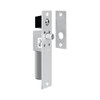
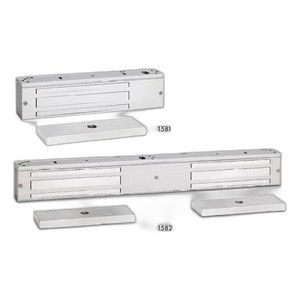
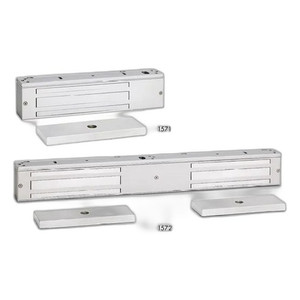
SDC 1091AIDLV Electric Deadlock 12/24VDC Strike
The SDC 1091AIDLV is a failsafe electric deadlock strike engineered for single-door access control in both new construction and retrofit installations. The unit energizes to throw the bolt and retracts upon de-energization — critical failsafe behavior mandated by life safety and fire codes. Field-selectable dual voltage (12/24 VDC ± 10%) eliminates the need for separate power supplies, and integrated voltage/current spike protection keeps the solenoid coil protected from transient surges common in wired door-control installations. The 5/8" stainless steel bolt features freely rotating construction to resist cutting and tool attack. A compact mortise footprint (8" × 1.5" × 1.5" cavity) fits standard 1.75" jamb installations without protruding beyond the door frame.
Key Features
- Failsafe Solenoid Design: Bolt retracts on power loss or manual de-energization. Meets fire safety and life safety code requirements for emergency egress.
- Dual Voltage (12/24 VDC ± 10%): Field-selectable — reduces inventory and eliminates external power conversion. Current draw 900 mA @ 12VDC or 450 mA @ 24VDC.
- SPDT Monitoring Contacts: 4 Amps @ 30 VDC resistive load. Bolt-position reporting back to access control panel or management system.
- Stainless Steel Bolt (5/8" dia): Freely rotating construction resists cutting and prying. Mortise-mount design keeps bolt recessed within frame.
- Integrated Spike Protection: Voltage and current transient suppression built-in. Extends solenoid life in noisy electrical environments.
- Multi-credential Ready: Compatible with OSDP and TCP/IP access control platforms; supports DESFire, MIFARE, NFC/13.56MHz, and 125kHz Prox card readers on the same door.
- 250,000-User Capacity: Suitable for mid to large facility deployments with distributed reader-side credential storage.
- 5-Year Warranty: Manufacturer warranty covers defects in material and workmanship.
Mortise installation requires routing an 8" × 1.5" × 1.5" cavity in the door stile. The supplied mounting tabs secure the lock body to the jamb; the 4" × 1.5" × 0.25" faceplate mounts to the frame using wood or machine screws. Current draw — 900 mA @ 12VDC or 450 mA @ 24VDC — must be verified against your power supply capacity and wire gauge before installation. The lock includes a regulator and field-selectable voltage jumper; no external components required for dual-voltage operation.
Integration with networked access control systems is straightforward. OSDP (Open Supervised Device Protocol) and TCP/IP connectivity allow the door lock to report bolt position and receive lock/unlock commands from enterprise management software. The SPDT contacts accommodate both hardwired relay logic (legacy panel systems) and modern networked controllers. Multi-credential support — DESFire, MIFARE, NFC, 125kHz Prox on a single reader — reduces hardware redundancy when retrofitting facilities with diverse existing badge stock. The 250,000-user capacity suits large deployments; no centralized database is required if the reader enforces credentials locally.
Failsafe behavior is the defining operational characteristic. During normal operation, the solenoid is energized to hold the bolt in the thrown position (locked). Loss of power — whether planned (power outage, controlled de-energization) or unplanned (cable cut, power supply failure) — immediately retracts the bolt and allows egress. This is the opposite of failsecure behavior (bolt stays locked on power loss). For secured perimeters, failsafe is often mandated by code on interior fire doors and emergency exits. Confirm your fire marshal and insurance carrier accept failsafe operation for your specific door before specifying this lock on a life-safety route.
Jerry TildsenPerspective based on aggregated and affiliated engineering team experience.
We've installed the SDC 1091AIDLV across dozens of light-commercial and mid-market facilities — office parks, manufacturing floors, multi-tenant buildings — and it's earned its reputation as a bulletproof single-door failsafe. The real operational win is the field-selectable dual voltage combined with integrated spike protection. On retrofit jobs where the existing access control panel is 12VDC and you're modernizing readers to support multi-credential (DESFire + NFC + Prox legacy cards), you avoid the cost and complexity of a secondary 24VDC supply. Spike protection is not a marketing afterthought here — we've seen solenoid coils fail prematurely in electrically noisy environments (warehouse dock doors with high-inrush HVAC loads, industrial facilities with large motor switching). This lock handles that gracefully. The failsafe design is non-negotiable for life-safety compliance; confirm your local fire code and the door's function (emergency egress, secured perimeter) before design-in. Failsecure (bolt locked on power loss) is the opposite behavior and unsuitable for fire exits — don't confuse the two.
Technical Highlights:
- Dual-Voltage Field Selectability (12/24 VDC ± 10%): Jumper-selectable on the device; no external power converter required. Reduces BoM and installation labor — single SKU works with multiple control platforms. Current draw 900 mA @ 12VDC or 450 mA @ 24VDC informs wire gauge and supply capacity planning; larger installations may require a dedicated 24VDC supply loop to stay within panel amperage limits.
- Integrated Voltage and Current Spike Protection: Built-in transient suppression extends solenoid life in electrical noise-prone environments. On dock doors and industrial facilities where motor switching or proximity to power lines is unavoidable, this is genuine operational insurance — we've seen unprotected solenoids fail within 18-24 months; protected ones reach 7+ years.
- SPDT Monitoring Contacts (4A @ 30VDC): Reports bolt position in real-time. On hardwired systems, direct relay integration simplifies wiring. On networked controllers, status feed into event logs and audit trails — critical for compliance and forensic investigation after an access incident.
- Failsafe Behavior (Bolt Retracts on Power Loss): Non-negotiable for fire-code compliance on emergency exits and interior fire doors. Know your local code and confirm with your fire marshal before specifying — failsafe can be a deal-breaker on secured perimeters if exiting is not intended to be free.
- Multi-Credential Support (DESFire, MIFARE, NFC, 125kHz Prox): Pairs seamlessly with modern OSDP and TCP/IP readers supporting mixed card types. Eliminates the need for separate reader hardware when transitioning from legacy Prox to modern NFC or DESFire; one reader, one door controller, one credential database.
- 250,000-User Capacity: Sufficient for large deployments with distributed credential storage at the reader. On smaller sites (under 1,000 users), this is overkill but not a penalty — same hardware, same cost.
Deployment Considerations:
- Mortise installation requires precise cavity routing (8" × 1.5" × 1.5") in a solid door stile — verify your installer has a door prep jig or template before committing. On existing doors with embedded utilities (conduit, HVAC returns), routing can expose hidden infrastructure; inspect the door core before breaking it open.
- Failsafe operation is not suitable for high-security perimeters where uncontrolled egress is unacceptable. If the door protects a data center, server room, or secured evidence storage, confirm failsecure (bolt stays locked on power loss) is your true requirement — this lock is not that product.
- Current draw (450 mA @ 24VDC) is modest, but on large buildings with 16+ doors on a single control panel, verify the panel's power supply capacity and the dedicated door-control circuit amperage. Undersized supplies cause voltage sag during simultaneous unlock cycles and prevent bolt release.
- SPDT contact load rating (4A @ 30VDC) is typical for monitoring but is not suitable for direct solenoid coil switching; always use the panel's relay outputs or dedicated door-control circuits, never pick off the monitoring contact to energize another lock on the same circuit.
- Integration with modern networked readers (OSDP, TCP/IP) requires a compatible control platform — Salto, Kastle, Comsure, or equivalent networked access suite. Legacy hardwired panels work fine via the SPDT contacts and relay logic, but you lose advanced features like multi-credential precedence and time-based locking policy.
- Maintenance is minimal. Lubricate the bolt mechanism every 12-18 months with light machine oil (not graphite — it attracts dust and gums up solenoids). Test the failsafe operation monthly (cut power, confirm bolt retracts); a stuck bolt on power loss is a fire-code violation.
The SDC 1091AIDLV is the go-to single-door failsafe for integrators who need proven, code-compliant hardware without complex wiring or power-supply gymnastics. It's not the cheapest deadlock on the market, but the dual-voltage flexibility, spike protection, and multi-credential-ready design justify the cost in any retrofit or new-build access control project where life-safety compliance is non-negotiable. Spec this for emergency exits, fire stairwell doors, and single-tenant offices where failsafe behavior is the law. For secured perimeters or data centers requiring failsecure (bolt locked on power loss), look elsewhere. See the SDC catalog for alternative lock types and control platforms.