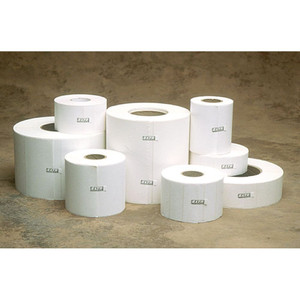
Sato SR30KT-10431 RFID 4x6 Thermal Transfer Label Stock
The Sato SR30KT-10431 is a 4" × 6" RFID-enabled label stock engineered for hybrid barcode and RFID identification in warehouse automation, asset tracking, and supply chain operations. This thermal transfer label combines an integrated RFID chip capability with standard barcode printing on a single label, allowing simultaneous optical and radio-frequency data capture without requiring separate label runs or manual encoding steps. Each case ships with 4,000 labels (4 rolls of 1,000 labels each) wound on 3" core spools with 8" outer diameter—a standard configuration that drops directly into Sato industrial thermal transfer printers without custom adapters.
Key Features
- RFID-integrated facestock: Chipset pre-installed in the label substrate eliminates post-print encoding labor. Printers with Sato RF Analyze auto-optimization dynamically tune ribbon and heat parameters per label batch, reducing encoding failures and minimizing rework across large production runs—critical when printing thousands of labels daily and encoding errors translate to downstream putaway or audit delays.
- Dual-mode identification on one label: Simultaneous barcode and RFID encoding means point-of-sale systems, hand scanners, and automated gate readers all work from the same physical label. No secondary encoding step, no label redundancy, no inventory complexity managing two separate SKUs for the same asset.
- Permanent acrylic adhesive: Formulated to bond reliably to cardboard, plastic, metal, and composite surfaces under temperature swings, moisture exposure, and mechanical handling stress typical of warehouse and outdoor logistics environments. Labels will not lift or degrade under the thermal and friction stress of high-speed conveyor systems or extended outdoor storage.
- 4,000 labels per case (4 rolls × 1,000): Reduces changeover frequency for high-volume operations. In multi-shift fulfillment centers, a single case supplies roughly one shift of continuous printing on a moderately loaded printer, simplifying inventory rotation and reducing partial-roll waste.
- Perforated between labels: Manual tear-off dispensing without label cutter equipment. Practical for integration points where semi-automatic labeling isn't economical or where operator speed and dexterity are preferred over additional machinery complexity.
- Wide ribbon compatibility: Supports Sato wax, wax-resin, and resin thermal transfer ribbons. Wax is lowest-cost for indoor or moderate-temperature environments; wax-resin balances durability and cost for general warehouse use; resin is required for extreme temperature, high-humidity, or chemical exposure scenarios.
Printer Integration & Compatibility
The SR30KT-10431 is qualified for Sato industrial thermal transfer printers, specifically the CL4NX Plus and CL6NX Plus series. These units include RF Analyze functionality, which automatically adjusts print head temperature and ribbon speed when detecting label resistance variation—a critical feature for RFID encoding consistency across long production batches. Inconsistent encoding is a common pain point in high-volume RFID deployments; RF Analyze eliminates the trial-and-error tuning that slows first-run changeovers. The 3" inner core and 8" outer diameter fit standard spindles on all Sato industrial printers, meaning no custom mounting or firmware adjustments are required for immediate deployment.
Deployment Considerations
The 4" × 6" footprint is the industry standard for pallet, carton, and asset identification in North American logistics. It provides adequate space for a Code 128 or QR barcode, RFID header information, human-readable text, and supplementary metadata (lot number, expiration, destination) without crowding or print quality loss. Organizations rolling out hybrid identification systems—where both barcode and RFID readers operate in the same workflow—benefit from single-label simplicity and reduced label inventory complexity.
Acrylic adhesive is permanent and intended for semi-permanent or permanent label application; labels should not be expected to cleanly remove from most surfaces without residue. If temporary or removable labels are required, consult the Sato label catalog for alternative adhesive formulations.
Typical Applications
Warehouse receiving and putaway (barcode scan at inbound dock, RFID gate confirmation on rack placement); asset tracking across multi-facility networks (forklift, pallet, container identification); reverse logistics and returns processing (dual-mode scan confirms both item and RFID history); cross-dock and transshipment operations where barcode speed and RFID accuracy both reduce handling error. Any operation already standardized on Sato CL-series printers and seeking to add RFID capability without equipment replacement or label redesign.
Frequently Asked Questions
Q: Does the SR30KT-10431 require special printer firmware or configuration to encode RFID?
A: No. Printers with RF Analyze (CL4NX Plus, CL6NX Plus) handle RFID encoding automatically. You configure the label data in your printer driver or label design software the same way you would for a standard barcode label; RF Analyze optimizes the encoding parameters in real time.
Q: Can these labels be used on metal surfaces without RFID read failures?
A: Metal proximity affects RFID antenna performance. The SR30KT-10431 is designed for standard warehouse environments (cardboard, plastic, wood). If the label will be mounted directly on metal (e.g., steel racks, metal bins), test encoding and read range in your specific environment before large-scale deployment.
Q: What happens if the adhesive bond fails during handling or conveyor transport?
A: Permanent acrylic adhesive is formulated for reliability under normal warehouse stress, but extreme temperature cycling, chemical exposure, or mechanical abrasion can degrade adhesion over weeks or months. If labels must survive harsh outdoor or chemical environments for extended periods, confirm the label is suitable for your specific conditions before committing to large orders.
Q: Are the 4 rolls individually wrapped or packaged in bulk?
A: The case contains 4 rolls of 1,000 labels each. Specific packaging detail (individual roll wrapping, bulk carton) is not specified in the available documentation. Contact the supplier for packaging configuration if this affects your storage or handling logistics.
Q: Can I mix ribbon types (wax, wax-resin, resin) on the same printer without recalibration?
A: RF Analyze detects ribbon resistance variation and adjusts automatically, so ribbon changes are supported. However, switching between ribbon types with significantly different thermal properties may require manual heat/speed adjustment on your first print run with the new ribbon. Test before production.
Q: What is the shelf life of the SR30KT-10431 labels, and are there storage conditions I need to follow?
A: Shelf life and storage requirements are not specified in the available evidence. Consult the product datasheet or contact Sato technical support for temperature, humidity, and storage duration guidance to avoid adhesive degradation or chipset issues.
Marty AllisonPerspective based on aggregated IP Security Depot and affiliated engineering team experience.
The Sato SR30KT-10431 is a straightforward engineering choice for operations that have already standardized on Sato CL-series thermal printers and are now adding RFID to their warehouse workflow. The pre-integrated chipset and RF Analyze auto-tuning eliminate the usual pain points of early RFID label deployments: encoding inconsistency, firmware compatibility headaches, and the need to maintain separate barcode and RFID label inventory. For high-volume operations, this matters.
Technical Highlights:
- 4,000 labels per case (4 rolls × 1,000): One case provides roughly 8–10 hours of continuous printing on a moderately loaded printer, keeping changeover frequency low and simplifying inventory rotation across multi-shift operations.
- RF Analyze auto-optimization: Dynamically adjusts print head temperature and ribbon speed per batch to maintain encoding consistency—directly reduces rework and downstream scan failures that force manual exception handling at gates or inbound docks.
- Permanent acrylic adhesive bonds to cardboard, plastic, metal, and composite: One label design works across mixed-material shipping containers, pallets, and asset tags without requiring different adhesive formulations for different surface types.
- Wax, wax-resin, and resin ribbon support: Flexibility to match ribbon cost to environment; wax for indoor/controlled temperature reduces material cost, while resin handles outdoor or chemical exposure without reprinting labels.
Deployment Considerations:
- Permanent adhesive means permanent removal difficulty: Once applied, these labels are not intended for clean removal. If you have scenarios requiring temporary or removable identification, you'll need a separate label SKU.
- Metal proximity degrades RFID read range: The SR30KT-10431 is optimized for standard warehouse surfaces (cardboard, wood, plastic). If your application includes direct labeling of steel racks or metal bins, pilot-test encoding and read distance before full deployment—metal can cut effective read range significantly.
- CL4NX Plus and CL6NX Plus only: Older Sato printer models without RF Analyze won't auto-tune RFID parameters. If you're running older hardware, manual tuning for each ribbon/label combination adds operational friction.
This label is a strong fit for hybrid barcode-plus-RFID deployments in warehouse receiving, putaway, and gate confirmation workflows—especially where you're already running Sato print infrastructure and want to avoid a forklift or redesign. Not the choice if your environment is primarily outdoor/metal asset tagging or if you need removable labeling.