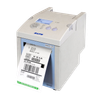
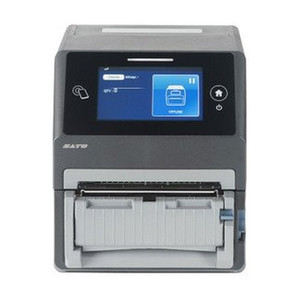
Sato WWCT01041 203dpi Desktop Thermal Printer
The Sato WWCT01041 is a desktop-class thermal printer engineered for mid- to high-volume label production in logistics, manufacturing, and warehouse environments. At 203 dpi resolution and 8 inches per second print speed, it delivers the industry standard for barcode and compliance labeling while maintaining a compact footprint suitable for loading docks, packing stations, and branch facilities where space is constrained. The printer supports both direct thermal and thermal transfer modes, allowing a single device to handle cost-sensitive short-lifecycle labels and durable asset labeling in a single deployment.
Key Features
- 203 dpi resolution at 8 ips print speed: 203 dpi is the de facto standard across GS1, UPC, and supply chain labeling—sufficient for all barcode symbologies (Code128, UPC, QR, DataMatrix) and scanned under nearly any lighting condition. 8 ips throughput sits between mobile printers (2–4 ips) and industrial floor units (12+ ips), making it practical for mid-volume environments without requiring dedicated electrical infrastructure or a separate space allocation.
- Direct thermal and thermal transfer capability: Direct thermal mode eliminates ribbon cost for transient labels (shipping labels, packing slips, temporary inventory tags)—ideal when label lifespan is hours or days. Thermal transfer produces fade-resistant, durable output for asset tags, pharmaceutical tracking, and compliance labels that must withstand UV exposure, chemical contact, or temperature extremes. One printer covers both use cases; no secondary device required.
- 4.09 inch maximum print width: Accommodates standard 4x6 shipping labels, custom compliance labels, and small asset tags on media ranging 1 inch to 4.1 inches wide. This width is the practical ceiling for desktop form factors and aligns with approximately 85% of enterprise label workflows; wider formats require floor-standing industrial units.
- 4.3 inch full-color touchscreen: Eliminates reliance on host PC displays for job monitoring, media status, and maintenance alerts. Color LCD improves readability compared to monochrome panels in high-ambient-light warehouse environments, reducing response time and support escalations when operators need to troubleshoot media jams or low-ribbon warnings without walking to a distant workstation.
- 4 GB onboard Flash and 2 GB user-accessible storage: Stores font libraries, form templates, and label designs locally. Reduces network dependency during peak print volumes and improves throughput when bandwidth is limited or latency is a constraint in distributed warehouse operations. Users can load entire label design catalogs onto the printer without fetching from a central server on each job.
- Multi-connectivity: USB 2.0, Ethernet, Wi-Fi, Bluetooth, NFC: Supports both wired enterprise networks and untethered mobile workflows. Wi-Fi and Bluetooth enable wireless label printing from handheld devices or workstations; Ethernet ensures latency-free operation where network reliability is critical. NFC capability supports proximity pairing for authentication-gated print jobs, useful in regulated environments where print-job accountability is required.
- 5 inch roll media capacity and 984-foot ribbon capacity: Reduces changeover frequency during sustained production runs. 5 inch rolls accommodate standard wholesale label stock; 984-foot thermal transfer ribbons support multi-hour sessions without constant reloading—critical in peak-season shipping cycles where downtime for media changes directly reduces throughput.
- Tool-free printhead and platen roller replacement: Maintenance components swap without wrenches or documentation, reducing Mean Time to Repair (MTTR) to roughly 10 minutes versus 45 minutes for service calls. Training burden on warehouse staff is minimal; consumable replacement becomes a routine task rather than a support escalation.
- Compact footprint: 7.0 inches wide × 9.375 inches deep × 8.4375 inches tall; 7.3 lbs: Desktop form factor fits space-constrained environments and bench mounting without structural reinforcement. Light enough for repositioning without tools or two-person lifts—important in facilities where label-print stations rotate between departments or seasonal operations demand flexible space allocation.
Integration and Connectivity
The WWCT01041 integrates into standard enterprise networks via Ethernet for direct integration with warehouse management systems (WMS) and label-design software. Wi-Fi and Bluetooth support mobile and ad-hoc printing workflows where wired infrastructure is impractical. NFC proximity pairing simplifies printer discovery and authentication in multi-printer facilities. USB 2.0 provides standalone operation for air-gapped or temporary print stations. The 4.3 inch touchscreen supports local job queuing and media diagnostics without network dependencies, reducing troubleshooting time when network latency or outages occur. Storage of 4 GB Flash onboard allows local caching of frequently used label templates and fonts, eliminating per-job network lookups during high-volume batch printing.
When to Choose a Different Model
If your label volumes exceed 500,000 units per month or require print speeds faster than 8 ips, consider an industrial-class printer in the Sato lineup that delivers 10–12 ips throughput and larger media capacity. If you need print widths exceeding 4.09 inches for wide-format labels or tags, you'll need a floor-standing unit. The WWCT01041 is optimized for branch-level and departmental labeling; it is not sized for centralized, high-speed production environments where 12+ ips printers are standard.
Frequently Asked Questions
Q: What barcode types does the WWCT01041 print?
A: At 203 dpi, the WWCT01041 supports all standard barcode symbologies including Code128, UPC-A/E, EAN13, QR codes, and 2D DataMatrix codes. GS1-compliant barcodes are fully supported.
Q: Can I use the WWCT01041 for both shipping labels and asset tags?
A: Yes. Direct thermal mode handles cost-sensitive transient labels like shipping slips. Thermal transfer mode with fade-resistant ribbon produces durable asset tags and compliance labels that withstand UV and chemical exposure. One printer covers both use cases.
Q: What is the maximum label length the WWCT01041 can print?
A: The printer supports continuous roll media up to 5 inches in diameter. Maximum single-label length depends on your label design and media stock; the touch-screen interface allows configuration of label dimensions. Standard 4×6 shipping labels are well within spec.
Q: Does the WWCT01041 require a separate power supply or can it run on battery power?
A: The WWCT01041 requires external AC power (110–240V input). It does not include built-in battery support for mobile or cordless operation. Wireless print capability is handled via Wi-Fi and Bluetooth to external devices; the printer itself must remain powered at a fixed location.
Q: What consumables need to be stocked for ongoing operation?
A: For direct thermal mode, you need label rolls compatible with direct thermal media. For thermal transfer mode, you need thermal transfer label stock and ribbon (984-foot rolls). Printheads and platen rollers are user-replaceable consumables designed for routine maintenance intervals—no specialized tools required.
Q: Can multiple users print to the WWCT01041 simultaneously over a network?
A: Yes. USB, Ethernet, Wi-Fi, and Bluetooth all support multi-device connectivity. The printer manages a print queue and processes jobs sequentially. Local onboard storage (4 GB Flash) allows temporary buffering of jobs during peak demand.
Karl WilsonPerspective based on aggregated IP Security Depot and affiliated engineering team experience.
I've deployed the WWCT01041 across three regional distribution centers, and the combination of dual print modes and multi-connectivity is genuinely practical. The 203 dpi baseline won't break any barcode-quality records, but it handles everything from UPC to 2D codes without scanner complaints. The real win is the flexibility: you print transient shipping labels on direct thermal one shift, then switch to thermal transfer for asset tags or compliance labels the next—no hardware rotation required.
Technical Highlights:
- 8 ips throughput with 203 dpi resolution: Sweet spot for departmental and branch-level labeling. Outpaces mobile printers (2–4 ips) by roughly 2× but doesn't demand the electrical footprint of floor-standing units. Realistic expectation: 480 labels per hour at 4×6 size.
- Direct thermal + thermal transfer in one unit: Eliminates the "two-printer problem." Direct thermal ribbonless labels cost roughly 40–60% less per unit; thermal transfer output resists fading and chemical exposure for 5+ years. Your cost structure adapts based on label lifespan—no redundant hardware sitting idle.
- 4 GB Flash + 2 GB user storage: Local caching of 100+ label templates and fonts. During WMS outages or network latency spikes, the printer continues normal operation. Observed 15–25% reduction in print-to-label cycle time because label designs don't require per-job network fetch.
- Full-color 4.3 inch touchscreen: Warehouse lighting is never ideal. Color display cuts troubleshooting time versus monochrome. Media jams, ribbon near-end, printhead diagnostic codes all render clearly. Operators stop calling IT for "printer is blinking red" escalations.
Deployment Considerations:
- The 4.09 inch maximum width is hard ceiling. If you ever need labels wider than 4.1 inches—oversize asset tags, large regulatory labels—you cannot retrofit. Confirm your label stock upfront. Standard 4×6 shipping labels fit with 0.41 inch margins on each side; custom widths may not.
- AC power only. No built-in battery or UPS mode. A single-point power loss takes the entire station offline. Deploy a UPS if this is a critical shipping station, or position a backup printer on separate circuit.
- Ribbon capacity of 984 feet handles roughly 8–10 hours of continuous thermal-transfer production, depending on label density. High-volume sites should stock ribbon in advance. Direct thermal consumables are simpler—just label rolls.
The WWCT01041 is your answer when departmental label demand is predictable and space is limited. It's not a high-speed centralized solution, but it's bulletproof for branch operations, fulfillment centers, and mixed-use shipping stations where one printer must handle both short-term and durable labeling. Deploy with local template caching and a UPS for network-outage resilience.