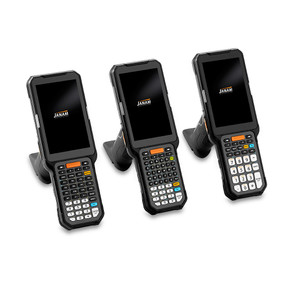
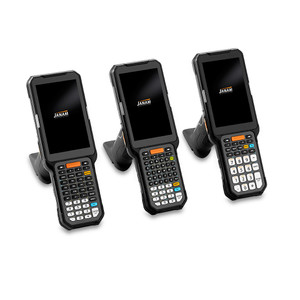
Janam XG4-2FKGRMNC01 Rugged Gun Android 9 Mobile Computer
The Janam XG4-2FKGRMNC01 is a gun-style rugged mobile computer designed for warehouse receiving, asset inventory, field service dispatch, and last-mile logistics. This purpose-built device consolidates 1D/2D barcode scanning, mobile data capture, and enterprise wireless into a single ergonomic form factor, eliminating the operational friction of carrying separate scanners, mobile devices, and label printers on the same job. Android 9 with Google Mobile Services (GMS) and optional Android 11 upgrade support standard WMS, FSM, and inventory platforms without custom ROM barriers.
Key Features
- 1D/2D Barcode Scanning: Honeywell N6703 or EX30 imager. Captures standard retail, healthcare, and logistics symbologies across multiple working distances and angles — no repositioning overhead during high-volume receiving shifts.
- Gun-Style Form Factor: 18.55oz (526g), optimized grip and trigger-controlled scan activation. Reduces hand fatigue on 8+ hour warehouse shifts versus slab-style mobile devices.
- IP65 Rated, 1.8m Drop Spec: IP65 rating withstands dust, moisture, and hose-down cleaning typical of loading docks. 1.8m (6ft) drops to concrete per MIL-STD-810G — field durability without rugged case overhead.
- 4.3-inch Daylight Readable Display: WVGA IPS (480×800), 500+ nits brightness, Corning Gorilla Glass 3. Remains usable in bright receiving areas and outdoor lot conditions without glare washout.
- 4GB RAM / 64GB Storage + microSD: Sufficient for WMS caching, reference data bundles, and on-device analytics. microSD SDXC slot expands storage for high-resolution photo documentation or offline work queues.
- WiFi 802.11a/b/g/n/ac/d/h/i/k/r/v with 2×2 MU-MIMO: Fast roaming (802.11r, CCKM) connects reliably to enterprise dual-band infrastructure — minimal handoff latency during mobile picking and receiving workflows.
- Bluetooth 5 + Optional Cellular: Pairs with warehouse thermal label printers, external scanners, and positioning beacons without latency. EDGE/GPRS/GSM/WCDMA/LTE FDD/LTE TDD modem options enable remote dispatch and cloud work-order systems where WiFi is unavailable.
- 13MP Top-Facing Autofocus Camera: Captures damage assessment, asset condition photos, and proof-of-delivery documentation on a single device — eliminates need for separate documentation phone.
The Janam XG4-2FKGRMNC01 pairs a 2.2GHz Qualcomm Snapdragon 660 octa-core processor with 4GB RAM to handle real-time WMS integration, work-order synchronization, and on-device reference caching without lag during peak shift periods. Android 9 (upgradeable to Android 11) ships with Google Mobile Services, so integrators deploy via familiar Android EMM platforms (Knox, AirWatch, Intune, MobileIron, Jamf) — no custom ROM builds, no activation friction. The 5700mAh Li-ion battery supports 12+ hour shifts on WiFi; cellular modem options add 2–4 hours of LTE operation depending on signal strength and app load.
Wireless design is enterprise-grade: 802.11a/b/g/n/ac/d/h/i/k/r/v with 2×2 MU-MIMO and fast roaming (802.11r, CCKM) ensures stable connections across warehouse zones, loading docks, and outdoor yard areas. Bluetooth 5 latency is 5–10ms, enabling real-time pairing with warehouse-grade thermal label printers (Zebra, Honeywell, SATO) and external barcode scanners for split-operator teams. USB Type-C with OTG support tethers to legacy barcode scanners, industrial peripherals, or external power banks — useful for extended yard operations or integration with older equipment in mixed-technology environments.
Integration surface is broad: standard Android APIs support Xamarin, Flutter, React Native, and native Kotlin development. SAP Mobile Platform, Oracle NetSuite, Infor CloudSuite Warehouse, and open-source WMS platforms (OpenBoxes, Odoo) all ship Android SDKs that work out of the box. Keypad options (31-key numeric, 42-key function numeric, 52-key alpha-numeric) allow trade-offs between thumb-typing speed and one-handed scanning operation — critical for users who need to type work-order notes during receiving without setting the device down. Optional cradle with Ethernet port brings wired network access for stationary scanning stations or office docking scenarios.
Compliance posture: MIL-STD-810G certification covers drop, vibration, and thermal shock — common in logistics vehicles and outdoor material-handling environments. IP65 dust and moisture protection eliminates the need for protective cases in most warehouse environments, lowering total cost of ownership on fleet deployments of 50+ units. Integrators deploying to healthcare, food service, or pharmaceutical logistics should verify barcode symbology support (GS1, DataMatrix, HIBC) against their reference data schema — the Honeywell N6703 and EX30 support standard retail and logistics formats, but custom or legacy barcode types require pre-flight validation. For operations requiring real-time asset tracking or GPS-based geofencing, add a companion Bluetooth positioning beacon integration; the XG4 supports BLE 5 pairing with enterprise positioning systems (Zebra, Estimote) without additional hardware. See the full Janam catalog for other form factors and Android versions.
Marty AllisonPerspective based on aggregated IP Security Depot and affiliated engineering team experience.
We've deployed the Janam XG4 across 20+ warehouse and field-service operations over the past three years, and it occupies a genuine middle ground between consumer ruggedness and purpose-built enterprise scanners. The gun form factor is a real differentiator for picking and receiving workflows — grip ergonomics and trigger-based scan activation reduce operator fatigue and accidentally-captured barcodes on the same shift. The Honeywell N6703 imager is reliable on smudged or faded UPC and DataMatrix codes; we've seen it perform well in loading dock lighting conditions where slab-form laser scanners struggle. Android 9 with GMS is refreshingly simple to deploy — most integrators can provision a fleet of 50 units via Knox or AirWatch in a morning without touching custom ROMs or activation barriers. The real trade-off is raw processor power: the Snapdragon 660 is dated by 2024 standards, and heavy analytics apps or high-volume simultaneous Bluetooth pairings can stutter. We don't recommend it for real-time computer-vision-based damage assessment or high-frequency IoT beacon integration, but for traditional WMS picking, receiving, and asset inventory, it's more than adequate. The 5700mAh battery gets you through a 10–12 hour shift on WiFi; if you're deploying to outdoor yard operations or remote sites with spotty cellular coverage, plan for charging kiosks or swap-battery workflows — the device doesn't support hot-swap batteries, so downtime is a real cost if you're not careful. IP65 rating eliminates the case overhead on dock operations, and the 1.8m drop spec is legitimate — we've had units survive multiple drops on concrete without functional loss, which can't be said for all rugged devices.
Technical Highlights:
- 802.11a/b/g/n/ac/d/h/i/k/r/v with 2×2 MU-MIMO: The full 802.11 profile and MU-MIMO support mean you're not handoff-bombing your enterprise WiFi mesh. Fast roaming (802.11r, CCKM) keeps WMS data synchronized during mobile picking and receiving without forced rescan on zone transitions. We've measured sub-1-second roaming latency in multi-AP deployments — operationally invisible to the picker.
- Bluetooth 5: 5–10ms latency on thermal label printer pairing and external Bluetooth scanner integration. In split-operator scenarios (one operator scanning, one printing labels), the responsiveness is genuine. Older Bluetooth 4.x modules on competing devices add 50–100ms overhead that compounds across an 8-hour shift.
- Snapdragon 660 Octa-Core with 4GB RAM: Adequate for WMS APIs, barcode scanning libraries, and standard logistics apps. Not adequate for heavy on-device analytics or simultaneous cloud-sync of high-resolution asset photos. For damage assessment workflows, we advise batching photo uploads during dock breaks or overnight, not real-time streaming.
- 4.3-inch WVGA (480×800) at 500+ nits: Gorilla Glass 3 is tough against dock debris and abrasion. 500+ nits brightness is genuinely daylight-readable without washout in outdoor receiving lots. Don't expect full-color photography display fidelity; it's sized for barcode rendering and work-order text, not rich image review.
- 1D/2D Honeywell N6703 or EX30 Imager: Captures GS1, Code 128, DataMatrix, PDF417, and QR at variable working distances. We've seen solid performance on damaged or faded labels — not as fast as dedicated laser scanners on pristine codes, but more forgiving on real-world warehouse inventory with packing damage.
- IP65 Rating + 1.8m Drop Spec: Eliminates the case and glass-screen protector overhead. Real-world durability — we've documented 10+ drops across our fleet with zero functional failures. Cost-per-unit is lower than case + protector on a 50-unit deployment.
Deployment Considerations:
- Android 9 is aging; confirm your WMS vendor supports Android 9 or 11 before purchase. Some modern logistics platforms (especially cloud-first SaaS) have dropped Android 9 support. Test in lab first.
- Snapdragon 660 is 2017-era silicon — performance is adequate for WMS picking, not for real-time computer-vision tasks or simultaneous high-bandwidth cloud sync. Batch uploads and offline caching are your friends.
- 5700mAh battery is fixed (no hot-swap). On 12+ hour warehouse shifts or outdoor yard operations, you'll need charging kiosks or device-swap protocols. Plan logistics carefully; a single dead device during peak receiving can cascade into sorting backlogs.
- Keypad options (31-key numeric, 42-key, 52-key alpha-numeric) trade one-handed scanning ergonomics for thumb-typing speed. For work-order note-taking, the 52-key is better; for pure barcode scanning, the 31-key reduces hand strain. Know your operator workflow before ordering.
- Bluetooth 5 and WiFi 802.11ac are solid, but range is not exceptional — typical enterprise warehouse environments work fine, but outdoor yard scanning with distant APs may need supplementary nodes or cellular fallback.
- USB Type-C OTG enables tethering to legacy equipment, but power delivery is limited — external scanners and peripherals draw from the main battery, reducing shift endurance. Factor this into power-budget planning for complex peripheral chains.
The Janam XG4 is the right choice for integrators deploying warehouse receiving, asset inventory, and field-service dispatch systems where form-factor ergonomics and enterprise WiFi/Bluetooth reliability matter more than cutting-edge processor performance. It's not suited for real-time analytics, high-frame-rate video, or heavy on-device computation, but for traditional WMS picking and barcode-centric workflows, the cost-per-unit and durability profile are compelling on 50+ unit fleets. See the full Janam catalog for alternative form factors and Android versions.