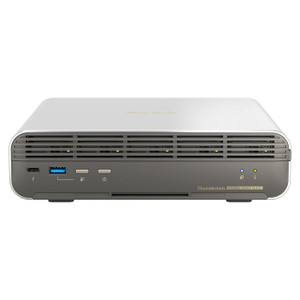
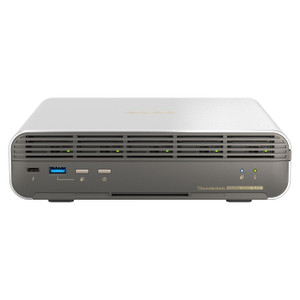
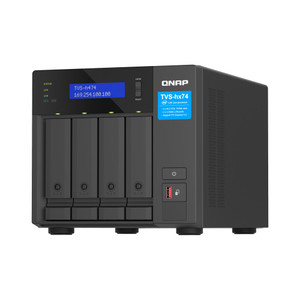
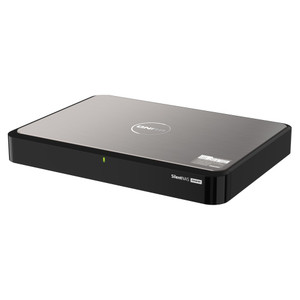
QNAP TBS-464-8G-US All-Flash 4-Bay NASbook
Overview
The QNAP TBS-464-8G-US is a compact, all-flash NASbook built around four M.2 2280 NVMe slots — no spinning drives, no vibration, no bulk. Powered by an Intel Celeron N5105 quad-core processor with 8 GB DDR4 and dual 2.5GbE ports, it fits in a briefcase and delivers the network throughput and storage performance of a rack appliance. If you need a portable or desktop-footprint NAS that handles NVMe-class IOPS without occupying a rack unit, this is the form factor to evaluate.
Key Features
- 4x M.2 2280 NVMe Gen3 x2 Slots: All four bays accept PCIe Gen3 x2 M.2 SSDs — no SATA bottleneck. Sequential throughput scales well beyond what 2.5GbE can saturate, so the network becomes the ceiling, not the storage. Ideal for high-frequency read workloads like surveillance clip retrieval or VM storage.
- Intel Celeron N5105 Quad-Core, Burst to 2.9 GHz: A 10nm processor with four cores and four threads handles simultaneous NAS services, transcoding, and container workloads without the idle power draw of a server-class chip. AES-NI hardware encryption is integrated, meaning volume encryption adds negligible CPU overhead.
- 8 GB DDR4 (Fixed, Non-Expandable): 8 GB covers QTS OS overhead plus moderate container and virtualization workloads. Note that memory is not expandable — if your workload roadmap includes memory-intensive VMs or heavy containerized services, factor this ceiling into the decision now rather than later.
- Dual 2.5GbE Ports: Two 2.5GbE interfaces let you bond both links for up to 5 Gbps aggregate throughput to a compatible switch, or use them as separate network segments (storage vs. management). Either way, you get 2.5x the bandwidth of standard gigabit without needing a 10GbE infrastructure upgrade.
- Dual HDMI Outputs: Two HDMI ports support direct display connection — useful for digital signage, local kiosk, or edge media deployments where you want the NAS to drive a screen without a separate media player.
- 2x USB 3.2 Gen 1 (5 Gbps): USB 3.2 Gen 1 ports handle direct-attach backup drives or USB UPS interfaces. At 5 Gbps, bulk backup transfers to an external SSD complete in a fraction of the time USB 2.0 would require.
- 4 GB Flash with Dual-Boot OS Protection: The 4 GB onboard flash runs QTS with dual-boot protection — if a firmware update goes wrong, the system falls back to the prior OS image automatically, reducing recovery time in remote or unmanned deployments.
Integration and Compatibility
The TBS-464-8G-US runs QNAP QTS, giving it access to the full QNAP NAS catalog of applications including surveillance station, container station, and virtualization station. It fits naturally into network-attached storage architectures alongside IP camera systems and serves as a capable edge recording node. For infrastructure planning, review our storage and retention planning guide to size NVMe capacity against retention windows. Pair with a PoE network switch to keep cabling consolidated on the same infrastructure. The dual 2.5GbE ports are compatible with any 802.3bz-capable switch for full link-aggregation benefit.
Frequently Asked Questions
Q: How many drives does the TBS-464-8G-US support, and what type?
A: It supports four M.2 2280 NVMe SSDs in PCIe Gen3 x2 slots. It does not accept 2.5-inch SATA or 3.5-inch hard drives — this is a purely all-flash platform.
Q: Can the 8 GB RAM in the TBS-464-8G-US be upgraded?
A: No. The 8 GB DDR4 memory is soldered and non-expandable. Plan your workload requirements around this fixed ceiling before purchasing.
Q: Does the TBS-464-8G-US support link aggregation across its two 2.5GbE ports?
A: Yes. Both 2.5GbE ports can be bonded for up to 5 Gbps aggregate throughput when connected to a switch that supports 802.3ad link aggregation.
Q: What operating system does the TBS-464-8G-US run?
A: It runs QNAP QTS on 4 GB of onboard flash storage with dual-boot OS protection that enables automatic rollback if a firmware update fails.
Q: Is hardware encryption supported on the TBS-464-8G-US?
A: Yes. The Intel Celeron N5105 includes an integrated AES-NI engine, enabling hardware-accelerated volume encryption with minimal impact on CPU performance.
The TBS-464-8G-US earns its place as an edge NAS specifically because of the all-NVMe architecture — four PCIe Gen3 x2 M.2 slots with no mechanical drives means no write-penalty from vibration and no rotational latency on retrieval. In a surveillance or distributed storage context, that matters more than raw capacity numbers.
Technical Highlights:
- NVMe-Only Storage Pool: Four M.2 2280 Gen3 x2 slots eliminate SATA overhead entirely. Random read performance typical of NVMe far outpaces what 2.5GbE can deliver — the network link will saturate before the storage array does under normal multi-client workloads.
- AES-NI Hardware Encryption: The Intel Celeron N5105 offloads AES operations to dedicated silicon, so encrypted volumes on QTS impose negligible throughput penalty. Deploy encrypted shares by default rather than as an afterthought.
- Dual 2.5GbE with Bonding Support: Two 2.5GbE interfaces give you a practical path to 5 Gbps aggregate on any switch supporting 802.3ad — meaningful when multiple camera streams or workstations are pulling simultaneously from the same NAS volume.
Deployment Considerations:
- The 8 GB DDR4 is fixed and non-expandable — validate container and VM memory headroom before deployment if running multiple QTS applications simultaneously alongside storage services.
- PCIe Gen3 x2 per slot caps individual drive throughput below what Gen3 x4 or Gen4 NVMe can deliver — adequate for most NAS workloads but worth noting if you are migrating from a high-IOPS direct-attach environment.
The TBS-464-8G-US is the right call for edge surveillance deployments, distributed branch offices, or portable lab environments where a rack unit is unavailable but NVMe-class storage performance and dual 2.5GbE connectivity are non-negotiable.