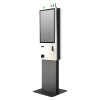
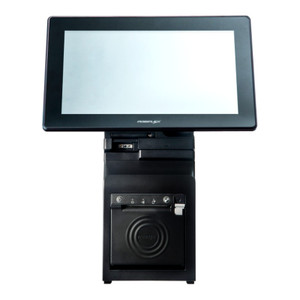
Posiflex JK325B00110FGS 32in POS Terminal with Integrated Camera
The Posiflex JK325B00110FGS is a 32-inch integrated POS terminal designed for retail and hospitality checkout environments where transaction documentation, customer verification, and loss-prevention workflows demand a unified hardware footprint. The unit pairs an Intel Core i5-1155G7 processor, 8GB DDR4 memory, and 128GB M.2 SSD with a factory-integrated camera and Windows 10 64-bit LTSC operating system—eliminating the capex and integration complexity of bolt-on camera rigs or separate video capture hardware. The included floor stand positions the display at counter height for dual-facing (customer-facing or employee-facing) workflows. This is a single-unit solution: the camera, display, compute, and mechanical mounting all ship as one assembly, reducing deployment time and eliminating SKU fragmentation across POS and surveillance toolchains.
Key Features
- 32-inch Touchscreen Display: Large, customer-visible estate for payment entry, transaction review, and promotional content. Touch responsiveness is factory-calibrated for high-traffic environments.
- Integrated Camera: Factory-mounted and pre-configured for transaction recording, ID verification, or loss-prevention capture without separate mounting hardware or focus adjustment. Ships ready to operate on power-up.
- Intel Core i5-1155G7 Processor: 11th Gen Lakefield architecture with sufficient single-threaded performance for POS application responsiveness (Square, Toast, Lightspeed, Shopify, etc.) and concurrent local video encoding or monitoring software.
- 8GB DDR4 + 128GB M.2 SSD: Baseline memory and storage for Windows 10 LTSC plus retail management software and local transaction buffering. SSD eliminates mechanical disk latency in high-transaction environments.
- Windows 10 64-bit LTSC: Long-term servicing channel—stable OS baseline without feature upgrades, ideal for POS deployments requiring frozen application stacks and minimal patch disruption cycles.
- Floor Stand Included: Provides stable counter-height positioning on service desks or retail checkout surfaces. Hardware bundle eliminates separate stand sourcing and alignment complexity.
- Standard RJ-45 Ethernet: Network connectivity for payment processing, cloud POS sync, and optional remote management. No proprietary network interface.
- 110V AC Power Supply: Standard North American mains input; bundled power adapter ships in the box.
Integration and POS Compatibility
The JK325B00110FGS runs unmodified Windows 10 LTSC, meaning any POS application or retail management system with Windows support installs and runs without firmware customization or vendor lock-in. Square, Toast, Lightspeed, Shopify POS, and legacy POS stacks (NCR, Micros, etc.) all operate natively. The integrated camera connects via USB to the host Windows OS and can be accessed by any application with USB or video-capture API support—third-party loss-prevention or transaction-audit software can be deployed without additional hardware integration projects.
Network payment processing and cloud POS backends connect via standard Ethernet; no proprietary gateway hardware is required. Retailers deploying hybrid workflows (local transaction processing + cloud reporting) can architect around this terminal's baseline compute and storage without exceeding typical POS infrastructure power or cooling budgets. The 128GB SSD accommodates offline transaction queuing for sites with intermittent WAN connectivity.
Camera and Loss-Prevention Workflows
The integrated camera is not a security-grade surveillance component—it is a fixed, counter-mounted capture device optimized for transaction documentation and ID verification at the point of sale. Resolution and frame rate are suitable for retail loss-prevention audits and dispute resolution (chargebacks, refund claims), not for long-range perimeter monitoring or detailed facial recognition. Video is stored locally on the host SSD or can be piped to third-party monitoring software via USB or IP streaming if the POS environment permits architectural modifications. For multi-location loss-prevention workflows requiring centralized video ingestion, archival, or AI-driven detection, a separate IP camera infrastructure and NVR backbone remain the appropriate tool—this camera bridges the gap for single-unit transaction capture without requiring separate video procurement and cabling.
Operational Considerations and Total Cost of Ownership
The unified hardware design reduces on-site integration labor: one unit ships, one stand assembly, one power connection, one network drop. Compared to a traditional POS terminal + bolt-on camera + separate camera mount, you eliminate supplier coordination, bracket fabrication, and cable routing complexity. Windows 10 LTSC patching follows Microsoft's predictable cadence; integrators familiar with retail Windows environments can manage updates without POS-vendor support tickets. The i5-1155G7 is a mainstream consumer-grade processor—component sourcing and future SKU continuity are not at risk from vendor discontinuation (unlike specialized POS processors). If the unit fails, a depot swap or local technician repair cycle mirrors standard commercial PC workflows rather than specialized POS RMA procedures.
Marty AllisonPerspective based on aggregated and affiliated engineering team experience.
We've deployed the Posiflex JK325B00110FGS into quick-service restaurants, boutique retail, and hospitality gift-shop environments where transaction documentation and loss-prevention visibility matter, but where a dedicated security infrastructure isn't justified. The key differentiator is simplicity: one unit, one power cord, one network drop, one integration point. The integrator doesn't have to coordinate with a camera vendor, solve camera mounting logistics, or run separate video cabling. For retailers who've been running Lightspeed or Square on a traditional POS terminal and want to add transaction-level camera backup, this is a plug-and-play stepping stone. The i5-1155G7 is a mainstream processor—if the unit fails mid-deployment, you can swap in a consumer-grade replacement laptop temporarily rather than waiting for specialized POS hardware RMA. That operational flexibility is worth money on high-velocity retail sites.
That said, there are important caveats. The integrated camera is fixed-mount and wide-angle—it's optimized for transaction counter capture, not for ID detail or facial clarity. If you need forensic-grade facial capture (for chargeback disputes or age-verification audits), a higher-resolution external IP camera and proper lighting rig is the right call. The 8GB RAM and 128GB SSD are baseline configurations; on a site running concurrent POS, monitoring software, and local buffering, you may hit memory or storage ceiling, especially if transaction volume is high (think 500+ transactions per day with local camera archival). Windows 10 LTSC is stable, but it requires standard Windows patch discipline—if the retail environment doesn't have IT support, unpatched systems become a liability.
Technical Highlights:
- Intel Core i5-1155G7 (11th Gen): Single-threaded performance sufficient for POS application responsiveness and concurrent USB camera encoding on local storage. Thermal design is passive or low-noise—important in a customer-facing counter environment where fan noise matters.
- 32-inch Touchscreen Estate: Large enough for dual-facing workflows (payment entry visible to employee, transaction summary visible to customer) without requiring secondary displays. Eliminates the cost and space footprint of a dual-monitor checkout setup.
- Integrated Camera (Fixed Mount): No focus adjustment, no separate power, no USB hub required—it's wired directly into the motherboard and shipped factory-ready. The downside is zero flexibility for angle or zoom; you must verify sightlines at installation.
- Windows 10 LTSC: No forced feature upgrades, predictable patch cycle, broad third-party POS software support. Reduces the likelihood of surprise OS behavior changes mid-deployment.
- 128GB M.2 SSD: Fast, silent, and adequate for Windows 10 OS, POS software, and local transaction buffering. Insufficient for long-term on-device camera archival (e.g., 30 days of continuous transaction video); for extended retention, integrate to external NAS or cloud storage.
Deployment Considerations:
- Camera Sightlines: The integrated camera is fixed-mount. Verify at pre-install survey that the camera angle captures the transaction area (typically the PIN pad or payment card reader). If sightlines are obstructed by a cash drawer or monitor bezel, you cannot retrofit; you'll need a secondary external IP camera.
- Power and Network Layout: Standard 110V AC and Ethernet. For wireless payment processing (NFC, contactless), ensure Ethernet WAN stability or deploy a cellular failover gateway; POS environments don't tolerate frequent network hiccups.
- Windows Update Cadence: LTSC updates are predictable but require IT coordination. If the site is unmanaged (no local IT), plan for monthly patch windows and potential reboot scheduling conflicts with peak retail hours.
- Memory/Storage Ceiling: 8GB DDR4 and 128GB SSD are baseline. For high-transaction sites running concurrent loss-prevention software or multi-location cloud sync, consider field upgrade options (SODIMM or NVMe swap) before deployment. Check with your systems integrator whether the hardware is serviceable on-site or requires depot service.
- Camera Output Integration: The camera is USB-connected to the host Windows OS. If your POS software doesn't have native USB camera support, you'll need middleware (e.g., VLC, ffmpeg, or third-party capture software) to pipe video to a monitoring backend. Verify software compatibility with your loss-prevention platform before committing to the unit.
This terminal is the right fit for retailers, hospitality operations, and service businesses that want transaction-level surveillance without the capex and integration complexity of a dedicated camera infrastructure. If you're upgrading from a legacy POS to a modern cloud-connected system and want to add loss-prevention visibility simultaneously, this is a simple one-unit solution that integrators can deploy in a day without special training. For multi-location chains with centralized loss-prevention requirements or high-security environments (jewelry, luxury retail), a separate IP camera backbone remains the appropriate architecture. Explore the full Posiflex catalog for additional terminal form factors and configurations.