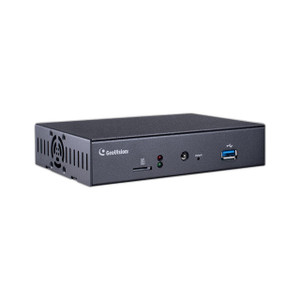
Geovision 89-PN40100-K010 PN401 Networked Signage Player
The Geovision 89-PN40100-K010 PN401 is a dedicated signage player designed to deliver content to networked digital displays in enterprise environments. It integrates directly with Geovision surveillance and access-control systems, enabling security teams to push real-time alerts, wayfinding graphics, and operational messaging across multiple display zones from a single management interface. Typical deployments span retail environments, corporate campuses, transportation hubs, and secure facilities where coordinated messaging and live video playback are operational requirements.
Key Features
- Network-Connected Architecture: Operates over IP infrastructure — eliminates dedicated signage cabling and simplifies multi-display rollouts across large facilities.
- IPCAM Cable Compatibility: Works with standard IPCAM (Cat5e/Cat6) network infrastructure — leverages existing surveillance cabling runs and PoE delivery.
- Geovision Ecosystem Integration: Native integration with Geovision GV-Center, GV-VMS, and access-control platforms — unified dashboard for video, alarms, and signage messaging.
- 24/7 Operational Reliability: Engineered for continuous operation in demanding environments without scheduled downtime.
- Multi-Zone Display Control: Manages content across multiple networked displays from a single player — reduces hardware footprint and simplifies provisioning.
- Enterprise-Grade Management: Remote content scheduling, monitoring, and failover — operational visibility into display uptime and content delivery status.
The PN401 bridges the gap between surveillance monitoring and facility communications. In retail environments, security can overlay real-time alerts or evacuation messaging on displays simultaneously. On corporate campuses, the player enables door-access events to trigger directional signage updates. Integration with Geovision's event-driven architecture means signage becomes an active component of your security operations rather than a standalone appliance — reducing the operational complexity of managing separate video, access, and digital display vendors.
Network deployment simplifies installation and reduces total capex. A single Cat6 drop carries both IP video feeds and signage content to the player; no separate control lines, no serial cascading, no proprietary cabling. This architecture is particularly valuable in retrofit scenarios where pulling new dedicated cabling is not feasible. The player's compatibility with standard IPCAM infrastructure means it integrates cleanly into existing Geovision camera and NVR deployments without additional network redesign.
Content scheduling and failover are managed through Geovision's central management platform. You define playlists, assign them to display zones, and trigger overrides based on real-world events (intrusion alarms, access-denied attempts, or system faults). If the primary player loses connectivity, failover logic can redirect content to a secondary player or fall back to cached content — ensuring critical messaging continues during network interruptions. This capability is essential for life-safety messaging and emergency egress signage in regulated facilities.
The PN401 is compatible with Geovision's full ecosystem including GV-VMS, GV-Center management platform, GV-Edge recording appliances, and networked door controllers. If your organization already relies on Geovision for surveillance and access, the signage player extends that unified operational model to facility communications without vendor fragmentation. Pricing, support, and training consolidate under a single vendor relationship, reducing lifecycle complexity and support overhead.
Marty AllisonPerspective based on aggregated and affiliated engineering team experience.
We've deployed the PN401 into mixed-use facilities where security operations and facility management overlap — libraries, government offices, healthcare campuses. The real strength is that it doesn't require a separate digital-signage vendor or parallel management toolchain. If your team is already managing Geovision cameras and access control, the PN401 slots into that operational model with minimal additional training. Content delivery is event-driven (intrusion detected → display evacuation route; tailgate event → alert signage) rather than time-based playlists — that's operationally useful in security contexts where reactive messaging matters more than rotational advertising. Against dedicated signage platforms like Samsung MagicInfo or Scala, the PN401 is less feature-rich for creative content scheduling, but it wins on integration cost and operational consolidation. If your primary need is pushing real-time security messaging and live video feeds to displays, it's a clear win. If you're running a retail network that happens to also have security cameras, a dedicated signage platform will give you more creative freedom and scheduling granularity. Know which use case you're solving for before committing.
Technical Highlights:
- Event-Driven Content Delivery: Signage responds to Geovision alarm rules, access events, and video analytics triggers — not just time-based playlists. Security messaging happens in real-time, not on a fixed schedule.
- IPCAM Infrastructure Reuse: Cat5e/Cat6 cabling that carries your IP cameras also powers the player — no separate signage power supply or control circuit required on many deployments. PoE delivery is possible, reducing in-wall wiring complexity.
- Multi-Display Zoning: Single player controls multiple networked displays with independent zone content — one zone shows live camera feeds, another shows emergency messaging, a third shows wayfinding graphics. Avoids the capex and management overhead of one player per display.
- Unified GV-Center Management: Signage playlists, display health, and content status appear in the same GV-Center dashboard as your cameras and access control. No separate web portal, no separate login, no separate monitoring tool.
- Failover and Cache Logic: Player caches critical content locally; if network to the server drops, cached messages persist. Failover to a secondary player is automatic if configured — important for life-safety messaging in regulated buildings.
Deployment Considerations:
- The PN401 is optimized for Geovision ecosystem integration — if your VMS or access platform is a third-party system (Genetec, Milestone, Avigilon), content triggering becomes manual or requires custom integration. Know your backbone before assuming event-driven signage works seamlessly.
- Network bandwidth for multi-display playback (especially with live video feeds) can be substantial. A 1 Gbps network segment per player is typical for 4K content or multiple simultaneous streams. Site bandwidth audit is essential before deployment.
- Display output (HDMI, DVI, or legacy analog) varies by model revision. Verify the specific output format required before specifying cable runs. Not all PN401 units have identical output connectors.
- Content encoding and format support are tied to Geovision's media library tools. Proprietary video formats or third-party graphics platforms require transcoding or custom middleware — budget integration time if you're importing content from external sources.
- Physical mounting and thermal management matter on 24/7 deployments. The player dissipates measurable heat; ensure adequate ventilation and ambient temperature control, especially in confined wall-mount enclosures or outdoor shelters.
The PN401 is the right fit for security operations that need reactive, event-driven signage tied to real surveillance and access events — not for retail chains optimizing creative content rotation. If your team is already standardized on Geovision and wants to unify messaging, monitoring, and recording into one platform, it's a solid choice. Explore the Geovision catalog to understand the broader ecosystem before committing.