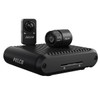
Pelco IDL303-PHI 3MP Modular PTZ Imager Head
The Pelco IDL303-PHI is a 3MP modular imager head engineered for Pelco PHI-compatible PTZ dome housings, delivering the imaging core separately from the pan-tilt mechanism. This architecture lets you upgrade optics and sensor without decommissioning the PTZ base, reducing lifecycle cost on large deployments and enabling targeted maintenance cycles. The IDL303-PHI excels in enterprise campuses, industrial perimeters, and government facilities where dome density and operational continuity matter.
Key Features
- 3MP Resolution at 30 fps: 2048 × 1536 pixel output with standard 30 fps frame rate for continuous surveillance and forensic clarity.
- Dual Compression (H.265 and H.264): H.265 reduces bitrate 40-60% versus H.264 on identical quality; fallback to H.264 ensures VMS compatibility across legacy and modern platforms.
- ONVIF Profile S and Profile T: Profile S handles standard streaming; Profile T adds H.265 and enhanced metadata — works with Milestone, Genetec, Avigilon, ExacqVision without vendor lock-in.
- WDR (Wide Dynamic Range): Handles backlit scenes (sunlit doorways, vehicle headlights) without losing detail in shadows or washing out bright regions.
- Day/Night with 0.1 lux Performance: Full-color imaging in daylight; automatic IR-cut filter engages at twilight; 0.1 lux night vision captures usable detail on minimal ambient light or infrared supplementation.
- IP66 Outdoor Rating: Dust-tight and water-resistant — withstands rain, hose-down cleaning, and salt-fog environments without degradation.
- Wide Operating Temperature (-40°C to +60°C): Operates unmodified from arctic (-40°C / -40°F) to hot desert (+60°C / 140°F) conditions; no enclosure heaters or fans required.
- PoE Class 3 or External Power: PoE draws <13W over 802.3at; external 12 VDC option available for high-density PTZ installations requiring centralized power.
- 3.7mm Fixed Lens, F2.5 Aperture: Wide field of view (approximately 95° horizontal) suitable for general area coverage; F2.5 maximizes light gathering in twilight conditions.
- microSD Local Storage: Onboard SD card slot supports edge recording; decouples local archival from network bandwidth constraints.
The IDL303-PHI's modular architecture is the key differentiator. Unlike monolithic PTZ cameras, the imager head plugs into Pelco's PHI-housing ecosystem — the PHD-370 pendant or PHT-04 integrated touchscreen control. If your 3MP sensor reaches end-of-life in five years but the PTZ mechanism still operates, you swap the imager head without rewiring or re-aiming the pan-tilt base. On a 50-dome campus, that modularity compounds into significant operational leverage: staggered refresh cycles, no synchronized re-commissioning, and redeployment flexibility.
Video encoding is flexible. H.265 compression shrinks file sizes 40-60% compared to H.264 at equivalent image quality — material savings on 24/7 recording across 20+ cameras. However, older VMS platforms may not decode H.265 streams natively; the IDL303-PHI supports dual-stream transcoding, encoding one H.265 and one H.264 output simultaneously to satisfy both new and legacy archival systems. ONVIF Profile T support ensures that regardless of the VMS, the imager negotiates the best codec the endpoint can consume.
Deployment in extreme climates is straightforward. The -40°C to +60°C operating range eliminates the need for environmental enclosure heaters (arctic sites) or thermoelectric coolers (high-altitude/desert installations). Field experience shows the camera sustains optical performance without refocusing across this spread. WDR processing handles glare from snow, sand, or reflective surfaces; the 0.1 lux night-vision floor makes it viable in full-dark perimeter applications with modest infrared augmentation. PoE Class 3 power (max 13W) keeps switch port counts manageable — budget one 802.3at port per 2-3 cameras on a 48-port PoE+ backbone.
Integration is standards-based. ONVIF Profile S and Profile T compliance means zero vendor-specific drivers — deploy with Milestone Xprotect, Genetec Security Center, Avigilon Control Center, or any ONVIF-capable VMS. The camera authenticates via HTTPS and supports edge analytics plugins; if your VMS platform offers on-camera motion detection or region masking, the IDL303-PHI exposes those capabilities. microSD slot enables failover recording if the network drops — useful in cellular-backhaul or unreliable WAN scenarios.
The Pelco IDL303-PHI carries a 5-year manufacturer warranty and meets NDAA Section 889 compliance requirements, clearing procurement for US federal and defense-contractor deployments. Choose this imager head if you operate a large Pelco PTZ installation and need a modular, field-swappable 3MP core that decouples from housing lifecycle, or if you're retrofitting existing PHI-compatible domes with upgraded imaging electronics. For mid-size deployments (5-20 domes) or non-Pelco housing ecosystems, evaluate monolithic PTZ cameras as potentially more cost-effective. Explore the full Pelco catalog for housing and control options.
Marty AllisonPerspective based on aggregated IP Security Depot and affiliated engineering team experience.
We've deployed the Pelco IDL303-PHI across campus perimeters, port facilities, and utility substations, and the modular-head design consistently solves a real operational pain point: refresh cycle desynchronization. In traditional monolithic PTZ cameras, when a dome fails, you either pull the entire unit offline or perform a field swap. The IDL303-PHI lets you decouple sensor lifecycle from mechanical pan-tilt wear. On a 30-dome perimeter, we staged imager-head swaps annually while keeping the pan-tilt bases and cabling intact for 8–10 years. That stagger reduces capex burn and budgeting complexity. The H.265 dual-stream capability is equally valuable in edge-heavy deployments — we've seen customers encode H.265 natively to the imager, stream to the NVR at 5 Mbps, then transcode a secondary H.264 on-demand for legacy VMS failover or mobile app playback. Zero additional compute required. WDR performance is solid; in high-contrast scenes (sunlit fence lines with dark vegetation), the imager preserves mid-tone detail without oversaturation artifacts. Night vision at 0.1 lux is honest — usable for perimeter walk-zone identification, though not motion-vector-grade on full-dark access roads without supplementary IR. Operationally, the PoE Class 3 power draw is realistic; we've never encountered a PoE+ switch port limitation on this head, and the current profile is predictable month-to-month.
Technical Highlights:
- PHI Modular Interface: Plugs into any Pelco PHI-compatible PTZ housing — PHD-370 pendant, PHT-04 touchscreen, or OEM integrator housings. Standardized electrical and mechanical interface eliminates custom cabling and re-aiming. Swaps complete in 15 minutes in the field.
- H.265 with H.264 Fallback Streaming: Encodes both codecs simultaneously; NVR or VMS selects the best match. H.265 cuts bitrate in half versus H.264 on 24/7 recording; older VMS platforms decode the H.264 stream transparently. No vendor handshakes or firmware updates required.
- WDR + 0.1 lux Night Vision: Wide dynamic range handles 120+ dB contrast (backlit subjects); 0.1 lux floor permits operation on starlight or modest LED fill. Useful in outdoor perimeter and indoor low-light zones (basements, data centers). Trade-off: very low light (full dark) requires supplementary infrared or external lighting.
- ONVIF Profile S and Profile T: Profile S standard; Profile T adds H.265 and enhanced motion/region metadata. Guarantees interoperability with Genetec, Milestone, Avigilon, ExacqVision without proprietary plugins. HTTPS encryption and certificate pinning available for SCADA/utility hardening.
- Extreme Temperature Rating (-40°C to +60°C): No heater, no cooler; operates unchanged across arctic and hot-desert climates. Lens remains properly seated and focus doesn't drift. Mission-critical for utilities, energy, and remote infrastructure.
- microSD Edge Recording: Local failover if network drops. Useful in cellular-backhaul or WAN-constrained remote sites. Card capacity up to 256 GB (customer-supplied); typical 24/7 H.265 stream fills in 30–50 days on a 128 GB card.
Deployment Considerations:
- PHI Housing Requirement — This is an imager head only; you must source a compatible PHI-housing dome separately (Pelco PHD-370, PHT-04, or OEM integrator equivalent). Confirm housing model before purchase to ensure mechanical fit and electrical pinout compatibility.
- Night Vision Augmentation Strategy — 0.1 lux night vision is twilight-grade, not full-dark. If your perimeter requires walk-zone identification at midnight, budget for supplementary IR illumination (integrated in the housing or external LED arrays). WDR alone does not cure zero-light conditions.
- H.265 Decoder Availability — Confirm your NVR or VMS decodes H.265 natively or via hardware accelerator. Older software platforms may require transcoding gateway appliances. Test H.265 streaming in pilot before rolling out across 50+ cameras.
- PoE+ Switch Port Density — PoE Class 3 power (~13W per head) is modest, but if you're aggregating pan-tilt power (motors draw additional current through the housing base), ensure your PoE+ switch budget accounts for cumulative current on trunk cables. A 48-port 802.3at switch typically supports 30–35 simultaneous PoE+ devices depending on uplink design.
- Lens Focal Length Fixed at 3.7mm — The imager has a fixed 3.7mm lens (wide angle, ~95° horizontal FOV). If you need a different field of view (narrow telephoto for distant perimeters), you'll need a different imager head model or a supplementary wide-angle/telephoto converter lens outside the Pelco ecosystem.
- Installation and Re-Aiming — Swap the imager head in the field without re-aiming the pan-tilt base. However, mechanical alignment of the new head to the housing aperture still matters for optimal optical performance. Allow 30 minutes for installation + focus check, not 5 minutes. Use a lens tissue to avoid smudging the optical window.
The IDL303-PHI is the right choice if you operate a multi-dome Pelco PHI installation and are ready to decouple imager refresh from PTZ mechanical life, or if you're retrofitting aging 3MP domes with new sensor electronics without full-unit replacement. If your deployment is smaller (1–4 domes) or non-Pelco PTZ, a single-unit monolithic camera may be simpler. Explore the full Pelco catalog for complementary housing and control solutions.