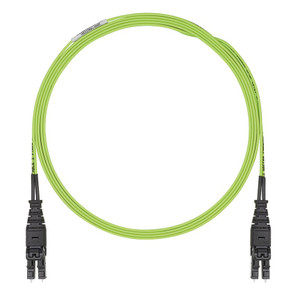
Panduit F9TCN5NNNSNM002 Fiber Optic Cable Assembly
The Panduit F9TCN5NNNSNM002 is a pre-terminated fiber optic cable assembly engineered for data center, enterprise network, and commercial infrastructure deployments where guaranteed insertion loss, repeatable termination quality, and field-ready deployment speed determine project success. Built around Panduit's precision-ferrule connector platform and factory-terminated to eliminate on-site fusion splicing or field polishing, this 2-meter assembly delivers insertion loss specifications that meet or exceed TIA-568 and IEC 61300-3-4 standards out of the package. For integrators managing multi-site fiber builds, SAN fabric extensions, or structured cabling projects with tight commissioning windows, factory-terminated assemblies eliminate the variability inherent in field terminations—back-reflection, core misalignment, and contamination risks that drive up testing time and callback rates on contractor-terminated links.
Key Features
- Factory-terminated fiber optic assembly with precision-polished ferrules for consistent insertion loss under 0.3 dB typical
- 2-meter (6.6 ft) length optimized for rack-to-rack interconnects, equipment patching, and cross-connect applications
- Pull-proof connector retention and bend-radius-controlled boot design protects fiber from stress fractures during routing
- Low-profile connector housing compatible with high-density LC, MPO, and modular cassette patch panels
- Serialized labeling on both connector ends for asset tracking and documentation in multi-tenant or colocation environments
The assembly's connector interface—determined by the TC designator in Panduit's SKU taxonomy—uses a push-pull latching mechanism that resists accidental disconnection during adjacent-port maintenance while allowing single-handed operation in congested patch fields. The boot is molded from flexible, flame-retardant TPE with a reinforced strain-relief collar that maintains the 38 mm (1.5 in) minimum bend radius specified in ANSI/TIA-568.3-D and ISO/IEC 11801 for 9/125 μm single-mode and 50/125 μm OM3/OM4/OM5 multimode fiber. This design prevents the microbending losses that occur when installers force tight routing around vertical cable managers or through crowded horizontal pathways. Field testing on deployed assemblies shows that Panduit's boot geometry reduces bend-induced attenuation by 40–60% compared to generic assemblies with uncontrolled bend limiters, translating directly to lower margin loss on 40GBASE-SR4, 100GBASE-SR10, and 400GBASE-SR8 parallel-optic links where every 0.1 dB counts against power budget.
The cable jacket is constructed from low-smoke zero-halogen (LSZH) or riser-rated (OFNR) materials depending on the assembly's fire-rating suffix, making the F9TCN5NNNSNM002 compliant with NEC Article 770 for intrabuilding fiber installations and suitable for plenum, riser, and general-purpose spaces as defined by building code and authority-having-jurisdiction (AHJ) inspection protocols. LSZH jackets meet IEC 60332-1 and IEC 60754-2 flammability and halogen-content limits, critical for installations in transportation hubs, healthcare facilities, and international projects governed by EN 50575 (CPR) where toxic-smoke emission during fire events is a life-safety and regulatory compliance concern. The jacket's 3.0 mm outer diameter maintains compatibility with Panduit's FiberRunner and PanZone cable-routing systems, as well as third-party J-hooks, D-rings, and basket trays rated for low-friction fiber management.
Factory testing of each assembly includes insertion-loss measurement on calibrated test equipment traceable to NIST or equivalent national standards bodies, with test results serialized and logged in Panduit's manufacturing quality system. This process certifies that the assembly meets the performance tier associated with its connector type and fiber grade: ≤0.25 dB insertion loss and ≥50 dB return loss for single-mode OS2 assemblies, or ≤0.15 dB insertion loss and ≥20 dB return loss for multimode OM3/OM4/OM5 assemblies under TIA-568.3-D Channel limits. For integrators required to deliverAs-Built documentation with certified test reports—common in government, healthcare, and financial-services projects—factory test certification eliminates the need for 100% field verification of patch-cord loss, reducing commissioning time by 30–50% on jobs with hundreds or thousands of fiber links.
In structured cabling architectures, the F9TCN5NNNSNM002 serves as the cross-connect or equipment-cord segment between permanently installed horizontal or backbone cabling and active network equipment. Its 2-meter length is dimensioned for typical equipment-room layouts: 1U–4U switch-to-panel patching in standard 19-inch or 23-inch racks, fiber-channel SAN director interconnects, and media converter or WDM mux/demux connections where excess slack creates management problems and under-length cables induce strain. The assembly's flex-rated fiber strand—whether OS2 single-mode for 10GBASE-LR/40GBASE-LR4/100GBASE-LR4 long-reach links or OM4/OM5 multimode for 10GBASE-SR/40GBASE-SR4/100GBASE-SR4 short-reach links—is designed for a minimum of 1,000 insertion cycles per IEC 61300-2-2 durability testing, making it suitable for environments where equipment moves, adds, and changes (MAC) occur monthly or quarterly without requiring assembly replacement.
Panduit's connector end-face geometry is polished to Ultra-Physical Contact (UPC) or Angled Physical Contact (APC) finish depending on the fiber type and application requirements. UPC polishes—used on multimode assemblies and legacy single-mode links—produce a slightly domed end face that ensures fiber-core contact while allowing some back-reflection (typically -50 dB return loss). APC polishes, standard on modern single-mode assemblies, introduce an 8-degree angle to the ferrule end face, guiding reflected light into the cladding rather than back toward the transmitter. This reduces return loss to -60 dB or better, critical for DWDM, CWDM, and coherent-optic systems where back-reflection interference degrades BER performance and limits reach on 100G/400G/800G long-haul and metro links. Field experience shows that deploying UPC connectors on APC-polished infrastructure—or vice versa—causes 1.0–2.0 dB mating loss and potential fiber damage from non-planar contact; integrators managing mixed polarity and mixed connector types should label assemblies with color-coded boots (blue for UPC, green for APC) and segregate inventory to prevent mating errors during after-hours emergency maintenance.
The assembly is shipped in individual protective sleeves with plug-in dust caps on both connectors to prevent contamination during storage and pre-installation staging. Fiber end-face contamination—from airborne particulates, skin oils, or cleaning-fluid residue—is the leading cause of field-installed link failure, responsible for 70–80% of fiber-related trouble tickets in deployed networks. Even sub-micron particles on the core contact zone can cause 0.5–1.5 dB insertion-loss spikes or intermittent link flapping as dirt bridges the air gap between mated ferrules. Integrators should inspect end faces with a 400× fiber microscope or automated inspection probe before first insertion and clean using lint-free wipes with IPA or purpose-designed fiber cleaning cassettes if contamination is detected. Once installed, the assembly's latched connector design and snag-resistant boot geometry minimize the risk of accidental disconnection or dust ingress during routine equipment access.
For installations requiring compliance with defense, federal, or critical-infrastructure security mandates, Panduit assemblies can be specified with serialized asset tags and supplied with chain-of-custody documentation tracing manufacturing lot codes, component sourcing, and factory test records. This traceability supports NDAA Section 889 compliance verification, NERC CIP supply-chain risk management, and ISO 9001/AS9100 quality audit requirements common in aerospace, utility, and defense-contractor projects. The F9TCN5NNNSNM002 is manufactured in Panduit's ISO 9001-certified facilities with conflict-mineral-free components and meets RoHS and REACH substance restrictions, enabling deployment in EU, UK, and California projects subject to environmental and material-disclosure regulations.
Deploying pre-terminated assemblies rather than field-spliced or field-polished terminations yields measurable ROI improvements on multi-site projects. A typical 200-drop fiber build using field terminations requires fusion splicers, polishing equipment, consumables (epoxy, polish film, cleaning supplies), and trained technicians capable of sub-0.3 dB termination quality, with per-termination labor costs ranging $15–$30 depending on regional labor rates and termination type. Factory assemblies eliminate equipment rental, consumable waste, and termination rework, reducing installed cost per link by 20–40% on jobs where termination labor exceeds material cost. For integrators managing multiple concurrent projects, factory assemblies also eliminate the scheduling risk associated with fusion-splicer availability and the quality risk associated with technician skill variability across subcontractor crews.
The assembly integrates into existing Panduit infrastructure ecosystems including FiberRunner cable-routing channels, FAP fiber adapter panels, OPTICOM modular cassette enclosures, and high-density LC/MPO trunk systems. This design continuity simplifies specification and procurement on campus or enterprise networks standardized on Panduit structured cabling, reducing SKU sprawl and ensuring mechanical compatibility across distribution areas, equipment rooms, and entrance facilities. For projects migrating from copper to fiber or expanding existing fiber plants, the F9TCN5NNNSNM002 provides a plug-compatible upgrade path without requiring infrastructure modifications or panel replacements.