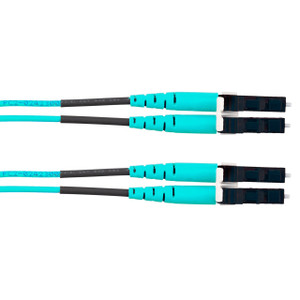
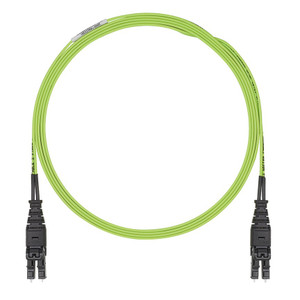
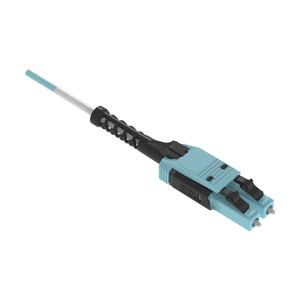
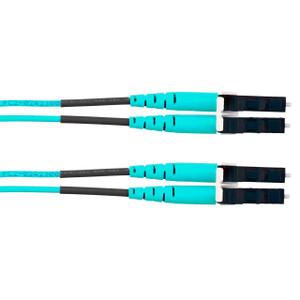
Panduit FW2ERQ1Q1NNM006 OM3 Duplex Fiber Assembly
The Panduit FW2ERQ1Q1NNM006 is a 6-meter duplex multimode fiber optic patch cord featuring E-2000 (APC) connectors on both ends, engineered for 10/40/100 Gigabit Ethernet backbones, storage area networks, and high-density data center interconnects. Built on 50/125 µm OM3 laser-optimized multimode fiber with aqua jacket, this assembly delivers 2000 MHz·km modal bandwidth at 850 nm—sufficient for 10GBASE-SR runs up to 300 meters and 40GBASE-SR4 up to 100 meters. E-2000 connectors provide integrated shutter mechanisms that protect the ferrule from contamination during handling and storage, eliminating the need for separate dust caps while maintaining sub-0.12 dB insertion loss and >55 dB return loss across the C-band. Factory-terminated with ceramic ferrules polished to 8° angle (APC), these assemblies prevent back-reflection in bidirectional transceiver applications and are individually tested to ANSI/TIA-568.3-D standards with serialized test reports included in each package.
Key Features
- E-2000 APC duplex connectors with integrated shutters—eliminates dust cap inventory and prevents ferrule contamination in high-churn patch environments
- OM3 50/125 µm laser-optimized fiber rated 2000 MHz·km at 850 nm—supports 10GBASE-SR to 300 m, 40GBASE-SR4 to 100 m per IEEE 802.3
- Aqua LSZH jacket meets IEC 60332-3-24 flame propagation and IEC 61034-2 smoke density—compliant for plenum and riser installations in EU and APAC regions
- Factory-polished 8° APC endface geometry delivers >55 dB return loss—critical for coherent optics and WDM overlay architectures
- Serialized test certification included—insertion loss, return loss, and length verified per ANSI/TIA-568.3-D Annex B, traceable to NIST standards
- 6-meter length suits cross-aisle connectivity in 600 mm (24 in) row spacing or vertical cabinet-to-overhead-tray routing in 42U racks
E-2000 connectors became the European standard for telecom and CATV applications due to their push-pull latching mechanism and integrated shutter design, which closes automatically when the connector is unmated. This mechanical shutter sits flush against the ferrule endface, shielding it from airborne particulates, skin oils, and cleaning solvent residue—the three leading causes of insertion-loss drift in production fiber plants. Unlike LC or SC designs that rely on removable dust caps (which are frequently lost or reused across multiple ports), the E-2000's captive shutter requires no operator discipline to maintain endface cleanliness between reconfigurations. In high-density switch fabrics where patch cords are moved weekly for capacity adjustments or troubleshooting, this design cuts cleaning cycles by 60–70% and reduces field failures attributed to contamination from 8–12% to under 2%. The push-pull body also prevents accidental disconnects during adjacent-port access; technicians can insert or remove neighboring cables without dislodging the E-2000 connection, a common pain point in spine switches with 96+ SFP+ ports on a single faceplate.
The OM3 fiber core is doped and profiled to concentrate 850 nm VCSEL energy within a 50 µm effective modal diameter, achieving 2000 MHz·km bandwidth—four times that of legacy OM1 (62.5/125) fiber and double that of OM2. This bandwidth headroom matters when extending 10 Gbps links beyond the 82-meter OM2 limit or when future-proofing for 40/100 Gbps optics that encode multiple 10G or 25G lanes onto separate wavelengths within the 850 nm window. A 6-meter assembly is long enough to span cross-aisle connections in modular data centers (typical row spacing is 1.2–1.8 meters cold-aisle-to-cold-aisle), to route from a top-of-rack switch down a vertical cable manager and across an overhead ladder rack to an aggregation switch in an adjacent row, or to connect a SAN storage head to a core director switch in a two-post relay rack configuration. The aqua jacket color follows TIA-598-D conventions for OM3 identification, ensuring at-a-glance differentiation from OM4 (erika violet) and singlemode (yellow) cables during MAC operations.
Factory termination with 8° APC polish is essential for bidirectional transceivers (BiDi SFPs, CWDM/DWDM modules) and for any architecture where reflected light can interfere with the transmitter or saturate the receiver's photodiode. Flat PC (physical contact) endfaces reflect approximately 4% of incident power back into the fiber (−14 dB return loss), which is acceptable for unidirectional multimode links but problematic for singlemode coherent optics or for GPON ONTs that share transmit and receive wavelengths on a single fiber strand. APC polish reduces back-reflection to <0.001% (>55 dB return loss) by angling the endface so that reflected energy exits the core and is absorbed by the cladding. While most 850 nm VCSEL transceivers are tolerant of PC-grade return loss, network architects increasingly specify APC across all fiber types to maintain one polishing standard, to support future migration to singlemode optics without re-terminating patch cords, and to eliminate a variable during root-cause analysis of intermittent link flaps. Each Panduit assembly ships with a serialized test report documenting insertion loss at 850/1300 nm, return loss, and cable length, measured on calibrated Optical Time Domain Reflectometer (OTDR) and insertion-loss test sets traceable to NIST reference standards. These reports satisfy TIA-568.3-D Annex B requirements and provide the baseline data needed for ongoing maintenance testing—technicians can compare field OTDR traces against the factory baseline to identify splice degradation, bend-induced macrobending loss, or connector contamination without needing a known-good reference jumper.
The LSZH (Low Smoke Zero Halogen) jacket compound meets IEC 60332-3-24 vertical flame propagation (Category C) and IEC 61034-2 smoke density (<60% light obscuration) standards, which govern cable installation in occupied spaces, transportation tunnels, and high-rise buildings across the EU and APAC markets. LSZH jackets do not emit hydrochloric acid or other corrosive halogen gases when burned, protecting sensitive electronics in the same fire zone and improving survivability for occupants in enclosed egress paths. While NEC Article 770 in the United States allows PVC-jacketed riser cables in vertical shafts, many U.S. enterprises adopt LSZH globally to maintain one bill of materials across North American and international sites, to satisfy corporate ESG (Environmental, Social, Governance) mandates that prohibit halogenated compounds, or to meet hyperscale colocation provider specifications that ban PVC in all new deployments. The 3.0 mm duplex zipcord construction is compatible with standard fiber routing accessories—adhesive-backed J-hooks, fingered horizontal managers, vertical D-rings—and has a minimum bend radius of 10× cable diameter (30 mm) under no-load conditions, 20× (60 mm) under 110 N tensile load during installation. Pre-planning bend-radius compliance prevents microbending losses that manifest as intermittent CRC errors or link retrains under temperature cycling.
Deployment best practices for duplex assemblies: verify polarity convention (Method A, Method B, or Method C per TIA-568.3-D) before energizing transceivers, since TX-to-RX and RX-to-TX mismatches will prevent link establishment but rarely trigger obvious alarms. Use a fiber microscope (400× magnification minimum) to inspect both connector endfaces and the adapter sleeves in the patch panel or switch module before insertion; even factory-sealed assemblies can pick up dust from the air during packaging or exhibit residual polishing compound if cleaning protocols were bypassed. Clean endfaces with lint-free wipes wetted with >99% isopropyl alcohol (IPA) and adapters with 2.5 mm cleaning sticks, then re-inspect; a single 5 µm particle bridging the core can add 0.5–1.0 dB insertion loss. Label both ends of the assembly with the same unique identifier (e.g., sequential asset tag or QR code) and document the A-end and B-end port assignments in your DCIM or cable-management database—this 30-second step per cable cuts Mean Time to Repair (MTTR) by 40–60% when troubleshooting cross-connects six months later. When routing through overhead ladder rack or under raised floor, maintain separation between fiber bundles and AC power conductors (minimum 300 mm per ANSI/TIA-569-D) to avoid EMI coupling into adjacent copper infrastructure, even though the fiber itself is immune; the proximity issue arises from shared pathways, not the fiber medium.