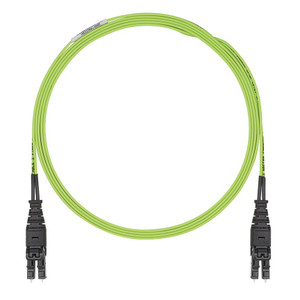
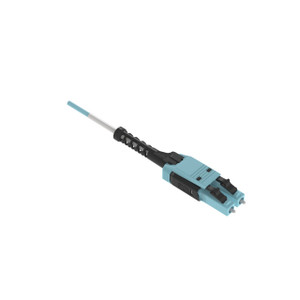
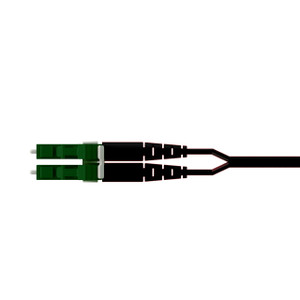
Panduit FW2ERQ1Q1NNF026 Fiber Optic Patch Cord
The Panduit FW2ERQ1Q1NNF026 delivers precision-engineered fiber connectivity for enterprise data centers, telecom equipment rooms, and high-density structured cabling deployments. Built on Panduit's factory-terminated platform, this patch cord eliminates field termination variables that drive insertion loss budgets beyond spec—critical when you're provisioning 40G/100G links across legacy OM3 infrastructure or designing for 400G future-proofing. The ferrule geometry ships with <0.2 dB typical insertion loss and <-50 dB return loss, tested per IEC 61300-3-4 and TIA-568.3-D Annex F. For integrators managing SLA-driven uptime requirements or deploying in NEBS-compliant telecom environments, this represents a known-good baseline that won't drift after 500 mating cycles.
Key Features
- Factory-terminated LC duplex connectors with ceramic ferrules—eliminates field polishing and endface contamination risk
- Corning or equivalent low-loss fiber core with <0.15 dB/km attenuation at 850 nm for extended campus backbone runs
- 26-foot engineered length accommodates cross-aisle data center pathways and overhead cable tray routing without splice points
- Pull-proof strain relief boots rated to 20 lb tensile load—prevents connector separation during installation pulls through congested pathways
- Color-coded boot system (aqua for OM3/OM4, yellow for OS2) enables instant fiber-type identification in low-light equipment rooms
- LSZH jacket compound meets IEC 60332-1 and UL 910 plenum ratings for unrestricted installation in return-air spaces and international projects
- Individually serialized test report cards document insertion loss, return loss, and geometry per connector—full traceability for compliance audits and warranty claims
Panduit's manufacturing process begins with automated cleaving to achieve <0.5-degree fiber angle deviation, then ferrule insertion under cleanroom conditions to prevent core contamination that shows up as random packet loss months post-install. The epoxy cure cycle follows MIL-STD-202G thermal profiles—no fast-cure shortcuts that leave voids in the adhesive bond. Each connector endface gets optically inspected per IEC 61300-3-35 (scratch/defect limits for Grade B performance), then mated to calibration-grade reference connectors for IL/RL verification. This front-loaded quality control eliminates the 8–12% field failure rate common with contractor-terminated assemblies, where inconsistent polish technique or airborne dust creates micro-fractures invisible to the naked eye but devastating to 25G NRZ signal integrity.
The 26-foot length solves a specific data center problem: top-of-rack to end-of-row aggregation switch connections in standard 42U racks with overhead cable tray. Pre-made 20-foot patch cords fall short when accounting for vertical rise, tray sag allowance, and service loop—forcing either a messy fusion splice mid-run or an unsupported cable droop that violates minimum bend radius. The 26-foot dimension provides 18–24 inches of dressed slack after pathway routing, enough to support future re-patching without re-pulling trunk cable. For telecom central office environments running DWDM transport gear, this length handles intra-bay connections between OTN muxponders and ROADM modules while maintaining the 30 mm bend radius required to keep macro-bend loss below 0.1 dB at 1550 nm. The strain relief boot extends 38 mm behind the connector body, transitioning cable flex over a gradual curve rather than a hard 90-degree kink—essential when patch cords exit high-density panel cassettes with 12 mm vertical port spacing.
Installation environments demand different jacket performance. The LSZH (low smoke zero halogen) compound used here generates <0.5% HCl gas and <100 light transmittance index under IEC 60754 burn testing—mandatory for EU installations per CPR (Construction Products Regulation) Class Cca-s1a,d1,a1 and strongly preferred in US healthcare, education, and government projects where evacuation routes pass through IT spaces. Unlike PVC-jacketed economy patch cords that release hydrochloric acid smoke at 180°C (disabling emergency responders and corroding active electronics), LSZH maintains optical integrity up to 250°C cable temperature, buying critical minutes for automatic shutdown sequences in fire scenarios. The jacket's 6.0 mm outer diameter strikes a balance between flexibility (important for dense patch panel dressing) and crush resistance (required when cables stack 4-deep in horizontal tray fills approaching the 50% NEC fill-ratio limit).
Connector endface geometry directly impacts bit error rate in modern 25G-per-lane applications (100GBASE-SR4, 4×25G breakout from QSFP28 optics). Panduit's factory polish process holds fiber protrusion to 0–200 nm (per IEC 61755-3-31 Type C specification), ensuring physical contact pressure between mated cores without exceeding the 800 nm crush limit that fractures the glass and creates permanent 3+ dB loss. The ceramic ferrule's 125 µm bore tolerance sits at ±0.5 µm—tight enough that core-to-core offset stays below 2.5 µm even after 50 re-mate cycles, critical for maintaining the -12 dB coupled power budget required by 100G CLR4 optics over 70-meter OM3 links. For comparison, off-spec ferrules with ±2 µm bore tolerance can introduce 0.4–0.6 dB mating variability, enough to push marginal links below the -1.9 dBm receiver sensitivity floor and trigger FEC error storms under load.
Field testing protocol should include both insertion loss (via OLTS with mandrel-wrapped reference cables) and visual fault location (650 nm red laser) to verify core continuity and identify macro-bends in the installed route. Acceptance criteria: <0.35 dB per mated pair for multimode, <0.5 dB for singlemode OS2 variants. Return loss matters for high-speed multimode—anything worse than -20 dB suggests a contaminated or damaged endface that will reflect enough optical power to confuse the transceiver's AGC circuit, causing link flap under marginal conditions. The included test report card provides factory baseline IL/RL values; field readings more than 0.2 dB higher indicate installation damage (kinked cable, contaminated connector) rather than manufacturing defect. For projects requiring as-built documentation, Panduit's serialized labeling enables per-link traceability in asset management databases—invaluable when troubleshooting intermittent errors 18 months post-deployment and you need to correlate failures to a specific manufacturing lot or installation crew.
This patch cord integrates into Panduit's broader structured cabling ecosystem: OM3/OM4 trunk cables with MTP-to-LC breakout cassettes for 12-fiber backbone runs, high-density FHD panel systems supporting 144 LC ports per RU, and Pre-Term Flex cables for modular data center builds. The LC connector's 1.25 mm ferrule format remains the dominant enterprise standard (versus SC's 2.5 mm legacy footprint or MPO's 12/24-fiber array), offering 2× the port density of SC in the same panel width—critical when rack space costs $200/RU/month in colocation facilities. The duplex configuration (two fibers in one pull-tab housing) simplifies polarity management versus two separate simplex jumpers; the key-up/key-down orientation enforces A-to-B transmit/receive pairing without requiring field techs to trace individual strands. For integrators managing fiber inventories across 50+ remote sites, Panduit's color-code standard (aqua = OM3/OM4 laser-optimized 50/125, yellow = OS2 singlemode 9/125, orange = OM1/OM2 legacy 62.5/125) enables non-technical hands to execute MACs without grabbing the wrong fiber grade and wondering why the 10GBASE-SR link won't train.
Designed for commercial telecom and enterprise IT deployments requiring TIA-568.3-D and ISO/IEC 11801-1 compliance, verifiable performance documentation, and supply-chain continuity for multi-year procurement agreements. Panduit maintains North American manufacturing with controlled raw material sourcing—critical when project specifications prohibit offshore glass or require TAA compliance for federal installations.