Panduit FW2ERQ1Q1NNM004 MPO Fiber Trunk Assembly
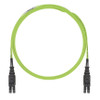
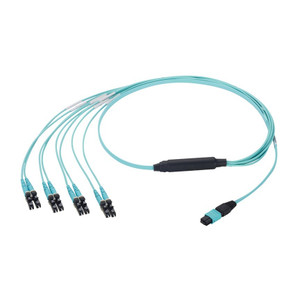
The Panduit FW2ERQ1Q1NNM004 is a pre-terminated MPO fiber trunk assembly engineered for 40G/100G datacenter spine-leaf architectures and high-density structured cabling deployments. This 4-meter assembly features MPO-to-MPO connectors with Method B polarity (key-up to key-down straight-through mapping), OM4 multimode fiber, and low-loss elite connector terminations factory-tested to exceed TIA-568.3-D insertion loss requirements. Built for rapid deployment in enterprise datacenters, colocation facilities, and storage area networks, this trunk eliminates field termination labor and provides guaranteed optical performance out of the box. Panduit's precision factory assembly process ensures <0.25 dB insertion loss per connector and <0.5 dB total channel loss, critical for 40GBASE-SR4 and 100GBASE-SR4 error-free transmission at full link distances. The LSZH jacket meets international flame and smoke requirements for plenum and riser installations.
Key Features
- MPO-to-MPO 12-fiber trunk with Method B (Type B) polarity — key-up to key-down configuration eliminates guesswork in parallel optics deployments
- OM4 laser-optimized 50/125 μm multimode fiber supports 100G to 150m and 40G to 400m per IEEE 802.3ba specifications
- Factory-terminated with Panduit elite MPO connectors — <0.25 dB insertion loss, <0.5 dB total assembly loss guaranteed
- 4-meter assembly length ideal for top-of-rack to end-of-row switch interconnects and cross-aisle aggregation links
- LSZH (Low Smoke Zero Halogen) aqua jacket — Euroclass B2ca, IEC 60332-3-24 compliant for international installations
- 100% factory tested with OTDR traceable certification — insertion loss, return loss, and length documented per assembly
- 2.0mm round trunk cable with aramid strength members — 20x bend radius compliance, pull tension rated to 100N
- Push-pull boot design with integrated strain relief — maintains <0.5 dB loss under 50-cycle mating durability testing
This trunk assembly addresses the core challenge in modern datacenter fiber infrastructure: delivering predictable, low-loss optical paths at scale while maintaining polarity integrity across hundreds or thousands of parallel fiber links. Traditional field-terminated MPO connectors introduce variability in insertion loss (0.3–0.75 dB typical), endface geometry defects, and polarity mapping errors that create costly troubleshooting cycles during turn-up. Panduit's factory process uses automated endface inspection (passing IEC 61300-3-35 geometry criteria), interferometric loss testing at 850nm and 1300nm wavelengths, and serialized documentation that ties each assembly to specific test results. For integrators deploying 40G or 100G leaf switches with MPO-based QSFP+ or QSFP28 transceivers, this translates to plug-and-light reliability — the assembly ships with insertion loss already validated below the IEEE 802.3ba channel budget, leaving margin for patch cord connections and any in-line adaptation. The Method B polarity configuration (also called Type B or ANSI/TIA-568-C.0 Array B) is the dominant standard for enterprise structured cabling: position 1 on the transmit end maps to position 12 on the receive end, enabling straight-through trunk cables to pair with standard duplex breakout cassettes or harnesses without crossover adapters. This eliminates the polarity translation step that trips up installers accustomed to duplex LC infrastructures.
The OM4 fiber core provides the bandwidth-distance product required for current 40G/100G optics and future 200G/400G migration paths. At 850nm (the wavelength used by cost-effective VCSEL-based SR transceivers), OM4 delivers 4700 MHz·km modal bandwidth compared to 2000 MHz·km for OM3, extending 100GBASE-SR4 reach from 100m to 150m and enabling campus backbone distances without stepping up to single-mode infrastructure. The 50 μm core diameter matches SR/SR4/SR10 transceiver launch conditions, minimizing differential mode delay (DMD) that causes intersymbol interference at multi-gigabit data rates. For SAN fabrics running 32G Fibre Channel, OM4 supports full 150m distances per FC-PI-6 specifications, critical for geographically dispersed storage arrays in large enterprise datacenters. The laser-optimized graded-index profile also future-proofs installations for BiDi (bidirectional) 100G optics that will push OM4 to 200m+ in coming transceiver generations. Installers working in mixed-generation environments appreciate the backward compatibility: this trunk works equally well with 10G SFP+ SR optics (supporting 400m links) and legacy 1G SX modules, allowing phased technology refresh without ripping out horizontal cabling infrastructure.
Physical installation considerations center on maintaining the 2.0mm trunk cable's minimum bend radius and managing MPO connector endface protection. The 20x bend radius (40mm minimum dynamic, 30mm static per TIA-568.3-D) is tighter than traditional 12-fiber distribution cables, enabling routing through 1U horizontal cable managers and around tight corners in high-density racks without kinking. Panduit uses aramid yarn strength members and a ruggedized outer jacket to handle the pulling forces encountered when fishing cables through vertical pathways or wire basket tray — the 100N tension rating accommodates installation loads far exceeding the 20N operational maximum, providing margin for real-world deployment conditions. The push-pull boot design is critical for maintenance: datacenter techs can disconnect MPO trunks from QSFP cages or patch panels with one-handed operation, and the boot's integral strain relief prevents the installer from grabbing the exposed fiber ribbon during moves/adds/changes (a common failure mode that causes fiber fractures invisible to the naked eye but catastrophic to link budgets). The aqua LSZH jacket color-coding follows the OM4 industry standard (TIA-598-D), ensuring instant visual identification during troubleshooting and preventing accidental cross-connection with OM3 (aqua vs. cyan) or single-mode (yellow) infrastructure. International projects requiring EN 50575 CPR compliance will appreciate the B2ca flame rating and halogen-free formulation that limits toxic gas emission during fire events — a mandate in EU member states for permanent installations in occupied spaces.
Testing and certification workflows leverage Panduit's factory test reports to streamline acceptance processes. Each assembly ships with a serialized test report documenting insertion loss (bidirectional, all 12 fibers), return loss, and physical length measured via OTDR. Installers can present these reports directly to commissioning engineers or building inspectors to satisfy TIA-526-14-B Tier 1 certification requirements without re-testing, saving hours on large projects with hundreds of trunk cables. For deployments requiring Tier 2 certification (full channel characterization including OTDR event maps), the factory test baseline provides a known-good reference: any installed channel showing >0.5 dB higher loss than the trunk's factory spec indicates a problem with patch cords, cassettes, or mating connections rather than the trunk itself, dramatically reducing fault isolation time. The test wavelengths (850nm and 1300nm) cover both OM4's primary operating window and the secondary wavelength used by some 10G LRM (long-reach multimode) optics, ensuring compatibility across diverse transceiver ecosystems. Length accuracy to ±0.5m helps cable management planning — at 4 meters, this trunk suits top-of-rack to middle-of-row aggregation switches in standard 42U rack layouts, with enough slack for service loops but not so much that excess cable creates airflow obstructions in hot aisle/cold aisle containment designs.
The Panduit FW2ERQ1Q1NNM004 fits deployment scenarios where optical performance, installation speed, and long-term reliability outweigh the marginal cost savings of field termination. Large-scale datacenter builds (50+ racks) benefit from the labor elimination: a single technician can install 20+ factory trunks per hour versus 4–6 field-terminated assemblies, and the consistent sub-0.25 dB connector performance eliminates the tail of high-loss outliers that force rework in field-terminated infrastructures. Colocation providers offering high-density interconnects to multiple tenants gain the documentation trail and repeatable performance needed for SLA compliance. Storage architects designing all-flash NVMe-oF fabrics appreciate the deterministic latency that comes from guaranteed low-loss optical paths — every 0.1 dB of additional loss increases receiver sensitivity requirements and can push marginal links into forward error correction (FEC) territory, adding microseconds of latency that compound across multi-hop storage networks. This assembly provides the foundation for lossless Ethernet (PFC-enabled) and RDMA over Converged Ethernet (RoCE) deployments where optical budget margin directly impacts application-layer performance.