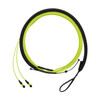
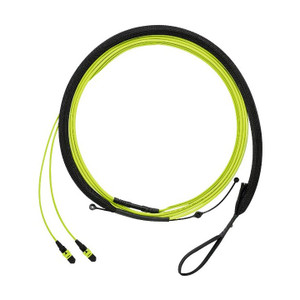
Panduit FWUYL7575LNM026 QuickNet OM5 24-Fiber Trunk Cable Assembly
The Panduit FWUYL7575LNM026 is a 26-meter (85.3 ft) OM5 wideband multimode trunk cable assembly engineered for high-density datacenter spine-leaf architectures and 40/100/400 Gigabit Ethernet migrations. This QuickNet™ SigCore assembly terminates 24 fibers of 50/125 μm OM5 in PanMPO female connectors at both ends, configured for Method B polarity with Ultra Insertion Loss performance. The HD Flex small-diameter construction uses 30-40% less pathway space than conventional trunk designs, solving congestion problems in overhead cable trays, under-raised-floor runs, and zone distribution cabinets where every cubic inch matters. The Low Smoke Zero Halogen (LSZH) jacket meets IEC 60332-3-24 flammability requirements for enclosed spaces, European building codes, and plenum-alternative installations where PVC off-gassing is unacceptable. Datacenter managers deploying 400GBASE-SR8 or planning migration paths to 800 Gigabit optics gain future-proof bandwidth from OM5's extended shortwave wavelength division multiplexing (SWDM) support—four lambda channels over a single fiber pair—without re-cabling backbone infrastructure.
Key Features
- OM5 wideband multimode fiber supports 400GBASE-SR8 at 150m and future 800G SWDM applications without infrastructure replacement
- PanMPO female-to-female connectors with Method B polarity deliver plug-and-play compatibility with QSFP-DD and OSFP transceiver modules
- Ultra Insertion Loss rating guarantees ≤0.35 dB per mated connector pair, preserving link budget on cascaded trunk-to-breakout topologies
- HD Flex small-diameter cable reduces bundle cross-section by 30-40%, freeing congested pathways and improving airflow in hot aisle containment
- LSZH jacket eliminates halogenated combustion products, meeting IEC 60332-3-24 and European EN 50575 CPR Cca-s1a,d1,a1 requirements
- 24-fiber count provisions 12 duplex 40/100G channels or six 4-pair 400G links in a single pull, reducing installation labor and pathway fill
- Lime green OM5-standard jacket color simplifies fiber-type identification during MACs and troubleshooting in mixed OM3/OM4 environments
- Factory-terminated and tested to TIA-604-5 (FOCIS-5) geometry eliminates field-polish variability and back-reflection failures
OM5 fiber is the wideband multimode standard (TIA-492-AAAD, IEC 60793-2-10 Type A1a.3) optimized for shortwave wavelength division multiplexing transmission schemes used in 400 Gigabit and emerging 800 Gigabit parallel optics. Unlike OM3 and OM4, which specify performance at 850 nm only, OM5 guarantees minimum effective modal bandwidth (MEBₑ) across four distinct SWDM wavelengths—850 nm, 880 nm, 910 nm, and 940 nm—enabling BiDi and SWDM transceivers to transmit multiple 100G or 200G channels over a single fiber pair. This multiplexing approach quadruples per-fiber throughput without increasing fiber count, critical when migrating leaf-spine fabrics from 100G to 400G optics within existing 24-fiber trunk infrastructure. A 400GBASE-SR8 link—typically eight fibers at 50 Gbps each—can be collapsed to two fibers at four wavelengths × 100 Gbps using OM5 SWDM modules, cutting required fiber by 75% and extending reach to 150 meters versus 100 meters on OM4. For greenfield datacenter builds planning 10-15 year infrastructure lifespans, OM5 trunk cables eliminate the risk of strand exhaustion when next-generation optics arrive, avoiding costly re-cabling projects that disrupt production traffic and require maintenance windows.
The PanMPO connector system on the FWUYL7575LNM026 is Panduit's precision-ferrule MPO implementation, delivering insertion loss below 0.35 dB per mated pair (Ultra IL grade) versus the 0.75 dB industry baseline. This 0.4 dB margin matters in cascaded topologies—trunk to patch panel to equipment cord—where three mated pairs consume 1.05 dB on standard connectors but only 0.9 dB on Ultra IL components, preserving receiver sensitivity on budget-constrained 400G-DR4 links. Method B polarity configuration (key-up to key-down) aligns with QSFP-DD and OSFP transceiver pinouts, enabling direct trunk-to-transceiver connection via MPO equipment cords without polarity-flip adapters or crossover modules. The female-to-female termination pairs with standard male MPO breakout cassettes and patch cords, fitting into TIA-568 structured cabling channel topologies. Each connector endface is factory-inspected for geometry compliance to TIA-604-5 FOCIS-5 radius-of-curvature and apex-offset specifications, eliminating the 30-50% field-termination failure rate caused by improper hand-polishing technique, contaminated consumables, or undertrained installers. Panduit ships these assemblies with removable dust caps and sealed packaging to prevent installation-site contamination from skin oils, airborne particulates, and construction dust—common causes of elevated insertion loss and intermittent link flapping discovered weeks after go-live.
HD Flex cable construction uses a reduced-diameter central strength member and compact buffer tube arrangement to shrink overall trunk diameter by 30-40% compared to traditional round-jacket designs. A standard 24-fiber trunk occupies roughly 0.85 square inches of cross-sectional area; this HD Flex variant drops to approximately 0.55 square inches, freeing 35% more usable space in 4-inch cable tray and under-floor conduit runs. In hyperscale datacenters running 400+ fiber connections per rack, that density gain translates to an additional 8-12 trunk cables per pathway before hitting NEC Article 392 40% fill limits—or improved airflow when pathway utilization stays constant. The smaller bend radius (typically 10× cable diameter loaded, 5× unloaded) also simplifies routing around tight cabinet corners, behind vertical cable managers, and through horizontal cross-connect knock-outs without violating the 15× minimum bend radius that triggers elevated attenuation or fiber stress failures. Installers working in retrofit scenarios—adding 400G capacity to five-year-old datacenters where every pathway is 90% full—can often fish HD Flex trunks through existing conduit without pulling older cables, avoiding the multi-day downtime and fiber-cut risk of a complete re-cable project.
The LSZH jacket formulation on the FWUYL7575LNM026 meets Low Smoke Zero Halogen flammability and toxicity standards including IEC 60332-3-24 (vertical flame spread), IEC 61034 (smoke density), and IEC 60754 (halogen acid gas content). When exposed to fire, LSZH jackets produce <0.5% hydrogen chloride and hydrogen fluoride by mass, versus 25-30% HCl from PVC cables, reducing corrosive damage to electronic equipment, structural steel, and copper grounding systems during fire suppression. Smoke transmittance remains above 60% versus 10-20% for PVC, preserving visibility for evacuation and firefighting in enclosed equipment rooms and under-floor spaces. European Union construction products regulation EN 50575 mandates Cca-class cables or better for permanent datacenter installations; this assembly's LSZH rating satisfies that requirement without needing plenum (CMP) certification, which costs 40-60% more and uses fluoropolymer jackets with stiffer bend characteristics. North American installations in return-air spaces, above T-bar ceilings, or inside air-handling equipment rooms still require CMP rating per NEC Article 770, but LSZH serves as the plenum alternative in mechanical rooms, electrical vaults, and IDF closets where air circulation is isolated from building HVAC—common in colocation facilities and enterprise server rooms with dedicated CRAC units.
This 26-meter length suits typical datacenter row distributions: main distribution area (MDA) to end-of-row (EOR) switch runs in pods with 15-20 meter aisle spans, vertical riser drops from second-floor meet-me rooms to ground-floor equipment rows, or cross-connect jumpers in large telco central offices where equipment lineups stretch 60-80 feet. The 24-fiber count provisions 12 duplex channels for 40GBASE-SR4 or 100GBASE-SR4 links, six 4-pair channels for 400GBASE-SR8 connections, or three 8-pair channels for future 800GBASE-SR8 deployments. In spine-leaf fabrics, one trunk typically supports two leaf switches (each consuming 12 fibers for six uplinks) or handles six 100G server connections via MPO-to-LC breakout cassettes mounted in the leaf switch enclosure. QuickNet system integration means this trunk pairs with Panduit's pre-terminated fiber cassettes, angled LC adapters, and high-density fiber enclosures without mix-and-match polarity conflicts—Method B trunk to Method B cassette to duplex LC patch cord maintains transmit-to-receive alignment across the channel. For teams managing multi-vendor environments, the PanMPO connector is mechanically compatible with generic MPO/MTP components per IEC 61754-7, though mixing connector grades (Elite vs. Ultra IL) in a single channel degrades overall insertion loss to the lowest-performing component's specification.
Factory testing and certification eliminate the two most common field-termination failures: endface geometry defects (scratches, pits, chips from improper polishing) and incorrect fiber mapping (pair 1 transmit wired to pair 2 receive). Each assembly ships with an insertion-loss test report documenting performance at 850 nm across all 24 fibers, typically showing 0.2-0.3 dB per connector and ≤0.5 dB for the full cable span—well within TIA-568-C.3 permanent link budgets of 1.5 dB for OM5 at 100 meters. Return loss exceeds 20 dB, preventing back-reflected light from destabilizing laser diodes in 100G and 400G transceivers that operate near threshold margins. Polarity verification confirms Method B pin mapping: fiber 1 position A side maps to fiber 12 position B side, fiber 2A to 11B, continuing the crossover pattern required for duplex transmission. This factory validation backs a manufacturer warranty covering material and workmanship defects, though the warranty does NOT cover installation damage (kinked fibers from over-tightening cable ties, crushed jackets from rack edges, contaminated endfaces from capless storage) or environmental exposure (UV degradation on outdoor-rated cable used indoors, moisture ingress in non-sealed enclosures)—common misapplication scenarios that void coverage and require expensive post-install rework.
Deployment begins with pathway survey and pull-tension calculation: the 26-meter length and LSZH jacket generate approximately 12-15 lbs pull tension in straight horizontal runs with three 90-degree bends, staying below the 50 lb maximum rated pulling force. Use Panduit's swivel pulling grip (or equivalent mesh grip) attached to the jacket—never pull on the exposed connectors, which can crack the ferrule or dislocate fiber positions inside the MT ferrule. Route the assembly with service loops (1-2 meters) at each termination point for future re-termination or equipment relocation, coiling the loop with a minimum 8-inch diameter to avoid microbend attenuation. Secure the trunk every 4-5 feet with hook-and-loop cable ties or J-hooks; avoid plastic zip ties tightened past snug, which create pinch points that elevate loss by 0.3-0.5 dB and become permanent stress concentrators. In vertical riser shafts exceeding 15 feet, install cable support clamps or wire-basket supports every 10 feet to prevent jacket creep and fiber sag that can exceed the cable's rated tensile load over months. Before mating connectors into cassettes or equipment, inspect each endface with a 200× fiber microscope or automated inspection probe: reject any endface showing scratches crossing the core region, particles larger than 5 μm, or epoxy smears occluding more than 10% of the core. Clean all endfaces—even factory-capped—using a dry-wipe cassette cleaner or lint-free wipes dampened with 99% isopropyl alcohol, confirming cleanliness with a second inspection before insertion. Contamination introduced during installation accounts for 70-80% of post-deployment insertion loss failures and intermittent link flaps that resist troubleshooting because they clear temporarily when connectors are reseated.
This assembly meets or exceeds TIA/EIA-568-C.3 (commercial building telecommunications cabling for optical fiber), ISO/IEC 11801 (generic cabling for customer premises), TIA-492-AAAD (OM5 fiber performance), TIA-604-5 FOCIS-5 (MPO connector intermateability), IEC 60793-2-10 Type A1a.3 (multimode fiber standards), and RoHS 2011/65/EU (lead, mercury, cadmium restrictions). The LSZH jacket formulation complies with IEC 60332-3-24 Category C vertical flame test, IEC 61034-2 smoke density ≤60% obscuration, and IEC 60754-1 halogen acid gas content ≤0.5%. For hyperscale and colocation facilities pursuing LEED certification or EU Green Building standards, the halogen-free construction and RoHS material compliance contribute to indoor air quality credits and hazardous-substance reduction goals. Note that LSZH rating does NOT equal plenum (CMP) certification under NEC Article 770.113—use this assembly in non-plenum spaces or verify local AHJ interpretation if installing in return-air pathways; CMP-rated versions carry different Panduit model numbers and typically cost 50-70% more. Installations in seismic zones (California, Pacific Northwest, Japan datacenter extensions) should verify that mounting hardware and cable support systems meet local seismic bracing requirements—the cable itself is compliant, but improperly supported horizontal runs can swing during seismic events and generate enough pull force to crack MT ferrules or dislodge fibers from connector positions, causing post-earthquake link failures that delay facility recovery.