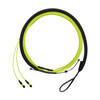
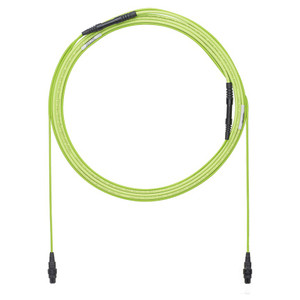
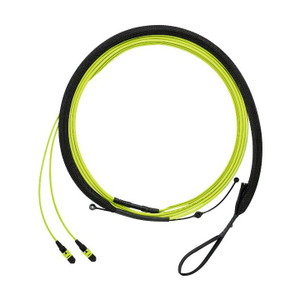
Panduit FWUYL7575LNM019 QuickNet 24-Fiber OM5 Trunk Cable Assembly
The Panduit FWUYL7575LNM019 is a 19-meter QuickNet trunk cable assembly engineered for data centers where rack density, extended reach, and fast deployment intersect. This 24-fiber OM5 trunk uses small-diameter construction that occupies 30 to 40 percent less pathway space than conventional assemblies—critical when you're threading dozens of trunks through congested overhead trays or under raised floors. OM5 wideband multimode fiber supports 40G/100G short-reach links today and positions your infrastructure for 200G/400G migrations without a cable pull. LSZH jacketing meets low-smoke, zero-halogen flammability requirements for enclosed spaces and international fire codes. Factory-terminated connectors eliminate field splicing labor and the risk of contamination or poor insertion loss that comes with on-site terminations.
Key Features
- 24-fiber OM5 wideband multimode trunk—50 µm core supports 40GBASE-SR4, 100GBASE-SR4, and future 200G/400G short-reach optics over extended distances compared to OM3/OM4
- 19-meter (62.33 ft) length covers typical row-to-EOR (end-of-row) or rack-to-MDA (main distribution area) spans in modular data centers
- Small-diameter trunk construction saves 30–40% conduit and tray fill compared to loose-tube or tight-buffered cable bundles—reduces congestion in high-density pathways
- Lime jacket color simplifies visual trunk identification and polarity management in multi-tier spine-leaf fabrics
- LSZH (low smoke zero halogen) flammability rating—required for plenum-equivalent installations under NFPA, IBC, and international building codes; reduces toxic fume risk during fire events
- Factory-terminated and tested—ships ready to deploy with guaranteed insertion loss and return loss performance; eliminates field splicing time and contamination risk
- QuickNet rapid-deploy system—modular trunk design integrates with Panduit cassettes, enclosures, and breakout modules for plug-and-play MTP/MPO to LC or SC fan-outs
- Meets TIA-568-C.3, ISO/IEC 11801, TIA-492-AAAD (OM5 fiber specification), IEC 60793-2-10 A1a.3, and RoHS compliance—supports procurement requirements for federal, healthcare, and enterprise data center projects
The FWUYL7575LNM019 trunk addresses a specific data center install challenge: how to scale port density in confined spaces without triggering costly pathway upgrades. Traditional tight-buffered 12-fiber or 24-fiber bundles consume 8–10 mm of tray width per trunk; Panduit's small-diameter design drops that to 5–6 mm, letting you fit 40–50% more trunks in the same 4-inch ladder rack or 2-inch conduit. That margin matters when you're adding leaf switches mid-lifecycle or densifying rows without ripping out existing cable trays. The 19-meter length is purpose-cut for the 15–18 meter horizontal runs common in co-location facilities and hyperscale pods—long enough to reach from a middle-of-row (MOR) switch to an EOR aggregation switch with service loop, short enough to avoid the 1 dB insertion-loss penalty you'd see on a 30-meter trunk.
OM5 wideband multimode fiber (850–950 nm wavelength window) is the critical upgrade path component here. Unlike OM3 (300 m at 40G) or OM4 (400 m at 100G), OM5 supports short-wavelength division multiplexing (SWDM), which lets 100GBASE-SR4 transceivers reach 150 meters and sets you up for 200G/400G optics that use four wavelengths per fiber pair instead of parallel 12-fiber or 24-fiber ribbons. If you're deploying 100G leaf-spine fabrics now with an eye toward 400G spines in three years, OM5 trunks let you reuse the physical layer—you swap transceivers and cassettes but leave the backbone in place. The lime jacket is more than color-coding: in a structured cabling plan, lime typically denotes OM5 per TIA-598-D, so techs doing MACs (moves, adds, changes) can visually distinguish OM5 trunks from aqua OM3 or erika violet OM4 without pulling cable tags. That reduces the chance of plugging an OM5-dependent 200G transceiver into a legacy OM3 backbone and seeing link errors or reduced reach.
QuickNet is Panduit's modular pre-terminated system: the trunk terminates in MTP (multi-fiber push-on) connectors—typically MTP-24 or MTP-12 depending on breakout strategy—that mate with QuickNet cassettes or breakout modules in your EOR or MDA enclosure. A single MTP-24 trunk fans out to 12 duplex LC ports via a cassette, giving you 12 usable 100G links (or 24×10G links if you're using bidirectional optics). Factory termination guarantees <0.35 dB insertion loss per mated connection and eliminates the field labor and test time you'd spend fusion-splicing individual fibers. In a 500-port leaf deployment, pre-terminated trunks can cut installation time from three weeks (field splicing) to three days (plug-and-play), and you avoid the $15,000–25,000 cost of a fusion splicer, cleaver, and OTDR test set plus the training overhead to keep techs certified.
LSZH jacketing is the fire-safety and regulatory compliance piece. Low-smoke, zero-halogen compounds produce <5% light-obscuration smoke and <0.5% hydrogen chloride gas under combustion—critical in enclosed data halls where smoke can't vent and personnel egress paths are limited. NFPA 70 (NEC Article 770) and IBC Section 2702 both restrict halogenated cables in air-handling spaces; LSZH satisfies those requirements without needing metallic conduit (which adds cost and reduces airflow). International projects—particularly in EU, APAC, and Middle East markets—often mandate LSZH under IEC 60332 or EN 50399 CPR (Construction Products Regulation) Euroclass ratings; specifying LSZH at design phase avoids the retrofit cost of swapping out PVC-jacketed cable after the AHJ (authority having jurisdiction) flags it during final inspection. The trunk's compliance with TIA-568-C.3, ISO/IEC 11801, and TIA-492-AAAD means it fits structured cabling standards for commercial buildings, so you can use it in mixed-use facilities (data center plus office or lab space) without bifurcating your cable plant.
This trunk is sized and specified for integrators deploying or expanding leaf-spine fabrics in co-lo, enterprise on-prem, or edge data centers where pathway space is the long-pole constraint. The 19-meter length, OM5 future-proofing, and small-diameter profile make it the right fit when you need to thread new 100G uplinks through an existing 70%-full cable tray without triggering a tray expansion project—or when you're building out a new pod and the electrical engineer has already allocated your 4-inch ladder rack based on old OM3 fill ratios, leaving you no room to add unplanned capacity mid-year.