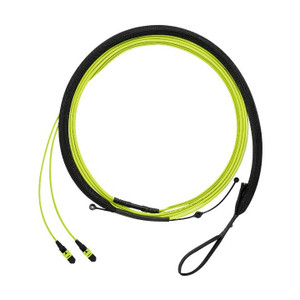
Panduit FWUYL7575KAM081 OM5 24-Fiber Trunk Cable Assembly
The Panduit FWUYL7575KAM081 is an 81-meter OM5 wideband multimode fiber trunk assembly engineered for high-density data center deployments requiring extended reach and future-proof bandwidth. This 24-fiber QuickNet trunk uses PanMPO female connectors on both ends, Low Smoke Zero Halogen (LSZH) jacketing, and Panduit's HD Flex transition design to address the core challenges integrators face: tight pathway congestion, fire-code compliance in enclosed equipment spaces, and the need to support 40G/100G parallel optics today while preserving headroom for 400G migration. The lime-jacketed assembly ships with a pulling eye on one end and delivers Ultra Insertion Loss performance across all 24 fibers, making it suitable for spine-leaf architectures, cross-connect trunking between MDA and HDA spaces, and multi-floor riser runs where OM4's 150-meter reach at 100G falls short.
Key Features
- OM5 Wideband Multimode Fiber: 50μm core optimized for 850–950nm shortwave wavelength division multiplexing (SWDM), delivering 4× the effective bandwidth of OM4 over the same fiber count — critical for 400G and future 800G optics using SWDM4 lane distribution.
- 24-Fiber PanMPO-to-PanMPO Configuration: Dual female PanMPO connectors support 12-lane or 24-lane parallel optics breakout, enabling six duplex 40G links, three 100G links, or a single 400G SR8 connection per QSFP-DD transceiver requirements.
- 81-Meter Extended Reach: Spans typical inter-floor distances (3–6 floors) or cross-campus data center links without intermediate patching, reducing failure points and simplifying fault isolation compared to multi-segment horizontal runs.
- LSZH Jacket for Enclosed Spaces: Meets IEC 60332-1 and 60754 low-smoke, halogen-free flame and toxicity requirements mandated by NFPA 90A for plenum-equivalent spaces, critical for air-handling pathways and equipment rooms where PVC off-gassing is prohibited.
- QuickNet HD Flex Design: Small-diameter trunk construction (30–40% space reduction vs. standard assemblies) with optimized bend-radius tolerance allows routing through congested 4" ladder rack and behind 42U racks without risking macrobend attenuation.
- Method A Polarity: TIA-568-C.0 Annex A keying aligns fiber positions for straight-through parallel optics without requiring polarity-flip adapters or field re-termination — the standard for 40G/100G SR4 and 400G SR8 deployments.
- Ultra Insertion Loss Grade: Factory-terminated and tested to ≤0.35 dB per mated connector pair (typical ≤0.25 dB), ensuring margin for long-haul OM5 links and multi-tier spine topologies where cumulative loss budgets are tight.
- Integrated Pulling Eye: Pre-installed pull cord attachment point on one end simplifies installation through conduit, overhead cable tray, or raised-floor pathways without risking connector damage or jacket deformation during pull tension.
- Lime Jacket Color Coding: TIA-568-C.3 Annex F specified lime green identifies OM5 fiber at a glance, preventing cross-connection errors with OM3 (aqua) or OM4 (magenta) infrastructure during mixed-generation deployments.
- Factory Quality Assurance: Each trunk is continuity-tested, insertion-loss verified, and serialized prior to shipment, with test data available for as-built documentation and baseline link certification to ISO/IEC 14763-3 Tier 2 standards.
OM5 Performance and Bandwidth Advantage: OM5 fiber distinguishes itself from OM3 and OM4 through its optimized effective modal bandwidth (EMB) across the 850–950nm window, a specification formalized in TIA-492-AAAD and IEC 60793-2-10 Type A1a.3. While OM4 delivers 4700 MHz·km EMB at 850nm, OM5 extends that performance across four distinct SWDM wavelengths (850, 880, 910, 940nm), enabling a single fiber pair to carry four independent 100G lanes — functionally quadrupling capacity without adding fiber count. For 400G applications, this means eight fibers (versus OM4's requirement for sixteen fibers in an SR4 breakout) suffice for full-duplex 400G connectivity when using SWDM-capable transceivers. The FWUYL7575KAM081's 24-fiber construction therefore supports three independent 400G links or twelve 100G links in a single trunk pull, addressing the core density challenge in hyperscale and colocation environments where pathway fill is the limiting constraint. The 81-meter length sits between IEEE 802.3ba's 100m OM4 reach limit for 100GBASE-SR4 and the practical realities of multi-floor data center construction — three to six floors of vertical rise plus horizontal distribution typically totals 60–90 meters, making this assembly appropriate for main-to-horizontal cross-connect links without requiring costly OM4-to-singlemode media conversion or additional patch panels.
PanMPO Connector Design and Polarity Management: Panduit's PanMPO connector is an enhanced MPO variant using tighter manufacturing tolerances and an improved ferrule-alignment mechanism to reduce insertion loss variability across the 12- or 24-fiber array. Standard MPO connectors exhibit ±0.15 dB loss variation fiber-to-fiber within a single array; PanMPO targets ±0.10 dB through precision ferrule endface geometry and controlled ferrule-to-housing concentricity. The FWUYL7575KAM081 ships as a female-to-female assembly with Method A polarity, meaning fiber position 1 on end A maps to position 1 on end B (straight-through). In a typical deployment, this trunk connects two Method A adapter panels or cassettes; the cassettes themselves handle transmit-to-receive crossover through internal fiber routing. This architecture prevents the common mistake of using gender-mismatch adapters or polarity-reversal keys in the field, which introduce additional insertion loss (0.3–0.5 dB per mating interface) and create documentation headaches during troubleshooting. For 40G and 100G SR4 optics, each transceiver uses twelve fibers (four transmit lanes, four receive lanes, four unused in a 12-fiber MPO). The 24-fiber trunk therefore supports two independent transceiver connections via breakout to dual 12-fiber legs, or a single 24-fiber breakout for future 400G SR8 applications requiring eight transmit and eight receive lanes. The pulling eye attachment is positioned to trail during installation, keeping the connector ends protected inside protective boots until final termination.
LSZH Compliance and Installation Environment: The Low Smoke Zero Halogen jacket formulation is a hard requirement for installations governed by IEC 60332-3 Category C (vertical flame spread), IEC 60754-1 (halogen acid gas content <0.5%), and IEC 61034 (light transmittance >60% during combustion). These standards map to NFPA 90A plenum-cable requirements in North America and are mandated by building codes in EMEA, APAC, and increasingly in U.S. federal and healthcare facilities. During a fire event, PVC-jacketed cable releases hydrochloric acid gas and dense black smoke, creating life-safety and equipment-damage risks in enclosed spaces; LSZH formulations produce minimal smoke and no corrosive halogens, preserving visibility for egress and preventing acid deposition on sensitive electronics. For data center integrators, this means LSZH trunks can be routed through above-ceiling return-air plenums, under-floor HVAC spaces, and vertical riser shafts without requiring metallic conduit or separate fireproof enclosures — a significant cost and time savings on large deployments. The tradeoff is reduced flexibility at low temperatures (LSZH compounds become stiff below 0°C) and higher material cost; however, for the 81-meter length of the FWUYL7575KAM081, the temperature concern is negligible in climate-controlled data centers, and the per-link cost is justified by the elimination of conduit and associated labor.
High-Density Routing and HD Flex Construction: Panduit's HD Flex trunk design reduces overall assembly diameter by 30–40% compared to traditional round-jacketed or zip-cord trunk constructions, achieved through tighter buffer-tube packing and a lower-profile outer jacket. For a 24-fiber trunk, this translates to an outer diameter of approximately 8–10mm versus 14–16mm for legacy designs. The practical impact: a standard 4-inch-wide ladder rack or vertical manager can accommodate 50–70% more trunks before exceeding NEC Article 300.17 conduit fill limits or introducing service-loop management problems. In high-density top-of-rack or end-of-row switch deployments, where a single 1U switch may require 12–24 trunk connections for full 40G or 100G uplink population, the reduced diameter is the difference between manageable cable dressing and a rat's nest that obstructs airflow and violates the 1-inch clearance minimums many manufacturers specify for intake vents. The HD Flex jacket also incorporates a controlled bend-radius design that maintains <0.1 dB macrobend loss at a 15mm radius (versus the 30mm minimum for standard OM5 cable), allowing trunks to navigate 90-degree turns inside 2U horizontal managers or behind rack-mount patch panels without risking attenuation spikes that degrade link margin.
This trunk assembly is built for integrators deploying 40G/100G leaf-spine fabrics, storage-area-network extensions across campus data centers, or backbone links in enterprise core networks transitioning from 10G to 25G/100G server connectivity. The 81-meter length is particularly relevant for facilities with multiple equipment rooms per floor or split main-distribution and horizontal-distribution-area architectures, where a single trunk pull eliminates intermediate cross-connects and their associated failure points. When combined with Panduit's FHD or FHDX cassette systems, the FWUYL7575KAM081 enables rapid 12-fiber or 24-fiber breakout to LC duplex patch cords at the equipment end, supporting mixed 10G/25G/40G/100G transceiver populations without requiring different trunk types. The assembly ships with factory-installed dust caps on both PanMPO connectors and includes a serialized test report showing per-fiber insertion loss, return loss, and length measurements traceable to NIST-calibrated OTDR and light-source test equipment, providing the documentation needed for TIA-568-C.1 Administration Standard labeling and ISO/IEC 14763-3 Tier 2 acceptance testing. The lime jacket color is a visual QA step: if you see aqua (OM3) or magenta (OM4) in a pathway designated for OM5, the color mismatch flags a provisioning error before transceivers are installed and link failures occur.