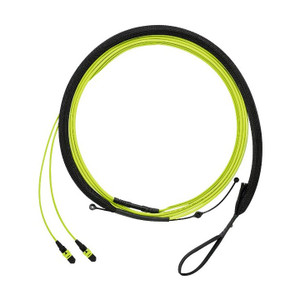
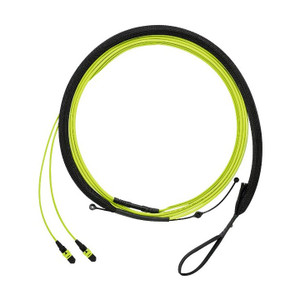
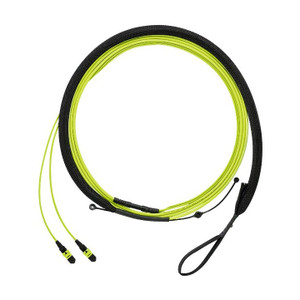
Panduit FWUYL7575KAM079 QuickNet OM5 24-Fiber Trunk Cable Assembly
The Panduit FWUYL7575KAM079 is a 79-meter OM5 trunk cable assembly engineered for high-density datacenter backbone installations where extended reach and rapid deployment are critical. Part of the QuickNet platform, this 24-fiber LSZH trunk features PanMPO female connectors on both ends with Method A polarity and ultra insertion loss performance, delivering reliable 40G/100G connectivity in a reduced-diameter form factor that consumes 30-40% less pathway space than traditional trunk designs. The lime jacket provides instant visual identification in structured cabling environments, while the integrated pulling eye simplifies installation through conduit or cable trays.
Key Features
- OM5 wideband multimode fiber supports shortwave wavelength division multiplexing (SWDM) for 40G/100G applications up to 440 meters
- 24-fiber count in a single trunk assembly reduces connector footprint and simplifies backbone patching
- PanMPO female-to-female connectors with Method A polarity ensure plug-and-play compatibility with datacenter standards
- Ultra insertion loss specification delivers maximum optical budget for extended-reach applications
- Low Smoke Zero Halogen (LSZH) jacket meets international fire safety requirements for enclosed spaces
- HD Flex Transition cable construction uses 30-40% less space than standard trunks, critical for high-density cable management
- 79-meter length provides backbone connectivity between distribution areas without mid-span splicing
- Lime jacket color aligns with TIA-598 OM5 identification standards for immediate fiber type recognition
- Integrated pulling eye on one end simplifies installation through conduit and overhead pathways
- Factory-terminated and tested to ISO/IEC 11801 and TIA-568-C.3 standards for guaranteed performance
The FWUYL7575KAM079 leverages OM5 fiber (ISO/IEC 11801 designation) with 50-micron core diameter and extended bandwidth optimization across the 850nm to 950nm spectrum. Unlike OM3/OM4 fibers optimized for a single 850nm window, OM5's wideband performance enables shortwave wavelength division multiplexing (SWDM), where four separate wavelengths (850nm, 880nm, 910nm, 940nm) transmit simultaneously over the same fiber pair. This allows a single OM5 duplex link to carry 40 Gbps (4×10G) or 100 Gbps (4×25G) using BiDi transceivers, quadrupling effective capacity without additional fiber strands. For datacenter operators migrating from 10G to 40G/100G, OM5 extends multimode reach to 440 meters at 40G and 150 meters at 100G—roughly double the OM3 distance and 50% beyond OM4—deferring the need for costly single-mode infrastructure or active equipment upgrades in mid-sized facilities.
The PanMPO connectors (Panduit's implementation of the MPO/MTP interface defined in TIA-604-5/FOCIS-5) house 12 fibers per connector in a single rectangular ferrule, meaning this 24-fiber trunk uses two 12-fiber rows within each PanMPO housing. Method A polarity—the industry-standard configuration for trunk-to-trunk or trunk-to-cassette connections—ensures that fiber position 1 on end A maps to position 1 on end B, maintaining straight-through transmit/receive pairing when used with Method A breakout cassettes or patch panels. The female (socket) interface on both ends is the standard datacenter trunk configuration: male (pinned) jumpers connect equipment to cassettes, while female trunks link cassettes to each other or to backbone panels, preventing accidental endface contact during handling. Ultra insertion loss certification guarantees that each fiber pair in this assembly meets stringent attenuation specs—typically ≤0.35 dB per mated pair for OM5 MPO connections—preserving optical budget for transceivers operating near their sensitivity thresholds. With 24 fibers available, a single trunk supports twelve duplex 40G links, six duplex 100G links, or twenty-four simplex 10G links, depending on transceiver population. Factory termination and testing eliminate the field labor and variability associated with on-site splicing or connectorization, while Panduit's HD Flex Transition cable design uses a reduced-diameter jacket (typically 5-6mm versus 8-10mm for legacy trunks) that increases conduit fill capacity and airflow in congested pathways.
In modern hyperscale and enterprise datacenters, the 79-meter length of the FWUYL7575KAM079 addresses the common backbone scenario between main distribution area (MDA) and intermediate distribution area (IDA) or between IDAs on the same floor but separated by hot/cold aisle architecture. Standard structured cabling horizontal limits (90 meters for twisted pair, 100 meters total channel) do not directly apply to multimode fiber, but datacenter operators typically design backbone segments in 30m, 50m, 70m, and 100m increments to match building column grids and row spacing. The 79-meter option covers the middle ground—longer than a simple cross-connect but shorter than a full floor-to-floor vertical riser—fitting deployments where equipment rows are separated by security cages, cooling plenums, or underfloor/overhead pathway restrictions. The 30-40% space savings delivered by HD Flex Transition construction directly impacts pathway utilization. A traditional 24-fiber round trunk might consume 10mm of diameter; this assembly uses roughly 6-7mm, meaning you can fit nearly double the fiber count in the same 4-inch conduit or cable tray without exceeding NEC fill ratios (40% for three or more cables). In retrofit scenarios—adding 100G uplinks to an existing 10G fabric without ripping out infrastructure—the reduced diameter allows new OM5 trunks to share pathways with legacy OM3 cabling, avoiding the costly ceiling tile removal, conduit replacement, and occupancy disruptions that come with pathway expansion projects.
The LSZH jacket is non-negotiable for datacenters in jurisdictions following IEC standards (Europe, Asia-Pacific, Middle East) and increasingly common in North American facilities seeking LEED certification or operating under local fire marshal requirements for enclosed IT spaces. Unlike PVC, which releases hydrochloric acid and dense black smoke when burning, LSZH compounds produce minimal smoke and no halogenated gases, improving visibility for evacuation and reducing corrosive damage to electronics in adjacent racks during a fire event. The lime color—standardized in TIA-598 Appendix C for OM5 identification—allows technicians to distinguish OM5 trunks from aqua (OM3/OM4) or orange (OM1/OM2) cables at a glance during MAC (move/add/change) work, preventing mismatched fiber types that would violate optical budgets and void transceiver warranties. The integrated pulling eye on one end is a practical installation aid often overlooked in spec comparisons. When routing this 79-meter assembly through multiple j-hooks, cable trays, or innerduct, the pulling eye attaches to a pull rope or fish tape, distributing tensile load across the cable's strength members rather than stressing the connectors or fiber strands. Panduit specifies maximum pulling tension (typically 200-300 lbf for this cable diameter) and minimum bend radius (typically 10× cable OD during installation, 5× OD at rest) in the installation guide; the pulling eye ensures installers can meet these limits without improvising tape or wire wraps that might compress the jacket or kink the fibers.
The FWUYL7575KAM079 ships with full compliance documentation for ISO/IEC 11801 (global structured cabling), TIA-568-C.3 (North American optical fiber), TIA-492-AAAD (OM5 fiber performance), IEC 60793-2-10 Type A1a.3 (fiber geometry), and RoHS (hazardous substance restrictions), covering the regulatory bases for multinational deployments and government contracts. For datacenter architects planning a 40G/100G spine-leaf fabric refresh, this 79-meter trunk length paired with OM5's extended reach means you can maintain two-tier architectures (leaf-spine) without needing three-tier (leaf-aggregation-core) or jumping to single-mode fiber—deferring both the capex of SM transceiver optics (typically 3-5× the cost of SR4 multimode) and the precision cleaning/inspection overhead that single-mode endfaces demand. The 24-fiber count aligns with common breakout cassette configurations (2×12-fiber MPO to 24×LC duplex), so a single trunk feeds a full cassette, a full 1RU patch panel, or six duplex 100G uplinks with zero strand waste—eliminating the dark fiber overhead and pathway congestion that comes from overprovisioning 48F or 72F trunks in right-sized deployments.