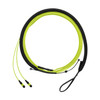
Panduit FWUYL7575KAM039 QuickNet OM5 24-Fiber Trunk Cable Assembly
The Panduit FWUYL7575KAM039 is a 24-fiber OM5 trunk cable assembly engineered for high-density data center backbone deployments requiring extended reach and future-proof bandwidth. Built on wideband multimode OM5 fiber (50/125µm), this 39-meter trunk supports short-wave division multiplexing (SWDM) across the 850-950nm spectrum, delivering four times the effective bandwidth of OM4 over the same fiber count. PanMPO female connectors terminate both ends with Method A polarity mapping, enabling direct trunk-to-breakout cassette connections without field polarity reversals. The Ultra Insertion Loss rating guarantees ≤0.35 dB per mated connector pair, critical for 40GBASE-SR4, 100GBASE-SR4, and emerging 400GBASE-SR8 optics operating near link-budget limits. HD Flex Transition construction reduces cable diameter by 30-40% compared to traditional 24-fiber trunks, reclaiming pathway fill and airflow capacity in congested overhead cable trays and zero-U vertical managers. Low Smoke Zero Halogen (LSZH) jacketing meets IEC 60332-1 and 60754 flame/toxicity standards for European and Asia-Pacific data centers where PVC is prohibited, and qualifies for U.S. plenum spaces under NFPA 90A when installed per AHJ approval. A factory-installed pulling eye on one end simplifies long-distance cable pulls through conduit and innerduct without stressing the connector boot or fiber bend radius. Lime-green jacket color provides instant OM5 visual identification per TIA-598-D, preventing accidental cross-patching with OM3/OM4 infrastructure during adds, moves, and changes.
Key Features
- OM5 wideband multimode fiber (50/125µm) supports SWDM 40G/100G/400G optics across 850-950nm with 4× effective bandwidth versus OM4
- 24 fibers in 12-pair trunk configuration handle 2× 100GbE links or 1× 400GbE SR8 connection in single cable pull
- PanMPO female to PanMPO female connectors with Method A polarity for standards-compliant trunk-to-cassette patching without field conversion
- Ultra Insertion Loss ≤0.35 dB per connector pair maximizes link budget for 100m+ SR4/SR8 reaches and low-power optics
- HD Flex Transition small-diameter design saves 30-40% pathway space versus conventional 24F trunks
- LSZH jacket meets IEC 60332-1 / 60754 for low smoke/toxicity in international facilities and U.S. plenum applications per AHJ
- Factory pulling eye on one end enables damage-free installation through conduit, innerduct, and cable tray radius bends
- Lime color per TIA-598-D instantly identifies OM5 fiber, preventing OM3/OM4 cross-connects
- 39-meter (127.95 ft) length suits intra-row, row-to-EOR, and vertical riser runs in enterprise data centers
- TIA-568-C.3 and ISO/IEC 11801 compliance with RoHS material restrictions for global deployment
OM5 fiber (ISO/IEC 11801 Category OM5, TIA-492-AAAD) extends the multimode roadmap by introducing wideband performance across 850nm, 880nm, 910nm, and 950nm wavelengths. Traditional OM3/OM4 fiber optimizes for 850nm VCSELs only; OM5's flatter attenuation and bandwidth profile across the full SWDM window allows a single 24-fiber trunk to carry four wavelengths per fiber pair—effectively multiplying capacity to 96 logical channels without adding physical fibers. This pays immediate dividends in 100GBASE-SR4 links (4× 25G lanes) and becomes essential for 400GBASE-SR8 (8× 50G lanes) where IEEE 802.3cm specifies SWDM as the multimode migration path beyond 100m. The FWUYL7575KAM039's 39-meter length falls well within OM5's 400G reach spec (150m for SR8), providing comfortable margin for insertion loss, splice loss, and connector cleaning cycles. Integrators deploying spine-leaf fabrics, storage area networks, or GPU cluster interconnects gain 5-10 years of optical bandwidth headroom while reusing existing 50µm termination hardware and test equipment. The Ultra Insertion Loss classification—Panduit's tightest factory spec—comes from automated interferometric inspection of every connector endface, ensuring ≤0.35 dB typical loss versus the 0.75 dB maximum allowed by TIA-604-5. In 100m SR4 links budgeted at 1.5-1.9 dB total channel loss, that 0.4 dB difference is the margin between pass/fail on initial certification and the buffer against future cleaning-related degradation.
PanMPO connectors use Panduit's variant of the MPO interface (IEC 61754-7, TIA-604-5 FOCIS-5) with mechanical and optical compatibility across MPO vendors while adding Panduit's keyed boot design for positive polarity orientation. The female PanMPO pinless sockets on both ends of this trunk mate with male pinned breakout cassettes, patch panels, or direct-attach transceivers (QSFP+, QSFP28, QSFP-DD) following Method A polarity convention. Method A maps transmit fibers 1-12 on one end to receive fibers 1-12 on the far end in straight-through fashion; standard breakout cassettes then cross the polarity internally to deliver correct TX-RX pairing at the duplex LC or CS ports. This eliminates the field polarity-flip procedures (Method B) or custom keying (Method C) required by some trunk designs, cutting installation time and misconnection risk during after-hours maintenance windows. The pulling eye crimped onto the cable strength member at one end lets installers attach a pull rope or fish tape, distributing tensile load across the aramid yarn rather than the connector boot or fiber. Rated for 100 lbf (445 N) pull tension during installation and 10 lbf long-term, the assembly survives typical horizontal and vertical cable-tray pulls without exceeding the 1.5 mm bend radius limit during dynamic stress. Post-installation, the pulling eye can be trimmed flush or left in place as a visual indicator of cable direction for future moves.
HD Flex Transition construction uses a reduced-diameter LSZH jacket (typically 9-10 mm OD for 24F versus 13-15 mm for legacy round designs) while maintaining the same 1.5 mm minimum bend radius and 100 lbf installation load rating. The space savings compound in vertical zero-U managers and overhead ladder rack: a 48-strand backbone requiring two 24F trunks consumes ~40% less cross-sectional area than equivalent round cables, improving airflow around hot-aisle containment and reducing pathway congestion that triggers NEC 300.17 fill-ratio violations. LSZH jacketing (Low Smoke Zero Halogen, per IEC 60754-1 halogen content <0.5% and IEC 61034 light-transmittance >60%) is mandatory in EMEA/APAC data centers under local fire codes and increasingly specified in U.S. colocation and hyperscale facilities as a risk-mitigation layer beyond plenum CMP ratings. In a fire event, LSZH compounds produce 60-80% less smoke opacity and near-zero hydrochloric acid compared to PVC, preserving visibility for egress and reducing corrosive damage to active electronics in adjacent racks. The lime jacket color follows TIA-598-D Appendix A color-coding for OM5 identification: aqua = OM3, erika violet = OM4, lime = OM5. Consistent color discipline across patch cords, trunks, and breakout legs prevents the most common day-two failure mode—accidentally patching OM3 to OM5, which passes OTDR tests but fails 100G optics due to modal bandwidth mismatch at 950nm. Panduit's QuickNet branding denotes factory-terminated assemblies that ship with serialized test reports (insertion loss and return loss per fiber) and protective dust caps, eliminating field termination labor and the 5-15% connector yield loss typical of field MPO installs.
This trunk meets TIA-568-C.3 Recognized Cable Assembly requirements (end-to-end IL ≤1.0 dB, RL ≥20 dB for multimode MPO), ISO/IEC 11801 Edition 2.2 OM5 channel specs (2000/950 MHz·km effective modal bandwidth at 850/950nm), and IEC 61754-7 MPO ferrule geometry (≤0.6 µm fiber height deviation, ≤0.25° angle deviation). RoHS compliance covers lead-free solder, cadmium-free dye, and restricted flame retardants per EU 2015/863 Amendment. The 39-meter length spec targets intra-building backbone runs: server row to end-of-row aggregation switch (15-25m typical), main distribution area to intermediate distribution area in multi-floor enterprises (30-50m), or top-of-rack to middle-of-row storage array (10-20m). For deployments requiring field-verifiable polarity or mixed-length trunk libraries, Panduit offers the same FWUYL series in 5m-150m increments with consistent Ultra IL and LSZH specs. Pair this trunk with Panduit FQMP-series breakout cassettes (FQMPLCL6, FQMP2LCL6) for 24F-to-12×duplex LC fanout, or direct-mate to QSFP28/QSFP-DD modules supporting MPO host interfaces. Cleaning: inspect endfaces with a 400× fiber microscope per IEC 61300-3-35 (MPO endface cleanliness), clean with lint-free MPO cassette cleaner or single-use click-cleaners rated for 12F/24F ferrules, never use isopropyl alcohol on LSZH boots (causes plasticizer migration and boot brittleness). Installation temp range: -10°C to +60°C; operating temp: -20°C to +75°C per Telcordia GR-326. For projects requiring NFPA 90A plenum documentation or AHJ-specific LSZH fire-test certs, request Panduit's compliance letter package at time of order—provided at no charge for quantities ≥10 assemblies.