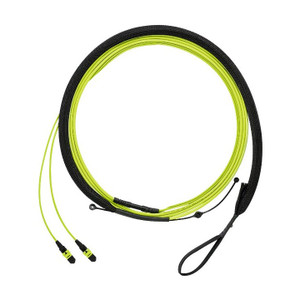
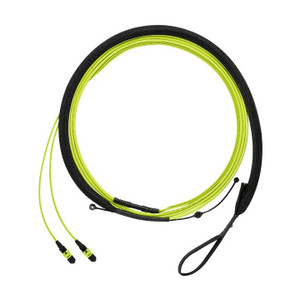
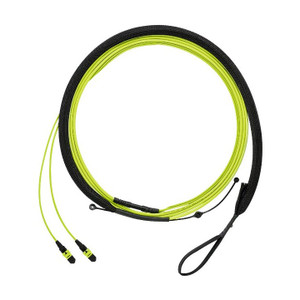
Panduit FWUYL7575KAM038 OM5 24-Fiber Trunk Cable Assembly
The Panduit FWUYL7575KAM038 is a 38-meter QuickNet OM5 trunk cable assembly engineered for high-density data center deployments where pathway space is at a premium and 100G/400G extended-reach performance is non-negotiable. This 24-fiber trunk terminates with PanMPO female connectors on both ends and ships with Method A polarity configuration, eliminating the guesswork during backbone installations. The HD Flex transition design and factory-terminated ultra insertion loss performance mean you're deploying a tested, known-good link—critical when your migration window is measured in hours, not days. LSZH jacketing meets IEC 60332-3-24 flame propagation and smoke density requirements for plenum-equivalent applications without the PVC toxicity risk, making this trunk a fit for international installations and facilities with strict indoor air quality mandates.
Key Features
- OM5 wideband multimode fiber supports 100GBASE-SR4 to 150m and 400GBASE-SR8 to 100m using short-wave VCSELs, doubling effective reach versus OM4 at 850nm wavelength
- 24-fiber count in a single trunk reduces connector density by 12:1 versus duplex LC, freeing panel real estate and simplifying MAC work in spine-leaf topologies
- PanMPO female-to-female termination with Method A pinout (straight-through on odd rows, reversed on even) pairs directly with switch modules and breakout cassettes without adapter polarity flips
- Ultra insertion loss specification (≤0.35 dB typical per mated pair) preserves optical budget for extended structured cabling links and reduces BER on marginal optics
- Low Smoke Zero Halogen (LSZH) jacket meets IEC 60754-1/60754-2 halogen content and IEC 61034-2 smoke density limits—required for EMEA/APAC installations and increasingly adopted in U.S. hospital, transit, and critical infrastructure projects
- Small-diameter trunk construction uses 30-40% less pathway volume than traditional fanout assemblies, easing conduit fill calculations and reducing cable-tray congestion in over-subscribed horizontal runs
- Integrated pulling eye on one end supports tensile loads up to rated cable spec during installation, allowing single-tech pulls through vertical pathways without custom pull grips or stress relief
- Factory-tested and serialized—each assembly ships with insertion loss and return loss results traceable to NIST standards, satisfying Tier III/IV data center acceptance testing requirements without field certification
- 38-meter length suits typical floor-to-floor riser distances in 3-4 story builds or cross-aisle trunk runs in modular data halls, eliminating the mid-span splice points that add loss and failure modes
OM5 fiber shifts the multimode equation for anyone running or planning short-wave 100G/400G links. Where OM4 maxes out at 100m for 100GBASE-SR4 and 70m for 400GBASE-SR8, OM5's wideband design pushes those distances to 150m and 100m respectively—a 40-50% reach extension using the same 850nm optics you already stock. That reach delta matters in larger builds where your EOR-to-MOR span barely fits within OM4 limits; OM5 eliminates the need to spec costly long-wave singlemode optics or re-layout the floor plan around cable distance constraints. The lime jacket color codes OM5 instantly during MAC work, preventing the costly mistakes that happen when OM3/OM4/OM5 trunks share the same pathways and someone plugs 400G optics into an OM3 link.
The PanMPO interface is Panduit's implementation of the IEC 61754-7 MPO standard with enhanced mechanical tolerances—tighter ferrule endface geometry and reduced pin-to-ferrule float—yielding lower insertion loss and higher return loss than generic MPO connectors. Method A polarity (TIA-568-C.3 Appendix D, Type A) means fibers 1-12 on one end map straight through to 1-12 on the far end, while the physical key orientation (key-up to key-down) flips transmit and receive pairs. This is the dominant polarity scheme for switch-to-switch trunking and works without adapters when paired with Method A breakout cassettes. If your patch panel or switch module uses Method B (key-up both ends, flipped fiber mapping), you'll need a Type A-to-B conversion cassette—document your infrastructure's polarity scheme before ordering. The female-to-female termination is standard for backbone trunks; it mates directly with the male MPO ports on QSFP/OSFP transceivers and cassette modules without requiring field-installable adapters that add 0.15-0.25 dB per connection.
LSZH jacketing is spec'd here for a reason. When PVC burns, it releases hydrochloric acid gas—corrosive, toxic, and opaque. LSZH compounds emit 30-50% less smoke and produce halogen acid concentrations below 0.5% by mass, meeting IEC 60754 limits. For U.S. integrators, this matters in three scenarios: international projects (LSZH is code-mandated in EU, UK, Australia, much of Asia), enclosed occupied spaces (hospitals, schools, transit stations), and any facility pursuing LEED or WELL certification where PVC is a restricted material. The tradeoff is cost (LSZH compounds run 15-20% more than PVC) and slightly reduced flexibility at low temperatures—LSZH jackets stiffen below 0°C, so if you're pulling cable in an unheated space during winter, warm the reels indoors before deployment. The IEC 60332-3-24 flame propagation rating here is equivalent to UL's CMR riser rating in terms of fire performance; LSZH is not inherently plenum-rated unless explicitly marked CMP/OFNP, which this trunk is not. Verify your AHJ accepts LSZH for the intended pathway type.
The 24-fiber count hits the sweet spot for spine-leaf fabrics and storage-area network trunking. A single trunk supports two 100G QSFP28 ports (12 fibers each via SR4 breakout) or three 40G QSFP+ ports (8 fibers active, 4 unused per link). For 400G deployments, you'll use two 24-fiber trunks per OSFP-SR8 port (16 fibers active, 8 dark) or run this as a single trunk feeding two 200G-SR4 links. The high fiber count reduces connector footprint at the panel—24 LC duplex connections condensed into two MPO footprints—and simplifies your labeling and documentation burden. Each MPO connector is roughly 7mm wide; 24 fibers in LC format would span 144mm of panel space (assuming 6mm per duplex LC), versus 14mm for two MPO. When you're designing a Tier III data center with 288-fiber patch panels in every row, that 10:1 density advantage translates directly into usable rack units.
The pulling eye is a small detail that eliminates big headaches. Standard trunk assemblies rely on cable-grip pull socks or tape anchors—both of which risk damaging the jacket or applying uneven tensile load across the fiber bundles. The integrated eye lets you attach a pull rope directly to a hardened anchor point rated for the cable's maximum tensile load (typically 200-300 lbf for a 24-fiber trunk). This matters most in vertical riser pulls and long horizontal conduit runs where friction loads build up; a tech can pull the full 38-meter length in one shot from the cable reel, through the pathway, to the terminal enclosure without mid-run hand-offs or re-rigging. Single-tech pulls reduce labor cost and eliminate the communication errors that happen when two techs are coordinating a pull across floors via radio.
Factory termination is the forcing function for quality. Every Panduit QuickNet assembly is terminated in a controlled environment with automated polishing, endface inspection (IEC 61300-3-35 criteria), and insertion loss testing across all 24 fibers. You receive a serialized test report showing IL and RL values for each fiber pair, typically ≤0.35 dB insertion loss and ≥20 dB return loss per mated connection. Compare that to field termination: even with an experienced tech and fusion-splice-on connectors, you're looking at 0.5-0.75 dB typical IL and high variability due to cleave quality and environmental contamination. The cost delta between factory and field termination narrows significantly when you account for labor (2-3 hours to terminate and test a 24-fiber trunk in the field), consumables (splice-on connectors, cleaner, inspection scopes), and rework (scratched endfaces, failed insertion loss tests). For projects with tight schedules or limited skilled labor, factory trunks are the only path to predictable optical performance.
The 38-meter length is dimensioned for specific installation geometries: three-story vertical riser runs (12m per floor plus slack), cross-aisle trunking in modular data halls (30-35m row-to-row with pathway overhead), or EOR-to-MOR spans in larger telecom closets. If you're designing a structured cabling system and this length doesn't fit, Panduit's QuickNet line offers the same trunk config in 10m, 15m, 30m, 50m, and 100m variants—always order the next standard length up rather than the next length down, because you need 2-3% slack at each end for termination strain relief and future re-termination. Excess length coils neatly in overhead cable trays or slack management panels; short trunks create tension that degrades endface contact and raises insertion loss over time.
This trunk is built to TIA-568-C.3 and ISO/IEC 11801 Ed. 2.2 structured cabling standards, tested to TIA-604-5 (FOCIS-5) endface geometry requirements, and ships RoHS-compliant for European market installations. The OM5 fiber itself is manufactured to TIA-492-AAAD and IEC 60793-2-10 A1a.3 specifications—wideband 50/125µm core/cladding diameter, 850nm effective modal bandwidth ≥3500 MHz·km, enabling the extended reach that defines OM5. If your facility requires TIA-942 Rated-3 or Rated-4 certification (Tier III/IV equivalent), factory-terminated trunks with serialized test reports satisfy the certification body's physical-layer verification requirements without additional field testing.