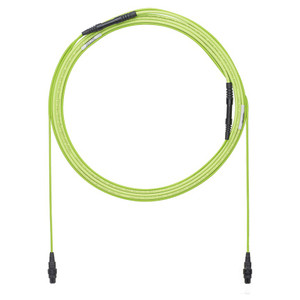
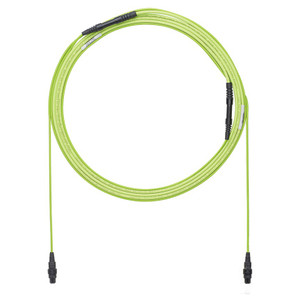
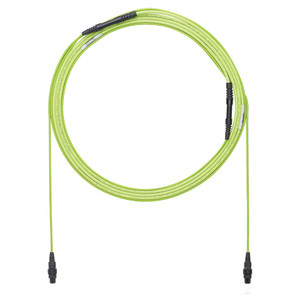
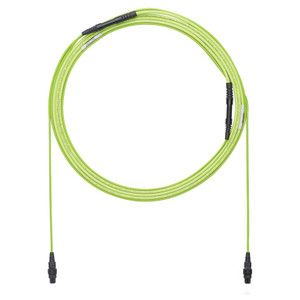
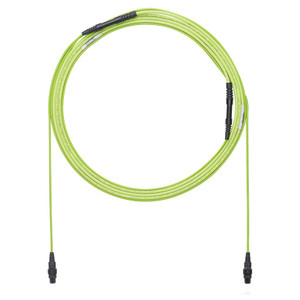
Panduit FWTYL7575LNM021 QuickNet™ OM5 12-Fiber Trunk Cable Assembly
The Panduit FWTYL7575LNM021 is a 21-meter, 12-fiber OM5 trunk cable assembly engineered for high-density data center deployments requiring extended reach and future-proof bandwidth capacity. Built on wideband multimode OM5 fiber (50µm), this trunk supports shortwave wavelength division multiplexing (SWDM) for 40/100 Gigabit Ethernet over extended distances, while maintaining a migration path to 400G applications. PanMPO female-to-female connectors deliver ultra-low insertion loss in a Method B polarity configuration, and the HD Flex cable construction reduces pathway congestion by 30-40% compared to legacy trunk designs. The low smoke zero halogen (LSZH) jacket meets international building codes for plenum and riser installations where smoke toxicity and flame spread are critical safety considerations.
Key Features
- OM5 wideband multimode fiber (50µm core) supports SWDM for 40/100G Ethernet at extended reach, with headroom for 400G migration
- 12-fiber count with PanMPO female connectors on both ends for direct spine-to-leaf or switch-to-patch-panel connections
- Method B polarity simplifies deployment in parallel optics architectures (40GBASE-SR4, 100GBASE-SR4, 100GBASE-SR10)
- Ultra insertion loss specification ensures margin for longer links and cascaded interconnects in multi-tier topologies
- HD Flex cable design uses 30-40% less pathway space than standard trunk cables, critical for congested overhead and underfloor routing
- 21-meter (68.9 ft) length covers typical intra-row and cross-aisle data center runs without mid-span splicing
- LSZH jacket rated for plenum and riser spaces in compliance with IEC 60332 and local fire codes—reduces smoke and halogen acid gas emission during fire events
- Lime green cable jacket and connector boots provide instant visual identification of OM5 infrastructure per TIA-598-D color standards
- Factory-terminated and tested to TIA-604-5 (FOCIS-5) insertion and return loss limits—eliminates field termination risk and accelerates deployment
- QuickNet™ system integration: designed for use with Panduit cassettes, panels, and enclosures in structured OM5 cabling systems
OM5 fiber represents the current state-of-the-art in multimode technology, engineered specifically for shortwave wavelength division multiplexing. Unlike OM3 and OM4, which rely on single-wavelength transmission (typically 850 nm), OM5 is optimized for four-wavelength SWDM transmission across the 850-950 nm band. This allows a single 12-fiber trunk to support four parallel 100G channels (effectively quadrupling capacity) or serve as a building block for 400G breakout configurations using BiDi or PAM4 modulation schemes. For integrators planning multi-year data center builds, OM5 provides the bandwidth overhead to accommodate next-generation switching without re-cabling—critical when cable pulls are constrained by building structure, hot/cold aisle containment, or occupied-space operations.
The PanMPO connector system is Panduit's implementation of the multi-fiber push-on interface standardized in TIA-604-5. Each connector houses 12 fibers in a single ferrule with an alignment key (either key-up or key-down) that enforces correct polarity. The female-to-female configuration on this trunk is designed for direct connection to male PanMPO ports on transceivers, switches, or patch panels, or for interconnection through a female-to-male adapter in patch-panel environments. Method B polarity (also called "straight-through" or "key-up-to-key-down") is the industry-standard pinout for parallel optics: transmit fibers on one end align with receive fibers on the other end when the cable is flipped, eliminating the need for crossover modules. This is the default polarity for 40GBASE-SR4 and 100GBASE-SR4 applications, and understanding Method B vs. Method A vs. Method C is critical when planning trunk-to-transceiver connections—incorrect polarity results in no link light and requires either cable replacement or field re-keying.
HD Flex cable construction addresses one of the most persistent challenges in hyperscale and enterprise data center design: pathway congestion. Legacy 12-fiber trunks using tight-buffered or distribution-style cable can exceed 8 mm in diameter, and a bundle of 24 trunks (288 fibers) quickly fills a 4-inch ladder rack or overhead J-hook pathway. The HD Flex design reduces cable diameter to approximately 5.5 mm through the use of ultra-thin buffer layers and optimized strength members, cutting cross-sectional area by roughly 50%. This translates to a 30-40% reduction in bundle fill ratio, which improves airflow in overhead pathways (critical for cooling efficiency), reduces tensile load on cable hangers, and simplifies cable management in dense switch-to-cassette connections where 20+ trunks may terminate in a single 1U panel. For retrofit projects in occupied data centers, the smaller diameter often means existing pathways can accommodate additional circuits without costly infrastructure upgrades.
The 21-meter length is a deliberate choice for intra-row and cross-aisle connectivity in data center environments with standard ceiling heights (10-14 feet). A typical use case: spine switch in end-of-row cabinet to leaf switch 15 meters away, with 6 meters of slack for vertical cable management, overhead routing, and service loop at each termination. Unlike cut-to-length field terminations (which introduce insertion loss variability and require specialized MPO tooling), factory-terminated trunks arrive with connectors pre-polished and tested to insertion loss limits of ≤0.35 dB per connection (ultra IL spec often tightens this to ≤0.25 dB). The result is predictable link budgets: a 21-meter OM5 link at 100GBASE-SR4 will typically show 1.5-2.0 dB total loss (cable + two connectors), leaving 5+ dB margin against the 100G-SR4 loss budget of 6.0 dB. That margin is critical when accounting for patch-cord connections, cassette pass-throughs, or future transceiver degradation.
Low smoke zero halogen jacket construction is increasingly required (or strongly recommended) by building codes, insurance carriers, and corporate environmental health and safety policies. Traditional PVC cable jackets, when exposed to fire, release hydrochloric acid gas and dense black smoke—both of which pose life-safety risks in occupied buildings and can cause corrosive damage to IT equipment in adjacent spaces. LSZH jackets use halogen-free polymer compounds (typically polyethylene or thermoplastic elastomer blends) that produce minimal smoke opacity (<60% light transmittance per IEC 61034) and negligible halogen acid gas (<0.5% by mass per IEC 60754). For data centers in high-rise buildings, healthcare facilities, or transportation hubs, LSZH is often mandated by local fire marshals or by NFPA 70 (NEC) interpretations for plenum spaces. Even where not mandated, specifying LSZH reduces liability exposure and simplifies multi-site standardization when building codes vary by jurisdiction.
The lime green cable jacket and connector boots are not cosmetic—they are a functional compliance feature specified in TIA-598-D. OM5 fiber is required to use lime green identification to distinguish it from OM3 (aqua) and OM4 (violet). In a mixed-generation data center where multiple fiber types coexist, color coding prevents accidental cross-connection of OM3 patch cords to OM5 infrastructure (which would negate the OM5 bandwidth advantage) or misidentification during maintenance windows. For inventory management and MAC (moves/adds/changes) operations, instant visual identification reduces the need to trace cables back to documentation or use fiber identifiers, cutting troubleshooting time and reducing the risk of service-affecting errors.
Factory termination and testing provide quality assurance that field terminations cannot match. Each connector on this trunk is terminated in a controlled cleanroom environment using automated polishing machines that ensure ferrule endface geometry meets TIA-604-5 specifications (radius of curvature, apex offset, fiber height). After polishing, each fiber is tested for insertion loss and return loss using calibrated test equipment, and results are typically documented in a test report that ships with the cable. This eliminates the variability introduced by hand-polishing in the field, where endface quality depends on technician skill, ambient conditions, and tool calibration. For link certification and warranty purposes, factory-terminated trunks provide a known-good baseline—if a link fails insertion loss testing, the problem is almost always at the patch cord or transceiver interface, not the trunk.
Panduit's QuickNet™ system is a structured cabling architecture that integrates trunks, cassettes, patch panels, and enclosures into a pre-engineered solution for OM5 deployments. This trunk is designed to mate with QuickNet cassettes (which convert 12-fiber MPO to individual LC duplex ports) in Panduit's FHD and FHS high-density enclosures. A typical spine-to-leaf deployment uses this trunk to connect a switch's 12-fiber MPO transceiver port to a cassette in a patch panel, where it breaks out into six LC duplex ports for individual 100G connections. The system approach reduces design time (compatibility is guaranteed), simplifies procurement (fewer part numbers to manage), and accelerates deployment (plug-and-play cassette installation vs. fusion splicing). For integrators managing multiple data center projects, standardizing on QuickNet reduces training requirements and allows technicians to replicate proven designs across sites.
Standards compliance spans TIA/EIA-568-C.1 and C.3 (commercial building telecommunications cabling), ISO/IEC 11801 (international generic cabling standard), TIA-492-AAAD (OM5 fiber performance specification), IEC 60793-2-10 type A1a.3 (multimode fiber detail specification), TIA-604-5 (MPO connector interface), and RoHS (restriction of hazardous substances). This broad compliance base ensures the trunk is suitable for installations subject to TIA standards in North America, ISO/IEC standards in Europe and Asia-Pacific, and IEC standards in telecommunications carrier environments. RoHS compliance is required for equipment sold in the European Union and is increasingly adopted by corporate procurement policies worldwide as part of environmental sustainability initiatives. For projects requiring third-party certification or owner's-representative approval, the combination of factory test reports and standards compliance documentation provides the audit trail needed to close out commissioning checklists.