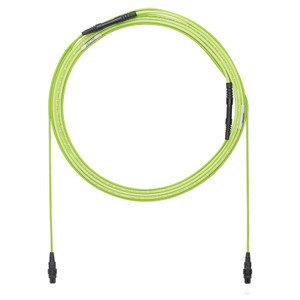
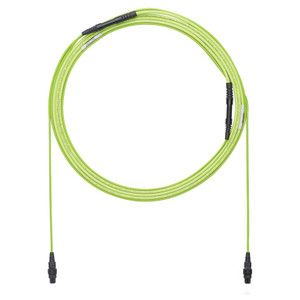
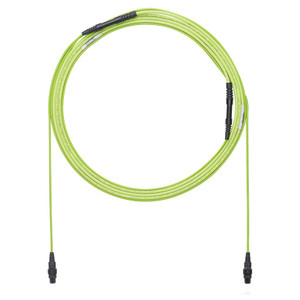
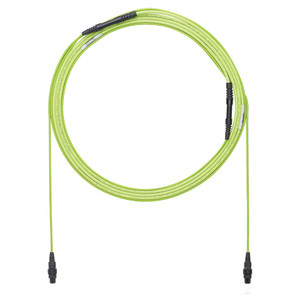
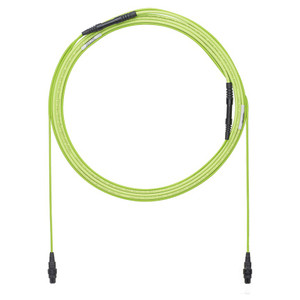
Panduit FWTYL7575KNM043 OM5 12-Fiber Trunk Cable Assembly
The Panduit FWTYL7575KNM043 delivers 43 meters of OM5 wideband multimode fiber in a 12-strand PanMPO-to-PanMPO trunk configuration, engineered for datacenter backbone deployments requiring extended reach and future-proof bandwidth. This pre-terminated QuickNet™ assembly combines Method A polarity, ultra-low insertion loss, and HD Flex small-diameter construction in an LSZH-rated jacket. The lime color provides immediate OM5 visual identification in mixed-fiber environments, while the 30-40% space savings over conventional trunk cables addresses the cable congestion that stalls high-density rack builds.
Key Features
- OM5 Wideband Multimode Fiber: 850-950nm short-wave wavelength division multiplexing (SWDM) support extends reach and capacity for 100GBASE-SR4, 400GBASE-SR8, and future 800G/1.6T optics without infrastructure replacement
- 12-Fiber PanMPO-to-PanMPO Trunk: Female PanMPO connectors on both ends with Method A polarity mapping eliminate field splicing and provide plug-and-play backbone connectivity between patch panels, cassettes, or switch MPO ports
- 43-Meter Extended Reach: 141-foot length suits cross-row datacenter links, building risers, or campus pathways that exceed standard 15-30m trunk lengths while maintaining OM5's 100m channel budget for 100G applications
- LSZH Jacket Construction: Low Smoke Zero Halogen outer jacket meets IEC 60332-3 and produces minimal smoke/toxic gas during fire exposure, required for enclosed cable pathways in many international datacenter standards and increasingly adopted in North American builds
- HD Flex Small-Diameter Design: Reduced cable OD compared to legacy 12-fiber trunks delivers 30-40% pathway fill reduction—critical when retrofitting existing ladder rack or overhead tray systems already near 40% TIA fill-ratio limits
- Ultra Insertion Loss Performance: Factory-terminated and tested PanMPO connectors deliver <0.35 dB typical insertion loss per mated pair, preserving link budget for long spans or multi-tier architectures with multiple connector points
- Pre-Terminated Factory Assembly: Eliminates field termination labor, fusion splicing equipment, and the 24-48 hour delay associated with on-site MPO connector installation and testing—deploy and certify the same day
- Lime Visual Identification: Industry-standard lime green jacket matches TIA-598-D OM5 color coding, preventing accidental cross-connection with OM3/OM4 infrastructure during maintenance or expansion work
OM5 wideband multimode fiber represents the current endpoint of MMF evolution for datacenter applications. Unlike OM3 and OM4, which operate exclusively at 850nm, OM5 supports short-wave wavelength division multiplexing across 850nm, 880nm, 910nm, and 940nm channels. This four-wavelength capability allows a single 12-fiber trunk to carry four times the data of equivalent OM4 infrastructure when paired with SWDM transceivers—a 400GBASE-SR4.2 link, for example, uses just two fibers (one transmit, one receive) instead of eight. For integrators designing 100G/400G spine-leaf topologies or planning migration paths to 800G, OM5 eliminates the fiber-count bottleneck that forces costly re-cabling when transceiver technology advances. The Panduit FWTYL7575KNM043's 12-fiber configuration supports six duplex 100G links in parallel optics mode, three 400G links in SWDM mode, or a single 400G link with ten fibers reserved for future expansion—flexibility that matters when your datacenter's five-year roadmap is uncertain. Method A polarity follows the TIA-568 standard straight-through mapping: position 1 on one end connects to position 1 on the far end, requiring a polarity-flipping component (typically a Type B cassette or cross-over module) at one end of the permanent link. This is the dominant polarity scheme for trunk-to-trunk and trunk-to-cassette connections in structured cabling, and it ensures that Tx lanes on one switch connect to Rx lanes on the other after passing through the appropriate conversion point. The ultra insertion loss designation indicates that Panduit's factory termination process—end-face geometry control, ferrule concentricity, and cleanliness protocols—holds insertion loss to <0.35 dB typical per mated connector pair, well below the 0.75 dB TIA-568-C.3 maximum. In a two-connector channel (patch panel to switch via this trunk plus jumpers on each end), that translates to ~1.0 dB total connector loss, leaving 90% of your link budget for fiber attenuation and margin.
Datacenter backbone deployments present three persistent challenges: pathway congestion, deployment velocity, and safety compliance. The FWTYL7575KNM043 addresses all three. HD Flex construction reduces this trunk's outer diameter by 30-40% compared to Panduit's standard 12-fiber tight-buffer trunk, a difference that becomes critical when you're pulling the sixth or eighth trunk through a 4-inch conduit already carrying power and copper. TIA-569 recommends keeping conduit fill below 40% to avoid jacket damage during installation; legacy 12-fiber trunks at 0.40-0.45 inches OD consume 0.13-0.16 square inches each, while HD Flex designs at ~0.30 inches OD drop to 0.07 square inches—you fit nearly twice as many cables in the same pathway. For integrators retrofitting 10G leaf switches to 100G in an operational datacenter, that space savings determines whether you can install new fiber without a disruptive ceiling-tile or floor-tile removal project. Pre-terminated trunks eliminate the field labor and risk associated with MPO connector installation. Installing a 12-fiber MPO connector in the field requires a fusion splicer, MPO termination kit, inspection microscope, and tier-2 certification test equipment—a process that takes 45-60 minutes per end when done correctly, and which introduces three failure modes (poor ferrule end-face geometry, misaligned fiber holes, contamination). Factory-terminated trunks arrive tested with insertion loss and return loss data sheets; you pull the cable, plug in both ends, and verify continuity. The time savings compounds on large projects: a 40-link spine-leaf build with 80 total trunk runs saves 60-80 labor hours compared to field termination, and eliminates the rework loop when a field-installed connector fails certification. LSZH jacketing has become the de facto standard in European and Asian datacenters due to IEC requirements for enclosed spaces, and adoption is accelerating in North American builds as hyperscale operators and colos standardize global specs. LSZH compounds produce <0.5% halogen content (vs. 25-30% in PVC jackets) and emit 10-20% of the smoke density during combustion. For cable pathways above suspended ceilings, in vertical risers, or in under-floor plenums where air movement could distribute smoke and corrosive gases, LSZH provides measurable life-safety improvement over PVC alternatives. The tradeoff is cost (LSZH jackets run 15-25% more than PVC) and slightly reduced flexibility at low temperatures, but for mission-critical facilities or installations subject to NFPA 75 or local AHJ interpretation, LSZH is often non-negotiable.
The FWTYL7575KNM043 ships with test data certifying compliance to ISO/IEC 11801 generic cabling, TIA-568-C.3 optical fiber cabling, TIA-604-5 (FOCIS-5) MPO connector intermateability, and TIA-492-AAAD (which defines OM5 fiber performance at four SWDM wavelengths). RoHS compliance ensures compatibility with EU equipment-import requirements and corporate sustainability procurement policies. This 43-meter length fits the 100-150 foot cross-row or inter-building link common in large datacenter halls and campus environments, a gap where 30-meter off-the-shelf trunks fall short but 60-70 meter lengths introduce unnecessary cable-management bulk. For integrators designing structured cabling per TIA-942 guidelines, this trunk serves as a backbone horizontal link between main distribution area (MDA) and horizontal distribution area (HDA) panels, or as a vertical riser link between floors in a multi-story facility. Pair it with Panduit's FMT or FQMM cassette modules to break out the 12-fiber trunk into individual LC or MPO duplex connections at the equipment end, and with FHD or FHLL high-density panels at the MDA for centralized cross-connect management. The lime jacket and QuickNet sub-brand integrate into Panduit's color-coded infrastructure strategy, where OM3 is aqua, OM4 is erika violet, and OM5 is lime—visual differentiation that prevents the $15,000 mistake of plugging a 10GBASE-SR OM3 jumper into a 400GBASE-SR8 OM5 backbone port during a late-night maintenance window.