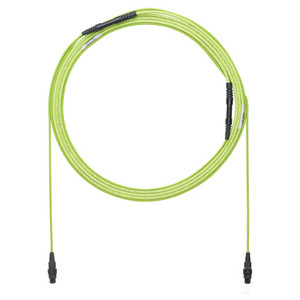
Panduit FWTYL7575KAM095 QuickNet 12-Fiber OM5 Trunk Cable Assembly
The Panduit FWTYL7575KAM095 is a 95-meter (311.68 ft) QuickNet trunk cable assembly engineered for high-density data center deployments requiring wideband multi-mode fiber connectivity with extended reach. Built on OM5 fiber technology with 50-micron core diameter, this 12-fiber trunk delivers up to four times the effective bandwidth of OM4 over the same infrastructure footprint, supporting short-wave wavelength division multiplexing (SWDM) for 40G/100G applications across 150-meter spans and future-proofing for 400G migration paths. The lime LSZH jacket provides IEC 60332-3-24 Category C flame performance with low smoke and zero halogen emissions, critical for enclosed pathways and international building codes. Small-diameter trunk construction reduces bundle cross-section by 30 to 40 percent compared to breakout assemblies, directly translating to higher fill ratios in cable trays, ladder racks, and overhead pathways where space is the limiting factor in capacity planning.
Key Features
- OM5 wideband multi-mode fiber supports SWDM transmission for 40GBASE-SR4, 100GBASE-SR4, and emerging 400G standards across 150m channel
- 12-fiber count in single trunk configuration optimizes pathway utilization for spine-leaf architectures and horizontally scaled pod designs
- 95-meter factory-terminated assembly eliminates field termination labor, test time, and insertion loss variability on long intra-building backbone runs
- LSZH jacket meets IEC 60332-3-24 Category C, IEC 61034-2 smoke density, and IEC 60754-1/2 halogen content limits for enclosed air-handling spaces
- Lime jacket color enables instant visual identification in mixed OM3/OM4/OM5 deployments per TIA-598-D fiber identification standard
- Small-diameter trunk construction reduces cable bundle OD by 30-40% versus breakout equivalents, increasing tray fill capacity and minimizing bend radius stress
- QuickNet sub-brand signifies factory pre-tested insertion loss and return loss performance per TIA-568-C.3 Tier 2 certification requirements
- MTP/MPO connector interface supports both 8-fiber and 12-fiber breakout modules for flexible distribution architecture at equipment racks
- Factory application of keying and polarity method B (flipped) enables plug-and-play deployment with duplex LC breakout modules for Tx/Rx lane alignment
- ISO/IEC 11801 Edition 2.2 and TIA-568-C.3 compliance ensures interoperability with global structured cabling standards and 25-year system warranties
OM5 wideband multi-mode fiber represents the current apex of premises multi-mode technology, extending usable bandwidth from OM4's 4700 MHz·km at 850nm to a full spectrum covering 850nm through 953nm wavelengths. This extended range unlocks short-wave wavelength division multiplexing, where four independent 28Gbps lanes are transmitted simultaneously over four distinct wavelengths on a single fiber pair—quadrupling effective bandwidth without quadrupling fiber count. For 100GBASE-SR4 applications, this translates to 100Gbps over eight fibers (four Tx, four Rx) with 150-meter reach on OM5 versus 100 meters on OM4, providing the margin needed for real-world patch panel interconnects and equipment cord lengths that consume channel budget. The FWTYL7575KAM095's 95-meter backbone length slots directly into horizontal intra-building distribution scenarios—typical distances between campus building MDF and IDF, or between data center entrance room and server hall—while leaving sufficient loss budget for four-connector channel configurations. Factory termination guarantees insertion loss under 0.35dB per mated connector pair and return loss exceeding 20dB, verified through automated test reporting that ships with each assembly. This eliminates the 0.5-0.75dB loss variability and 4-8 hour labor cost associated with field-terminated MPO connectors, a critical factor when deploying dozens of trunks during new build or refresh projects.
The trunk cable form factor fundamentally changes pathway economics in high-density environments. Traditional breakout cable designs route 12 individual 2mm zipcord subunits from a common fanout point, creating a bundle approximately 18-22mm in overall diameter once you account for overbraid and required bend radius. The FWTYL7575KAM095 consolidates all 12 fibers into a single 6-8mm diameter LSZH jacket with central strength member, reducing cross-sectional area by 65-70 percent. In a 4-inch ladder rack scenario, this difference determines whether you route 18 trunks or 48 trunks before hitting NEC Article 770 fill-ratio limits. The benefit compounds in vertical riser pathways and cable tray transitions where every millimeter of diameter affects friction load during pulls. Small-diameter construction also minimizes the bend radius—typically 10x cable OD under load, 20x unloaded—allowing tighter routing around structural obstacles and reducing the 3D space consumed by service loops at patch panel terminations. The lime LSZH jacket serves dual purposes: immediate visual identification per TIA-598-D (lime=OM5, aqua=OM3/OM4, orange=OM1/OM2) preventing accidental cross-patching that would limit link distance, and regulatory compliance for installation in air-handling plenums, vertical shafts, or international facilities governed by IEC standards rather than NEC. Low smoke zero halogen construction produces less than 0.5% HCl gas and maintains light transmittance above 60% during combustion per IEC 61034-2, directly reducing evacuation risk and fire-service visibility impairment compared to PVC-jacketed alternatives.
Deployment architecture typically pairs trunk assemblies like the FWTYL7575KAM095 with MTP-to-LC breakout modules (cassettes or harnesses) at both ends, creating a 12-strand backbone that fans out to six duplex LC connections per termination point. Polarity method B (flipped) is standard for Panduit QuickNet trunks: the key-up MTP connector on one end maps to a key-down connector on the opposite end, ensuring that fiber 1 transmit on the near end reaches fiber 12 receive on the far end when using straight-through breakout modules. This plug-and-play polarity eliminates the crossover patch cords and field verification that plagued earlier-generation trunk deployments, reducing commissioning time from hours to minutes per link. For spine-leaf data center fabrics, a common design uses 12-fiber trunks for spine-to-leaf uplinks: each leaf switch receives one trunk from each of four spine switches, and the MTP interface breaks out to six 40GBASE-SR4 ports (consuming eight fibers) with four fibers reserved for future 100G upgrade via breakout module swap. This approach delivers the port density and upgrade flexibility that breakout cables cannot match while maintaining clean cable management and rapid MAC (move/add/change) operations. Standards compliance spans ISO/IEC 11801 Edition 2.2 Class OM5, TIA-568-C.3 multi-mode backbone cabling, TIA-604-5 (FOCIS-5) MPO connector geometry, and RoHS material restrictions, ensuring compatibility with global purchasing requirements and eligibility for structured cabling system warranties that demand certified components end-to-end.