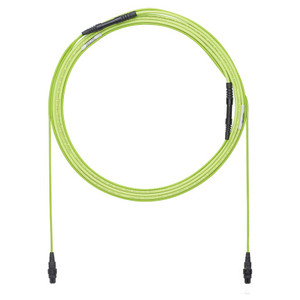
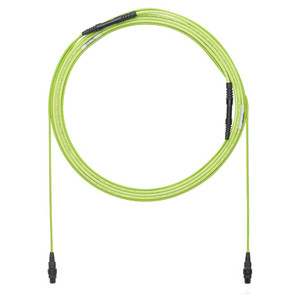
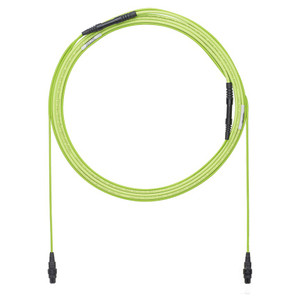
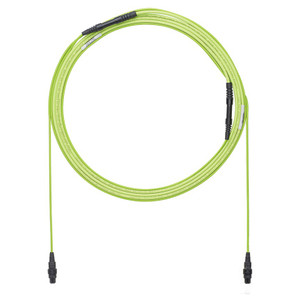
Panduit FWTYL7575KAM080 QuickNet OM5 12-Fiber Trunk Cable Assembly
The Panduit FWTYL7575KAM080 delivers 80 meters of OM5 wideband multimode fiber in a pre-terminated 12-strand trunk assembly engineered for high-density data center backbone and horizontal cabling deployments. OM5 fiber supports short-wave division multiplexing (SWDM) across four wavelengths (850/880/910/940 nm), enabling 40GBASE-SR4 and 100GBASE-SR4 transmission over extended distances compared to OM3/OM4—critical when rack-to-rack spans exceed 100 meters or when future-proofing 400G migration paths. The QuickNet factory-terminated design eliminates field splicing labor and fusion-splice equipment costs while guaranteeing insertion loss ≤0.35 dB and return loss ≥20 dB per TIA-568-C.3 performance tiers. Lime LSZH jacketing meets IEC 60332-3-24 flame propagation limits and emits 50% less smoke opacity than PVC during fire events—mandatory for plenum-equivalent spaces in EMEA and increasingly specified in U.S. hyperscale facilities under NFPA 70 Article 770 optical fiber cable classifications.
Key Features
- OM5 wideband multimode fiber (50 µm core) certified to ISO/IEC 11801 and TIA-492-AAAD specifications for 100 Gb/s SR4 to 150 m and 40 Gb/s SR4 to 440 m
- 12-fiber trunk configuration supports six duplex LC connections or three MTP®-to-LC breakout cassettes in structured cabling architectures
- 80-meter assembly length spans typical raised-floor data center row-to-MDA distances without mid-span splice points
- Small-diameter trunk construction reduces pathway fill by 30–40% vs. bundled duplex cables, preserving airflow in overhead cable trays and under-floor grids
- Factory-terminated connectors ship with test reports documenting insertion loss, return loss, and end-face geometry per IEC 61300-3-35 interferometry standards
- LSZH (Low Smoke Zero Halogen) jacket complies with IEC 60754-1 halogen-free requirements and IEC 61034-2 smoke density <60% light transmittance
- Lime jacket color provides instant visual identification in mixed OM3/OM4/OM5 plant environments per TIA-598-D color coding
- Pre-tested assemblies eliminate on-site OTDR certification time—plug-and-play deployment reduces installation labor by 70% compared to field-terminated solutions
- RoHS 3 compliant construction meets EU Directive 2015/863 substance restrictions for lead, mercury, and brominated flame retardants
The 12-fiber count aligns with industry-standard MTP-12 and LC duplex breakout cassette topologies deployed in three-tier leaf-spine data center fabrics. A single FWTYL7575KAM080 trunk supports six 10GbE or 25GbE duplex links, three 40GbE QSFP+ ports (via MTP breakout), or one 100GbE QSFP28 connection when paired with appropriate transceiver modules and breakout cassettes. OM5's 50 µm core diameter maintains modal bandwidth ≥4700 MHz·km at 850 nm (OM4 = 4700 MHz·km, OM3 = 2000 MHz·km), but the wideband specification extends usable bandwidth across 880/910/940 nm wavelengths—each carrying an independent data stream in SWDM applications. This four-channel parallelism allows 100GBASE-SR4 transmission using four 25 Gb/s lanes over a single duplex fiber pair, compared to OM4's requirement for eight fibers (four duplex pairs). For 40 Gb/s links, OM5 achieves 440-meter reach vs. OM4's 400-meter limit—a decisive advantage when cabling between buildings in campus environments or spanning large server halls without intermediate distribution frames.
The QuickNet trunk's small-diameter construction uses a tight-buffered central tube design with aramid yarn strength members and a 4.8 mm outer diameter—35% smaller than twelve individual 2.0 mm zip-cord cables bundled together. In a 4-inch-wide overhead cable tray, this size reduction increases usable capacity from 18 to 28 trunk assemblies before exceeding NEC 40% fill ratio limits, directly translating to deferred infrastructure costs when retrofit projects hit pathway congestion. The tight-buffer design also provides superior crush resistance (≥220 N/cm per IEC 60794-1-2 method E3) compared to loose-tube outdoor cables, making it suitable for under-floor installations where rolling server racks and personnel traffic impose repetitive mechanical stress. Installers gain a 25 mm minimum bend radius during installation (10× the cable diameter) and a 38 mm long-term static bend radius—tight enough to route through 2-inch conduit elbows without kinking or inducing macrobend attenuation spikes that degrade link budgets.
LSZH jacketing addresses two critical data center safety requirements: flame propagation containment and occupant egress visibility during fire events. The IEC 60332-3-24 Category C vertical flame test requires the assembly to self-extinguish within 2.5 meters of vertical char length when exposed to a 20 kW propane burner—far more stringent than NEC CMP plenum cable tests. During combustion, LSZH compounds emit <0.5% hydrogen chloride and <0.5% hydrogen fluoride by mass (per IEC 60754-1), eliminating the corrosive acid gases that PVC jackets release when burning—gases that corrode server electronics, contaminate CRAH units, and obscure exit signage. The <60% light obscuration result per IEC 61034-2 (3-meter cube smoke chamber test) means building occupants retain visibility for emergency egress, and fire suppression systems can locate the ignition source. European data centers operating under EN 50173 and ISO/IEC 11801 standards mandate LSZH for all intra-building fiber, while U.S. facilities increasingly specify it for electrical rooms and HVAC plenums where PVC off-gassing poses equipment contamination risks—particularly in lithium-ion battery energy storage system (BESS) co-location scenarios where thermal runaway events generate sustained high temperatures.
Factory termination quality separates pre-manufactured trunk assemblies from field-installed connectors. Each FWTYL7575KAM080 ships with insertion loss ≤0.35 dB and return loss ≥20 dB measured at 850 nm across all twelve fibers, documented on serialized test reports traceable to NIST-certified reference standards. End-face geometry meets IEC 61300-3-35 interferometric limits for radius of curvature (7–25 mm), apex offset (<50 µm), and fiber height (-150 to +50 nm)—parameters that field polishing rarely achieves without cleanroom conditions and iterative inspection cycles. The factory process uses diamond-grit lapping films progressed through 9 µm, 3 µm, 1 µm, and 0.3 µm stages, followed by automated interferometry that rejects any connector outside specifications. This process consistency eliminates the 0.5–1.0 dB insertion loss variability common in field terminations, preserving link budget margin for future transceiver upgrades (10G → 25G → 100G) without re-cabling. For a 12-fiber trunk, field termination typically requires 4–6 hours of labor (including adhesive curing, cleaving, polishing, and inspection), compared to 15 minutes for QuickNet plug-and-play deployment—a labor cost delta of $400–$800 per assembly at prevailing data center installation rates.
The 80-meter length targets three common data center topologies: (1) horizontal cabling from main distribution area (MDA) to end-of-row aggregation switches in <100-meter server rows; (2) backbone links between MDA and intermediate distribution areas (IDA) in multi-building campuses where outdoor-rated cable isn't required; (3) storage area network (SAN) connections between compute racks and centralized NVMe-oF or Fibre Channel storage arrays positioned in separate fire compartments. TIA-942 Rated-3 and Rated-4 data centers specify ≤90-meter horizontal channel limits (including patch cords) to maintain <2.6 dB insertion loss for 10GBASE-SR links; the FWTYL7575KAM080's 80-meter trunk leaves 10 meters of budget for equipment cords while staying within that envelope. For 40GBASE-SR4 and 100GBASE-SR4 applications, OM5's extended reach means this assembly supports full 80-meter backbone runs with 3.5 dB worst-case link loss (0.35 dB × 12 connectors + 0.096 dB × 80 m fiber attenuation)—well below the 1.9 dB 100GBASE-SR4 receiver sensitivity and 7.0 dB link budget allocation. Installers gain deployment flexibility to route around structural obstacles (CRAH units, cable ladder turns, seismic bracing) without worrying that a 5-meter detour will push the span beyond transceiver reach specifications.
Compliance with TIA-568-C.3, ISO/IEC 11801 Ed.2.2, and IEC 60793-2-10 Type A1a.3 ensures the FWTYL7575KAM080 integrates into standards-based structured cabling systems with interoperability across multi-vendor active equipment. The assembly's OM5 classification guarantees ≤2.3 dB/km maximum attenuation at 850 nm and ≥4700 MHz·km effective modal bandwidth (EMB) calculated per IEC 61280-4-1 differential mode delay (DMD) measurements—the same performance floor that Cisco, Arista, Juniper, and Broadcom reference when publishing transceiver reach specifications. TIA-604-5 (FOCIS-5) dimensional compliance for LC connectors ensures mating compatibility with Panduit, Corning, CommScope, and Leviton cassettes, patch panels, and media converters without adapter sleeves or hybrid jumpers. RoHS 3 certification addresses EU supply chain restrictions and simplifies customs documentation for multinational deployments, while the UPC polish (versus APC) aligns with IEEE 802.3 Ethernet standards that prohibit angled physical contact connectors in 10/25/40/100 Gb/s multimode applications.