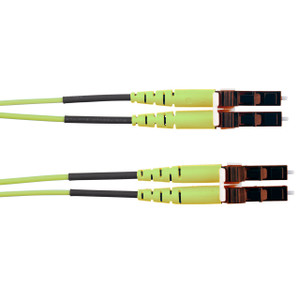
Panduit FW2ERLNLNSNM030 Opti-Core OM5 LC Duplex Fiber Patch Cord
The Panduit FW2ERLNLNSNM030 is a 30-meter (98.4 ft) OM5 multimode fiber patch cord engineered for datacenter backbone installations, high-speed vertical risers, and next-generation 100G/200G/400G Ethernet deployments. Built on Panduit's Opti-Core platform with duplex LC connectors on both ends, this patch cord delivers the bandwidth and modal dispersion performance required for shortwave wavelength division multiplexing (SWDM) applications while maintaining backward compatibility with legacy OM3/OM4 infrastructure. The 1.6mm cable diameter supports high-density patching in structured cabling environments where every rack unit counts, and the OFNR (Optical Fiber Nonconductive Riser) flame rating meets NEC Article 770 requirements for installation in vertical shafts and plenums without additional conduit. Standard polarity configuration aligns with TIA-568 structured cabling guidelines, eliminating the need for field re-termination or adapter-based polarity conversion when integrating into existing fiber backbones.
Key Features
- OM5 wideband multimode fiber supports 100GBASE-SR4, 200G/400G SWDM over 100m at 850nm-950nm wavelengths
- 30-meter (98.4 ft) length ideal for backbone runs, inter-building connections, and vertical riser installations in multi-floor facilities
- Duplex LC to duplex LC configuration with standard polarity (A-to-B, per TIA-568) ensures plug-and-play compatibility with structured cabling systems
- 50-micron core diameter with 4700 MHz·km effective modal bandwidth at 953nm (OM5 specification) supports SWDM transmissions across four wavelengths simultaneously
- 1.6mm cable diameter enables high-density patching in confined spaces—25% smaller than legacy 2mm fiber cables
- OFNR riser-rated jacket meets IEC 60332-1-2 flame propagation standards for vertical pathways without additional sleeving
- Lime green jacket color per TIA-598-D fiber identification standard—instant visual differentiation from OM3 (aqua) and OM4 (erika violet)
- Panduit Opti-Core construction with factory-terminated, factory-tested LC connectors—guaranteed insertion loss and return loss performance out of the box
- 2-fiber count supports full-duplex transmission for point-to-point links in switched Ethernet and SAN fabric architectures
- Standard insertion loss specification ensures <0.35 dB typical loss per connector pair, preserving link budget for extended reach
OM5 fiber represents a generational shift in multimode technology, optimized specifically for shortwave wavelength division multiplexing (SWDM)—a transmission method that uses four distinct wavelengths (850nm, 880nm, 910nm, 953nm) simultaneously over a single fiber pair to quadruple effective bandwidth. Where OM4 fiber achieves 100G transmission by bonding four parallel fiber pairs (100GBASE-SR4 over 8 fibers), OM5 can deliver the same 100G throughput over a single duplex pair using SWDM optics, cutting fiber count and transceiver port requirements by 75%. This architecture becomes critical in hyperscale datacenter deployments where every fiber strand saved translates to hundreds of additional connections per rack. The FW2ERLNLNSNM030's 30-meter reach covers the majority of intra-datacenter backbone scenarios—rack-to-aggregation switch, end-of-row to core, floor-to-floor vertical risers in mid-rise colocation facilities—while maintaining full 100G/200G/400G support across all four SWDM channels. At this distance, modal dispersion remains well within OM5's 4700 MHz·km effective modal bandwidth ceiling at 953nm, ensuring clean eye diagrams even at 400G PAM4 signaling rates.
Polarity management is the silent killer of fiber deployments—reverse a single transmit/receive pair and an entire trunk goes dark until a technician traces every connector. Panduit ships the FW2ERLNLNSNM030 in standard TIA-568 Type A-to-B polarity: Position A fiber 1 (transmit) terminates to Position B fiber 1 (receive), Position A fiber 2 (receive) to Position B fiber 2 (transmit). This is the universal configuration for point-to-point duplex links and matches the pinout of every enterprise switch, storage array, and media converter on the market. No MPO-to-LC breakout adapters, no field-swappable boots, no keystoning—plug this patch cord between two LC duplex ports and the link comes up on first insertion. For installations following TIA-606-B labeling and TIA-568.3-D cabling standards, the lime green jacket serves as instant visual confirmation of OM5 media, preventing the common field error of mixing OM3 backbone with OM5 horizontal or vice versa. In densely packed IDF closets where dozens of fiber runs converge, color-coding isn't a convenience—it's a reliability control that eliminates mis-patching during MAC (move/add/change) operations.
The 1.6mm cable diameter might seem like an incremental detail, but in high-density LC patching scenarios it's the difference between a manageable installation and a rat's nest. Traditional 2mm zipcord fiber consumes roughly 25% more horizontal space in cable managers and LC panel ports, and that percentage compounds across every layer of the stack. A 48-port LC duplex panel with 2mm cables requires roughly 15% more bend radius clearance than the same panel with 1.6mm cables, translating to an extra 1U-2U of vertical space lost to cable management in every rack. Over a 42U rack, that's the difference between fitting four switches or five. The smaller diameter also reduces jacket-on-jacket friction in high-fill conduit runs—critical when pulling multiple fiber trunks through a shared 3-inch vertical riser conduit where every fractional reduction in bundle diameter eases installation and lowers the risk of exceeding maximum pulling tension. Despite the reduced outer diameter, the FW2ERLNLNSNM030 maintains a robust 900-micron tight-buffered fiber construction with aramid yarn strength members, providing the same crush and pull resistance as legacy 2mm designs.
OFNR (Optical Fiber Nonconductive Riser) rating is the minimum flame classification for fiber cables installed in vertical shafts, ducts, and risers that penetrate more than one floor—per NEC Article 770.154. The FW2ERLNLNSNM030's jacket passes the UL 1666 riser flame test and IEC 60332-1-2 vertical flame propagation test, meaning it self-extinguishes when the ignition source is removed and does not propagate flame beyond a limited distance. This rating permits installation in building risers without additional metallic conduit or fire-stopping sleeves in many jurisdictions, cutting material cost and labor hours on multi-floor backbone runs. Note that OFNR is distinct from OFNP (plenum): if the cable route passes through an air-handling plenum or space used for environmental air circulation (not just a vertical shaft), OFNP-rated cable is required. For dedicated riser shafts, mechanical rooms, and cable trays outside of plenum spaces, OFNR is the code-compliant choice. The nonconductive construction—all-dielectric design with no metallic components—also eliminates the need for electrical isolation or bonding/grounding when the cable is installed in proximity to AC power conductors, simplifying installation in shared raceway environments common in datacenter hot/cold aisle builds.
Panduit's Opti-Core fiber platform is factory-terminated and factory-tested, meaning every LC connector on this patch cord has been polished, inspected, and insertion-loss-tested before it leaves the manufacturing line. Contrast this with field-terminated connectors, where polish quality, ferrule end-face geometry, and fiber protrusion are operator-dependent variables that introduce 0.1-0.5 dB of loss variability per connector. On a duplex link with four connectors (two on each end), that variability can consume 2 dB of link budget before a single meter of fiber attenuation is factored in. The FW2ERLNLNSNM030 ships with guaranteed maximum insertion loss per connector pair, typically <0.35 dB, preserving link budget for extended reach or cascaded connections. Return loss—the measure of back-reflection caused by impedance mismatches at the connector interface—is similarly controlled, minimizing the optical noise that degrades signal-to-noise ratio in high-speed DWDM and SWDM transmissions. For 100G/400G optics operating at 25Gbaud or 50Gbaud PAM4 symbol rates, even minor reflections can push bit error rates above forward error correction thresholds, causing CRC errors and packet retransmissions that throttle effective throughput. Factory-terminated connectors eliminate this variable.
This patch cord is purpose-built for installations where OM5's future-proofing justifies the cost premium over OM3/OM4: datacenter operators planning 100G/200G/400G migrations within the 5-10 year infrastructure lifespan, enterprise campuses deploying 100G backbone links today with an eye toward 400G aggregation tomorrow, and AV/broadcast facilities running 12G-SDI or emerging SMPTE ST 2110 IP video over fiber where bandwidth headroom prevents costly re-cabling during format upgrades. The 30-meter length specifically targets backbone and vertical riser applications—too long for typical rack-to-rack horizontal connections (where 1m-5m cables dominate) but well-suited for aggregation layer uplinks, floor-to-floor risers in mid-rise buildings, and inter-building connections in campus environments where the distance between MDFs or IDFs exceeds what copper DAC or active optical cables can support. For integrators managing structured cabling as a 15-20 year capital investment, OM5 provides a hedge against the next two Ethernet speed bumps without requiring a fork-lift upgrade of the physical layer.