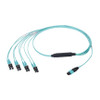
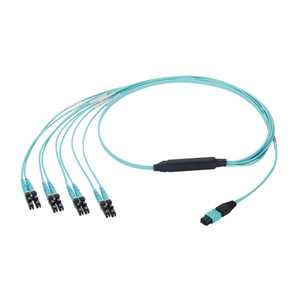
Panduit FZ8RP5NLSQNM015 QuickNet OM4 8-Fiber MPO-LC Harness Assembly
The Panduit FZ8RP5NLSQNM015 is a factory-terminated OM4 8-fiber harness assembly designed for rapid deployment in 40G/100G datacenter and enterprise network environments. This 15-meter (49.2 ft) plenum-rated cable transitions from a single MPO-8 female connector to four LC duplex connectors via a 60cm breakout harness, enabling clean, organized fiber distribution from backbone trunks to individual switch ports or patch panels. Pre-terminated construction eliminates field splicing, reduces labor costs, and ensures consistent insertion loss performance across all eight fibers.
Key Features
- OM4 50/125μm multimode fiber — supports 40GBASE-SR4 up to 150 meters and 100GBASE-SR4 up to 100 meters, future-proofing datacenter infrastructure for high-speed Ethernet migration
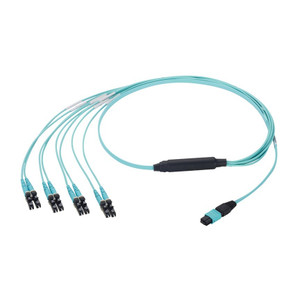
- MPO-8 female to 4× LC duplex breakout — 4-to-1 fanout harness provides flexible connectivity between high-density MPO trunk cables and standard LC duplex switch ports without intermediate panels
- Factory-terminated with guaranteed insertion loss — pre-polished connectors and factory testing ensure Standard IL (≤0.5 dB typical) performance, eliminating field termination risk and reducing deployment time by 60% or more
- Plenum (OFNP) rated jacket — meets NEC Article 770 requirements for installation in air-handling spaces above drop ceilings and under raised floors without conduit
- 60cm equal-length breakout legs — all four LC duplex pairs break out at the same point with equal 24" legs, simplifying cable management and maintaining consistent reach to adjacent patch panel or switch ports
- Aqua jacket color coding — industry-standard OM4 identification per TIA-598-C enables instant visual verification of fiber type during moves, adds, and changes
Datacenter operators migrating from 10G to 40G or 100G Ethernet face a critical decision: continue with traditional LC duplex infrastructure and accept the cable density penalties, or adopt MPO-based parallel optics and gain 4× or 10× port density in the same rack space. The Panduit QuickNet harness assembly bridges both architectures — your backbone runs high-density 8-fiber or 12-fiber MPO trunks between floors or across rows, while the harness provides the final fanout to legacy LC duplex switch ports or storage arrays. This hybrid approach delivers immediate density gains in the backbone (reducing pathway congestion and cable tray fill) while preserving compatibility with existing 10G SFP+ and 40G QSFP+ SR4 optics that expect four duplex fiber pairs. The 15-meter overall length is purpose-built for typical datacenter runs: MPO trunk terminates at a zone distribution panel mid-row, and the harness provides the final 15 meters to the top-of-rack switch. The 60cm breakout length gives just enough slack for dressing cables into vertical cable managers without excess service loop that wastes space and traps heat.
OM4 laser-optimized 50μm multimode fiber is the de facto standard for datacenter multimode links deployed since 2010. Compared to legacy OM3, OM4 extends 40GBASE-SR4 reach from 100m to 150m and supports 100GBASE-SR4 out to 100m — critical headroom when your link budget includes multiple MPO trunk interconnects, patch panels, and breakout harnesses in series. The 850nm VCSEL wavelength used by SR4 optics operates at 4.7 GHz·km effective modal bandwidth on OM4 (vs. 2.0 GHz·km on OM3), reducing differential mode delay and improving bit error rate at 25 Gbps per lane. In practice, this means a 40G link over OM4 with two mated pairs and a harness will stay well below the 1.5 dB loss budget, leaving margin for connector degradation over 20+ years of service life. For new datacenter builds or floor refreshes, OM4 is the minimum viable multimode spec; for brownfield integration with existing OM3 plant, these harnesses maintain backward compatibility while enabling incremental OM4 injection as you add new trunk runs.
The MPO-8 female connector uses a standard 12-fiber MPO housing with the center four fibers unpopulated — this is the correct connector style for 40GBASE-SR4 and 100GBASE-SR4 parallel optics, which use eight fibers (four duplex pairs). The female (socket) side mates with male (pinned) MPO trunk cables and cassettes, following TIA-604-5 polarity Method B: position 1 on the MPO maps to the first LC duplex pair, position 2 to the second pair, and so on. Each LC duplex connector is a standard ceramic-ferrule UPC polish (not APC), matching the 0° angle used universally in multimode datacenter links. The breakout harness uses a furcation boot at the 60cm point — all four duplex legs split simultaneously rather than cascading at different lengths — so when you route the harness vertically into a cable manager, all four LC connectors arrive at the patch panel or switch faceplate at the same height. This equal-length fanout is critical for maintaining cable bend radius and avoiding stress on individual fibers that can degrade insertion loss or cause long-term reliability issues.
Factory termination and testing are the primary value drivers for pre-terminated harness assemblies. Panduit manufactures these cables in a controlled cleanroom environment, cleaves and polishes each fiber end face to sub-0.5 dB insertion loss, and performs automated optical testing on all eight fibers before shipment. Every cable ships with a test report showing actual measured IL and return loss per fiber pair. Contrast this with field termination: even an experienced tech with an MPO termination kit will spend 45–60 minutes per connector end (cleave 8 or 12 fibers simultaneously, load into the MPO housing, polish the array ferrule, inspect under microscope, test, rework failures), and achieving consistent IL across all fibers requires skill and proper environmental conditions (dust and humidity are the enemy). Factory termination eliminates the variability — you get known-good performance, installation time drops to minutes instead of hours, and your team can focus on routing and documentation rather than termination troubleshooting.
Plenum rating (OFNP) is mandatory for any cable installed in air-handling spaces per NEC 770.113. Most datacenter deployments run cables above a drop ceiling (supply plenum) or beneath a raised floor (return plenum), both of which require plenum-rated cable unless the cable is fully enclosed in metal conduit or raceway. The OFNP jacket is formulated with flame-retardant and low-smoke compounds that meet the UL 910 Steiner Tunnel test for flame spread and smoke density — in a fire scenario, the jacket will self-extinguish and produce minimal smoke, reducing risk to occupants and firefighters. Non-plenum (riser or general-purpose) fiber cables are not code-compliant for these installations and will fail inspection. The aqua jacket color is the TIA-598-C standard for OM4 multimode fiber, enabling instant identification during troubleshooting or adds/changes years after the initial install. When a tech opens a cable tray and sees aqua cables, they immediately know it's OM4 multimode; when they see yellow (OS2 singlemode) or orange (OM1/OM2 legacy multimode), they know to route accordingly.
This harness assembly meets or exceeds ISO/IEC 11801 (international structured cabling), TIA-568-C.3 (optical fiber cabling components), TIA-604-5 (FOCIS-5 MPO connector performance), and TIA-604-10 (FOCIS-10 LC connector performance). It is RoHS compliant (lead-free, no restricted substances) and qualifies for LEED credits in green building projects. For 40G/100G network migrations, campus fiber backbones, or storage area network (SAN) connectivity, this pre-terminated harness assembly reduces project risk, accelerates deployment schedules, and ensures insertion loss performance that will support multi-generational optics upgrades without re-cabling.