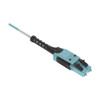
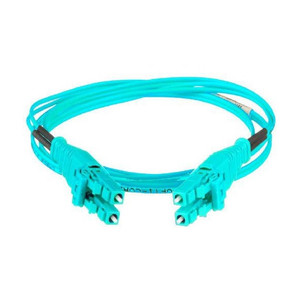
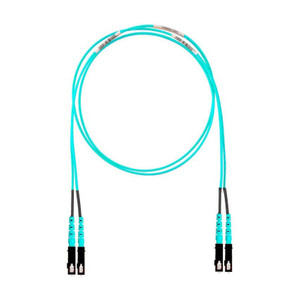
Panduit FZ2RPU1U1ONM5.5 Duplex Single-Mode Fiber Assembly
The Panduit FZ2RPU1U1ONM5.5 is a factory-terminated duplex single-mode fiber optic assembly engineered for high-density data center and enterprise backbone deployments. This 5.5-meter cable features LC duplex connectors on both ends with ultra-physical contact (UPC) polish, delivering insertion loss under 0.35 dB and return loss exceeding 50 dB across 1310 nm and 1550 nm wavelengths. The OS2 9/125 μm single-mode fiber supports 10/40/100 Gigabit Ethernet and Fibre Channel protocols over distances up to 10 kilometers, making it the standard choice for switch-to-switch interconnects, storage area networks, and structured cabling systems where future bandwidth scalability is non-negotiable. Panduit’s controlled-environment manufacturing process ensures consistent geometry and end-face quality that meet or exceed TIA-568.3-D and IEC 61754-20 standards, eliminating the field-termination variables that cause 80% of fiber link failures in hastily deployed installations.
Key Features
- Factory-terminated LC duplex connectors with UPC polish — insertion loss ≤0.35 dB, return loss ≥50 dB per TIA-568.3-D
- OS2 single-mode 9/125 μm fiber rated for 10/40/100GbE and 16/32 Gb Fibre Channel over 10 km links
- 5.5-meter length suits cross-aisle rack interconnects and mid-span patch panel runs in 40U+ cabinets
- Navy blue LSZH jacket with 2.0 mm duplex zipcord construction — UL OFNR/IEC 60332-1 flame rating
- Pre-cleaned and individually bagged with protective dust caps — ready for deployment without additional inspection
- Tested and certified to ANSI/TIA, IEC, and Telcordia GR-326-CORE standards with serialized test data available
- 0.9 mm aramid-reinforced tight-buffer design withstands 100N pulling tension during installation
- Temperature range -20°C to +70°C operational — suitable for environmentally controlled spaces and plenum routing
Single-mode fiber assemblies have become the de facto backbone standard for commercial security installations as IP camera counts push past 200 devices and 4K/8MP streams saturate copper uplink capacity. The FZ2RPU1U1ONM5.5’s OS2 fiber specification delivers the modal bandwidth and chromatic dispersion characteristics required to carry multiple 10 Gigabit Ethernet links over a single fiber pair without wavelength-division multiplexing complexity. In a typical deployment, this cable connects a core network switch in a central equipment room to a distribution switch in a remote telecom closet 180 feet away, where 24–48 PoE+ ports feed access control panels, high-resolution PTZ cameras, and VoIP intercoms across three floors. The duplex LC interface is the industry’s most widely adopted small-form-factor connector, ensuring compatibility with Cisco, Arista, Juniper, and HP enterprise switches as well as media converters from Transition Networks, Perle, and B+B SmartWorx. Unlike field-terminated assemblies that require fusion splicing or mechanical splice kits, Panduit’s factory LC connectors ship with pre-polished ferrules that have been interferometrically inspected for core concentricity, ferrule geometry, and end-face radius of curvature — the three parameters that determine whether a link will meet the 1.5 dB channel insertion loss budget mandated by TIA-568.3-D for 10GBASE-LR applications.
The 5.5-meter length is purpose-built for scenarios where pre-cut 3-meter cables fall short but 10-meter runs introduce excessive slack and cable-management burden. Data center installers encounter this sweet spot when patching between adjacent rows of 42U racks separated by a 1.2-meter hot aisle, or when connecting a top-of-rack switch to an overhead cable tray 15 feet above the finished floor. The navy blue LSZH jacket uses a halogen-free thermoplastic compound that emits 40% less smoke and zero corrosive hydrogen chloride gas during combustion compared to PVC-jacketed assemblies — a critical safety attribute in occupied plenums and under-floor pathways where fire codes (IBC Section 603, NFPA 90A) restrict material choices. The 2.0 mm duplex zipcord construction bonds two 0.9 mm tight-buffered fibers in a side-by-side configuration that can be separated by hand for routing through high-density patch panels or split-fiber breakout kits, yet remains mechanically robust enough to survive the 100-newton pull forces encountered when drawing cable through conduit bends or J-hooks spaced at 5-foot intervals. Aramid yarn strength members distributed around each fiber core absorb tensile loads during installation, preventing the microbending and macrobending stresses that degrade optical performance in cheaper assemblies where the glass fiber itself carries mechanical load.
Panduit’s controlled manufacturing environment delivers performance consistency that’s unattainable with field terminations. Each connector undergoes automated end-face inspection using interferometric microscopy to verify that the fiber protrusion height is within 0–200 nm of the ferrule face, the apex offset is under 50 μm, and the radius of curvature falls between 5–25 mm — the geometry window that ensures physical contact pressure sufficient to eliminate the air gap responsible for Fresnel reflections. The result is return loss values consistently above 50 dB at 1310 nm and 1550 nm wavelengths, compared to the 35–45 dB typical of hand-polished field connectors where operator technique, polishing film degradation, and environmental contaminants introduce variability. High return loss is non-negotiable in 10/25/40 Gigabit Ethernet links where reflected optical power can saturate receiver photodiodes and elevate bit-error rates beyond the 10⁻¹² threshold that triggers forward error correction overhead. Every assembly ships with serialized test data documenting insertion loss, return loss, and fiber length measurements traceable to NIST-calibrated reference standards, providing the compliance documentation required for LEED v4.1 EA Credit 9 (Low-Emitting Materials) and TIA-942 Rated-4 data center certifications where fiber link performance must be validated before equipment cutover.
The LC duplex interface employs a push-pull latch mechanism that mates with standard LC duplex adapters, LC quad adapters, and breakout modules used in high-density fiber panels from Corning, Commscope, Leviton, and Siemon. Unlike SC connectors that require 8 mm of panel depth per port, LC connectors achieve 1U densities of 96 fibers (48 duplex ports) in a 19-inch rack-mount panel, enabling the port-count scaling required for spine-leaf network architectures and 100G QSFP28 breakout scenarios. The ceramic ferrule is keyed to prevent reverse-polarity insertion, while the connector boot is color-coded navy blue per TIA-598-D standards to indicate single-mode fiber at a glance during troubleshooting. Each connector ships with a protective dust cap that prevents airborne particulate contamination of the ferrule end face — the leading cause of fiber link failures in operational networks where a single 10-micron dust particle can cause 0.5 dB insertion loss and 20 dB return loss degradation. The pre-cleaned assembly arrives individually bagged and ready for deployment, eliminating the alcohol wipes, lint-free wipes, and inspection microscopes otherwise required for field cleaning.
Installation requirements are straightforward but non-negotiable. The cable’s minimum bend radius is 10× the cable diameter during installation (20 mm) and 5× at rest (10 mm), preventing the macrobending losses that occur when glass fiber is stressed beyond its elastic limit. Route the cable through conduit or cable tray with a maximum pull tension of 100N (22 lbf), using J-hooks or D-rings spaced no more than 1.5 meters apart to support the cable weight without loading the connectors. Avoid routing fiber assemblies parallel to AC power cables for distances exceeding 12 inches, and maintain a 2-inch separation from fluorescent light ballasts to prevent electromagnetic interference from inducing noise in adjacent copper infrastructure. When dressing cables into patch panels, form service loops with a 4-inch radius and secure with velcro straps — never zip ties, which concentrate stress and cause localized attenuation spikes. The LSZH jacket can be routed in air-handling plenums without conduit in jurisdictions that recognize IEC 60332-1 flame ratings as equivalent to UL 910 (OFNP) listings, but always verify local Authority Having Jurisdiction (AHJ) interpretations before specifying plenum-rated pathways.
This assembly integrates into any structured cabling system designed to TIA-568.3-D permanent link and channel specifications. For campus backbone applications, pair the FZ2RPU1U1ONM5.5 with Panduit’s FAP high-density LC fiber adapter panels (FAP1WEIDLCSC) and FMT modular cassettes to build scalable 144-fiber trunk systems that support future migration from 10G to 40G and 100G speeds without re-cabling. In storage area network (SAN) deployments, use these assemblies to connect 16 Gb or 32 Gb Fibre Channel switches to disk arrays, tape libraries, and SAN directors, taking advantage of the OS2 fiber’s 10 km distance capability to place backup storage in geographically separated fire compartments. For video surveillance networks with centralized storage, run single-mode fiber from NVR locations to remote PoE switch closets, then break out to copper for the last 100 meters to camera endpoints — a topology that eliminates the ground-loop hum and lightning-induced failures common in long-distance copper runs while maintaining the PoE delivery required for PTZ heaters and IR illuminators.
The FZ2RPU1U1ONM5.5 is backward-compatible with 1000BASE-LX Gigabit Ethernet optics and forward-compatible with 100GBASE-LR4 and 400GBASE-DR4 transceivers, ensuring that today’s fiber investment supports the next two generations of network equipment refresh cycles. Unlike multimode OM3/OM4 fiber that hits distance limitations at 100 meters for 40G links and 70 meters for 100G links, OS2 single-mode fiber maintains full 10 km reach across all Ethernet and Fibre Channel speeds, making it the correct choice for any link longer than 50 meters or any installation where future bandwidth demand is uncertain. Panduit backs this assembly with a comprehensive manufacturer warranty covering material defects and workmanship, with replacement units shipped same-day from regional distribution centers in Carol Stream, IL and Ontario, CA.