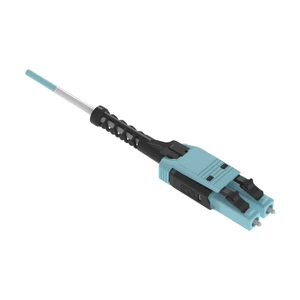
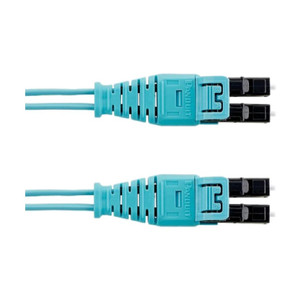
Panduit FZ2RLU1U1ONM043 QuickNet™ OM4 LC Uniboot Fiber Assembly
The Panduit FZ2RLU1U1ONM043 is a factory-terminated OM4 multimode fiber optic assembly featuring LC uniboot connectors, LSZH jacketing, and a 43-meter (141-foot) length engineered for datacenter spine-leaf architectures, SAN fabrics, and inter-row 40/100 Gigabit Ethernet links. The uniboot connector design reduces panel density by 50% compared to traditional duplex LC configurations while providing tool-free polarity reversal—critical for rapid deployment in TIA-942-B tier-rated facilities where cabinet real estate and change-order speed directly impact uptime. LSZH (Low Smoke Zero Halogen) jacketing meets IEC 60332-3-24 and international building codes for enclosed pathways, eliminating halogenated combustion byproducts that damage sensitive electronics and pose life-safety risks during fire events.
Key Features
- OM4 50/125µm multimode fiber supports 40GBASE-SR4 to 150 meters, 100GBASE-SR4 to 100 meters, and 10GBASE-SR to 400 meters over duplex LC at 850nm
- LC uniboot connector configuration halves faceplate port consumption and pathway congestion compared to standard duplex LC—24 ports per 1U panel vs. 12
- Tool-free polarity reversal via integral push-pull boot (180° rotation) eliminates re-termination and MPO adapter keys when switching A-to-B / B-to-A patching schemes
- LSZH jacket (2mm diameter) meets IEC 60332-1-2 flame propagation, IEC 61034-2 smoke density under 50%, and zero halogen emission per IEC 60754-1—required for ASHRAE TC 9.9 and NFPA 75 datacenter environments
- 43-meter length addresses typical spine-switch-to-leaf-switch horizontal runs, rack-to-rack SAN paths, or single-floor vertical risers in enterprise datacenters without splice points
- QuickNet™ factory termination delivers insertion loss under 0.15 dB and return loss exceeding -35 dB per TIA-568.3-D, tested end-to-end with traceable serial numbers and included test reports
- Aqua jacket color per TIA-598-D OM4 standard ensures instant visual identification in mixed-mode infrastructure
- Bend-insensitive fiber construction allows 7.5mm minimum bend radius under load (15mm unloaded) for tight pathway routing without attenuation spikes
- Compliant with TIA-568.3-D, ISO/IEC 11801-1, ANSI/TIA-942-B datacenter telecommunications infrastructure, and EN 50173 European cabling standards
OM4 multimode fiber delivers 4,700 MHz·km effective modal bandwidth at 850nm—sufficient for 100GBASE-SR4 transmission over 100-meter structured cabling links (IEEE 802.3bm) and 40GBASE-SR4 to 150 meters (IEEE 802.3ba). At the specified 43-meter length, this assembly supports current 100G optics with 24 dB link loss budget headroom, future-proofing for 200G and 400G short-reach datacenter optics as transceiver technology evolves. The 50µm core diameter and optimized refractive index profile minimize differential mode delay to under 0.14 ps/m, ensuring modal dispersion stays well below the 1.5 ps/m ceiling that triggers bit error rate degradation in VCSEL-based transceivers. Factory polish to sub-0.15 dB insertion loss means the assembly consumes only 7-10% of the IEEE 802.3 link budget, leaving margin for panel adapters, MPO cassettes, and in-line attenuators without requiring link-loss recalculation.
The LC uniboot connector consolidates transmit and receive fibers into a single 6.25mm-pitch footprint—identical width to a single simplex LC but carrying a full duplex pair. This halves the faceplate consumption on high-density modules (Panduit FAP6WEIDLC 144-port panels, Cisco Nexus 9300 QSFP+ line cards, Dell PowerEdge MX7000 fabric switches) and reduces pathway fill ratios in 4-inch cable trays where traditional duplex LC creates handling congestion above 60% capacity. The push-pull boot provides 180° polarity rotation without tools: when a transceiver or panel requires reversed polarity (Method B to Method A per TIA-568.3-D Annex A), the installer rotates the boot body to swap fiber positions at the ferrule—no patch-panel key swaps, no MPO adapter replacements, and no field re-termination labor. Internal strain relief transfers pull forces to the aramid strength member rather than the 2mm cable jacket, maintaining connector loss under 0.05 dB even after 500 insertion cycles per IEC 61300-2-2 durability testing. The aqua LSZH jacket uses a halogen-free polymer compound that self-extinguishes within 60 seconds of ignition (per IEC 60332-1-2 vertical flame test) and generates under 50% light obscuration in the IEC 61034-2 smoke chamber—critical for VESDA and aspirating smoke detection systems that trigger at 0.5-2.0% obscuration per square meter. During combustion, zero hydrogen chloride, hydrogen fluoride, or bromine gases are released (IEC 60754-1), preventing acid condensation on server backplanes, disk arrays, and power distribution busbars that causes latent corrosion failures 6-18 months post-event.
The 43-meter length maps to common datacenter topology dimensions: (1) spine-to-leaf horizontal runs in 12-rack rows with 42U cabinets spaced at 1.2-meter centers plus 8-meter overhead tray routing, (2) equipment distribution area (EDA) to main distribution area (MDA) connections spanning single-floor vertical risers with 3-4 meter ceiling heights and ladder-rack detours, and (3) SAN fabric switch-to-disk array links crossing hot/cold aisle containment barriers in modular datacenter pods. Unlike field-terminated solutions requiring on-site fusion splicing (30-45 minutes per 12-fiber trunk, 150-300 dollar labor per termination point, 0.3-0.5 dB splice loss) or mechanical splice connectors (0.2-0.3 dB typical loss, 5-10% field failure rate from contamination), the QuickNet assembly ships plug-ready with factory cleanliness, eliminating the 24-48 hour cure time for epoxy-polish terminations and the OTDR verification step that adds 200-400 dollars per link to commissioning costs. In 40GBASE-SR4 and 100GBASE-SR4 parallel optics deployments using MPO-to-LC breakout modules (Panduit FQTLP-24-10AS), the 43-meter length provides sufficient slack for Z-fold cable management in 1200mm-deep cabinets while maintaining the 7.5mm minimum bend radius at 90° transitions—preventing the bend-loss spikes exceeding 0.3 dB that occur when 2mm cable is kinked below 5mm radius in crowded vertical managers. The length also suits blade server environments (Cisco UCS 5108, HPE Synergy 12000) where top-of-rack leaf switches connect to chassis fabric modules through overhead trays spanning 15-25 meters of horizontal path plus 10-15 meters of vertical drop and service loop.
TIA-942-B datacenter standard mandates multimode fiber links of 300m or less for 10GBASE-SR and 150m or less for 40GBASE-SR4, making this 43-meter assembly compliant with Tier I through Tier IV topologies when used in structured cabling permanent links (ISO/IEC 11801-1 Class OM4). LSZH jacketing satisfies NFPA 90A plenum cable substitution hierarchy (LSZH acceptable in lieu of OFNP where local codes permit) and is required by IBC Section 2702 for cables installed in air-handling spaces without metal conduit in jurisdictions adopting the 2021 International Building Code. For international deployments, the assembly meets EN 50173-5 datacenter cabling (OM4 recognized to 550 meters at 10Gb/s), CENELEC EN 60332-3-24 Category A/F flame spread (under 2.5m vertical propagation for bundled cables), and CPR (Construction Products Regulation) Euroclass Dca-s2-d0-a1 performance when installed in EU member states requiring CE marking on permanent-link components. The QuickNet factory process includes automated end-face inspection per IEC 61300-3-35 (sub-0.5µm scratch width, zero debris in core/cladding zones), serialized test documentation showing insertion loss at 850nm and 1300nm wavelengths, and TraceView labeling for as-built documentation integration—ensuring the assembly passes acceptance testing per ANSI/TIA-526-14-B OFSTP-14 multimode loss measurement without installer rework. This assembly integrates with Panduit FiberRunner cable management, FAP high-density panels, and Opti-Core MPO-to-LC modules for a single-vendor structured cabling solution where warranty, lead time, and TAC support unify under one engineering contact.