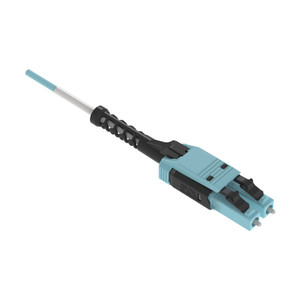
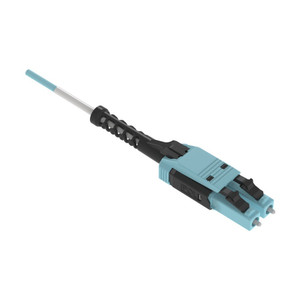
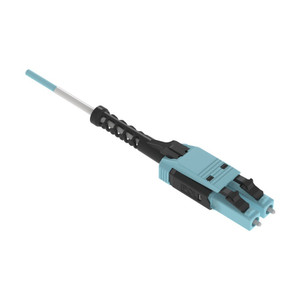
Panduit FZ2RLU1ZNNNM023 QuickNet™ 23m OM4 2-Fiber LC Duplex LSZH Cable Assembly
The Panduit FZ2RLU1ZNNNM023 is a factory-terminated 23-meter (75.5 ft) OM4 multimode fiber optic cable assembly engineered for high-speed datacenter and telecom applications where installation speed, density, and fire safety are non-negotiable. Built on Panduit's QuickNet™ platform, this 2-fiber LC duplex uniboot cable delivers 50/125µm OM4 performance in a Low Smoke Zero Halogen (LSZH) jacket, supporting 10GBASE-SR, 40GBASE-SR4, and 100GBASE-SR4 transmission over distances up to 150 meters at 10 Gb/s and 100 meters at 40/100 Gb/s. Pre-terminated at the factory with precision-polished LC connectors and rigorously tested for insertion loss and return loss, this cable eliminates field termination labor, reduces installation errors, and accelerates deployment timelines in mission-critical environments. The 23-meter length is optimized for intra-rack, inter-rack, and horizontal datacenter runs where standard 15m or 30m cables would require custom field work or leave excessive slack.
Key Features
- OM4 Multimode Fiber (50/125µm): Laser-optimized for 10/40/100 Gb/s Ethernet; 150m reach at 10G, 100m at 40/100G per IEEE 802.3 standards
- LC Duplex Uniboot Connector: Push-pull latch design in compact uniboot housing; 50% footprint reduction vs. dual-boot LC for high-density panel applications
- LSZH Jacket (Low Smoke Zero Halogen): IEC 60332-1/-3 flame-rated; emits minimal smoke and zero corrosive halogen gases during fire — required for enclosed datacenter hot aisles, telecom equipment rooms, and air-handling spaces per NFPA 90A and TIA-942-B
- Factory Pre-Terminated & Tested: Each cable assembly endface-inspected and tested for <0.35 dB insertion loss and >20 dB return loss; serialized test report available; eliminates field splicing and reduces deployment time by 70% vs. loose fiber installation
- 23-Meter Length (75.5 ft): Purpose-built for mid-distance datacenter trunk runs between aggregation switches and top-of-rack switches, or horizontal cable distribution in telecom equipment rooms where standard increments don't fit
- QuickNet™ Platform Compatibility: Integrates with Panduit QuickNet fiber cassettes, enclosures, and MPO-to-LC breakout modules for structured cabling architectures; supports migration from 10G to 40/100G without re-cabling
- Compliance: TIA-568.3-D, ISO/IEC 11801-1 Ed. 1.1, ANSI/TIA-942-B (datacenter telecommunications infrastructure), IEC 61754-20 (LC connector interface standard)
- Pull-Through Design: 2mm cable diameter with bend-insensitive fiber core; supports 90° bend radius down to 20mm during installation and 10mm static — critical for cable management in 1U fiber panels and zero-U vertical managers
OM4 Performance & Application Context: OM4 multimode fiber is the de facto standard for modern datacenter and enterprise network backbones supporting 10/40/100 Gigabit Ethernet over VCSEL (Vertical-Cavity Surface-Emitting Laser) transceivers. The FZ2RLU1ZNNNM023 cable uses aqua-jacketed 50/125µm laser-optimized fiber with a minimum effective modal bandwidth of 4700 MHz·km at 850nm, enabling 10GBASE-SR transmission up to 400 meters (though this specific cable is 23m) and 40/100GBASE-SR4 up to 100 meters per IEEE 802.3ba. The LC duplex uniboot connector — featuring a single compact boot housing both transmit and receive fibers — reduces panel congestion by 50% compared to traditional dual-boot LC designs, a critical advantage in high-density 1U fiber panels with 72+ ports. The push-pull latch mechanism allows one-handed insertion and extraction even in fully populated panels, and the polarity of the duplex pair is fixed at the factory (transmit on position A, receive on position B per TIA-568.3-D), eliminating the crossed-pair errors common with field-assembled connectors. Each connector ferrule is precision-polished to a physical-contact (PC) endface geometry and inspected under 400x magnification for scratches, pits, and debris before leaving the factory; insertion loss is guaranteed below 0.35 dB and return loss above 20 dB per TIA standards, ensuring link budgets remain within transceiver receiver sensitivity limits even after multiple mating cycles.
LSZH Jacket & Datacenter Fire Safety: The Low Smoke Zero Halogen (LSZH) jacket on this cable is compounded from halogen-free polymers that meet IEC 60332-1 (single vertical flame test) and IEC 60332-3 (bunched cable flame test) requirements, as well as IEC 61034 (smoke density) and IEC 60754 (halogen content) standards. In a fire, LSZH cables emit <50% light transmittance loss (low smoke) and <0.5% halogen acid gas (zero halogen), compared to standard PVC cables that can produce dense black smoke and corrosive hydrochloric acid gas. This is a hard requirement under ANSI/TIA-942-B for Tier III and Tier IV datacenters where fiber cables are routed through hot-aisle containment systems, under-floor air-handling plenums, and overhead cable trays in enclosed equipment rooms. Many datacenter operators and enterprise IT departments mandate LSZH for all horizontal and backbone fiber cabling to protect both personnel (visibility and toxicity) and equipment (corrosive gas damage to switch ASICs and optics during fire suppression activation). NFPA 90A (Standard for Installation of Air-Conditioning and Ventilating Systems) and local building codes in Europe, Asia, and increasingly North America require LSZH or plenum-rated (OFNP) cables in air-handling spaces; the aqua LSZH jacket on OM4 cable is the globally recognized color code per TIA-598-D, simplifying visual inspection and change management.
Pre-Termination & Deployment Advantages: Field termination of fiber optic cables — whether fusion splicing pigtails or epoxy-polishing connectors — is labor-intensive, requires specialized equipment (fusion splicers, polishing pucks, inspection microscopes), and introduces variables that affect long-term link performance (endface quality, fiber alignment, contamination). A single fusion splice typically takes 5-10 minutes per fiber and requires a trained technician; epoxy/polish connectors take 15-20 minutes per connector and have higher insertion loss variance. The Panduit FZ2RLU1ZNNNM023 eliminates this entirely: the cable arrives on-site with factory-installed LC connectors on both ends, each pre-tested and individually serialized with insertion loss, return loss, and length measurements stored in Panduit's quality database. Installation is reduced to a pull-and-plug operation — route the cable through cable tray or conduit, dress it into the fiber panel, insert both LC connectors into duplex adapters, and verify link light on the switch. For a typical 42U rack deployment with 24 fiber links (48 connectors), field termination would require 12-16 hours of technician time plus splice/polish consumables; pre-terminated cable reduces this to 2-3 hours of pulling and dressing. The 23-meter length is purpose-built for mid-distance datacenter runs: connecting a core aggregation switch in row A to top-of-rack switches 15-20 meters away in row B, or linking telecom equipment room patch panels to entrance facility demarcation points where the physical distance exceeds 15m but falls short of 30m standard increments. The 2mm cable diameter and bend-insensitive fiber allow routing through crowded vertical cable managers and 1U horizontal panels with tight bend radii (down to 10mm static, 20mm dynamic), reducing the need for service loops and slack management that waste rack space.
The FZ2RLU1ZNNNM023 complies with TIA-568.3-D (Optical Fiber Cabling Components Standard), ISO/IEC 11801-1 Ed. 1.1 (Generic Cabling for Customer Premises), and ANSI/TIA-942-B (Telecommunications Infrastructure Standard for Data Centers), the latter governing structured cabling design for Tier I through Tier IV datacenter classifications. TIA-942-B mandates permanent link insertion loss budgets of ≤2.0 dB for OM4 horizontal links and ≤3.0 dB for backbone links, including connectors and splices; a 23-meter OM4 cable with two LC connectors contributes approximately 0.85 dB total (0.08 dB cable attenuation + 0.35 dB × 2 connectors), leaving ample margin for patch cords and panel adapters. The QuickNet™ platform is architected for scalability: this cable integrates with Panduit's FAP fiber adapter panels, FMP modular cassettes, and FHD high-density enclosures, allowing datacenter operators to start with 10GBASE-SR infrastructure today and migrate to 40/100GBASE-SR4 tomorrow by swapping transceivers without re-pulling cable. For commercial integrators, IT infrastructure contractors, and datacenter build teams deploying mission-critical fiber backbones under aggressive schedules, the Panduit FZ2RLU1ZNNNM023 delivers factory-certified performance, regulatory-compliant fire safety, and field-proven reliability in a plug-and-play package that eliminates the single largest variable in fiber installations: the quality of field terminations.