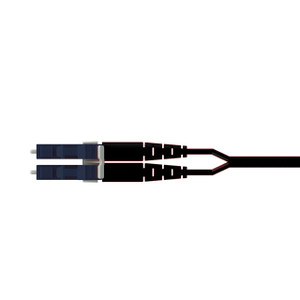
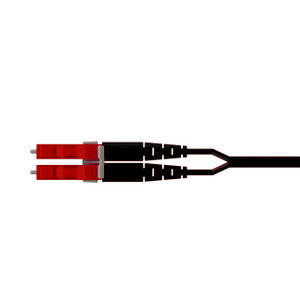
Panduit FS2EPKCKCNCM007 Opti-Core™ OM4+ 2-Fiber LC Duplex Patch Cord with C-Code Keying
The Panduit FS2EPKCKCNCM007 delivers laser-optimized OM4+ performance with physical-layer security for high-density data center and enterprise backbone deployments. This 7-meter duplex LC patch cord features Signature Core™ fiber technology for ultra-low insertion loss, C-code keyed connectors to prevent unauthorized or accidental cross-connects, and plenum-rated (OFNP) construction for unrestricted routing through air-handling spaces. Green cable jacket and connectors meet TIA-598 color standards for instant OM4+ identification in congested pathways, while factory termination and testing eliminate field labor variability on mission-critical 40G and 100G links.
Key Features
- OM4+ Signature Core™ fiber supports 40GBASE-SR4 to 150m and 100GBASE-SR4 to 100m with headroom for future 400G migrations
- C-code keyed duplex LC connectors provide physical-layer security—components mate only with matching coded counterparts to prevent wrong connections in secure or mission-critical environments
- Ultra-low insertion loss (typically <0.15 dB per mated pair) maximizes link budget for extended reach and higher transceiver sensitivity margins on 10/40/100G links
- Plenum-rated OFNP jacket meets NEC Article 770 for unrestricted installation in ceiling plenums, raised floors, and HVAC ducts without conduit
- Zipcord 1.6mm cable design enables tight-radius bends and simplified routing in high-density racks and cable managers
- Green color coding per TIA-598 standard ensures instant OM4+ identification and reduces deployment errors during moves, adds, and changes
- Factory-terminated and tested to Panduit quality standards—eliminates field termination labor and insertion-loss variability
- 7-meter length suits cross-aisle data center runs, row-to-row rack patching, and IDF equipment interconnects
OM4+ fiber represents the next evolution beyond standard OM4 multimode, tightening modal bandwidth and geometry tolerances to extend reach and improve margin on 40G and 100G short-reach links. Panduit's Signature Core™ manufacturing process produces fiber with concentricity and ovality specifications that exceed TIA-492AAAD minimums, resulting in insertion losses typically below 0.15 dB per mated pair—well under the TIA-568.3-D Grade B limit of 0.35 dB. For integrators deploying leaf-spine fabrics, storage area networks, or converged infrastructure stacks, this translates to fewer optical transceivers operating at the edge of their receive sensitivity and greater confidence in link uptime under temperature fluctuations, connector reseating cycles, or aging. The tighter tolerances also preserve margin when daisy-chaining through cassette modules or fiber distribution panels, where each additional mated pair compounds insertion loss.
The duplex LC connector form factor remains the industry standard for 10/25/40/100G transceivers across enterprise switches, storage arrays, and blade server interconnects. Its small footprint enables high port density on QSFP28, QSFP+, and SFP+ modules—critical when populating 48-port top-of-rack switches or 96-port spine switches in a two-post rack. LC's push-pull latch mechanism simplifies blind mating in congested rear-panel environments and resists accidental disconnection during adjacent cable moves, unlike older SC or ST connectors with twist locks that require more clearance and manipulation force. Factory polishing to physical-contact (PC) endface geometry ensures fiber cores make flush contact under spring tension, minimizing Fresnel reflection and air-gap losses that degrade signal integrity on high-speed links.
The C-code keyed connector system addresses a persistent challenge in secure facilities, multi-tenant data centers, and mission-critical network operations centers: accidental or malicious cross-patching. Each keyed connector features a mechanical tab-and-slot geometry that physically prevents mating with standard LC adapters or differently coded connectors (A-code, B-code, etc.). Deploying C-code patch cords on classified networks, financial trading floors, healthcare systems with PHI segregation requirements, or industrial control networks with OT/IT air gaps adds a tangible access-control layer beyond MAC address filtering or VLAN tagging. Even an authorized technician in the main distribution area cannot accidentally bridge isolated network segments without the matching keyed adapters—the connector simply will not insert. This mechanical enforcement complements logical security controls and satisfies physical-layer audit requirements under NIST SP 800-53, HIPAA Security Rule, or PCI DSS compensating controls for network segmentation.
The color-matched green boot and cable jacket also simplify visual audits and documentation. TIA-598-D specifies green for OM4 and OM5 laser-optimized multimode fiber, distinguishing it at a glance from aqua OM3, orange OM1/OM2, yellow singlemode, and blue OS2 low-water-peak singlemode. In a data center with thousands of fiber strands across dozens of racks, instant color recognition reduces human error during troubleshooting, MAC (moves-adds-changes), and emergency failover patching. You can verify that 40G uplinks are using OM4+ and not accidentally terminated with OM3 from a prior build phase—critical because OM3's lower bandwidth would throttle 100GBASE-SR4 links or force distance derating below the 100-meter minimum that OM4+ guarantees.
Plenum-rated OFNP (Optical Fiber Nonconductive Plenum) construction is non-negotiable for installations above drop ceilings, in air-return pathways, or under raised floors where conduit is impractical. This cord's outer jacket meets NFPA 262 (UL 910) flame and smoke propagation limits, ensuring code compliance in commercial office buildings, hospitals, schools, and government facilities where local AHJs enforce NEC Article 770. PVC-jacketed cables (OFN or OFNG riser-rated) would require metal conduit or continuous J-hooks outside the plenum, adding material cost and limiting flexibility for future reconfigurations. The OFNP jacket's low-smoke, low-flame-spread formulation also reduces life-safety risk during a fire event—critical in occupied spaces where smoke inhalation is the leading cause of fire fatalities.
The zipcord cable geometry—two buffered 900µm tight-buffered fibers side by side under a single flat jacket—strikes a balance between flexibility, protection, and space efficiency. Unlike round distribution cable with a central strength member, zipcord's flat profile lays neatly in horizontal cable managers without rolling or twisting, and its 1.6mm overall diameter permits tight-radius bends (10x bend radius = 16mm) for navigating congested vertical finger ducts and rear-panel clearances in 19-inch and 23-inch racks. The tight buffering protects each 125µm fiber from microbending stress that would attenuate signal, while the outer jacket provides abrasion resistance during repeated handling. This design is ideal for patch-cord applications where flexibility and reusability matter more than crush resistance or rodent protection (traits reserved for indoor/outdoor distribution cables).
The 7-meter (22.97 ft) length is a practical choice for intermediate-distance data center interconnects: cross-aisle patching between rows of racks (typical hot-aisle/cold-aisle layouts with 3-4 meter aisle widths), row-to-end-of-row distribution to fiber cassette panels, or equipment-to-MDA runs in telecom rooms where 3-meter cords fall short but 10-meter cords create excess slack. Excess slack invites cable sag, tangling, and airflow obstruction in overhead ladder racks or under-floor wire baskets—problems that violate BICSI DCIM best practices and complicate future MAC work. Proper length selection also reduces material waste and simplifies documentation: each patch cord can be routed with a single service loop near the termination point, giving you enough slack for transceiver reseating or switch replacement without coiling 5 meters of surplus cable that blocks adjacent ports or hides asset tags.
Factory termination and insertion-loss testing are non-negotiable for production data center deployments. Panduit terminates each LC connector under controlled clean-room conditions, uses automated polishing to achieve PC endface geometry with minimal apex offset, and validates insertion loss with an optical loss test set (OLTS) before packaging. This eliminates the 0.10-0.50 dB variability inherent in field terminations (fusion splicing, mechanical splices, or adhesive epoxy/polish connectors) and ensures every cord ships with insertion loss well below TIA Grade B limits. When you're populating a 10,000-port data center fabric, that consistency translates to predictable link budgets, fewer troubleshooting calls for intermittent 100G links, and faster commissioning because you're not hunting for high-loss outliers that need rework.
Integrates with Panduit's broader Opti-Core ecosystem—cassette modules, adapter panels, trunk cables, and distribution enclosures—all available with matching C-code keying for end-to-end physical-layer security across campus and data center networks. Meets TIA-568.3-D and ISO/IEC 11801 structured cabling standards for OM4 multimode fiber; complies with RoHS Directive 2011/65/EU for installations in EU member states or companies with global environmental procurement policies. Ships in cartons of 10 for volume deployments; individually packaged for break-bulk orders and sparing inventory.