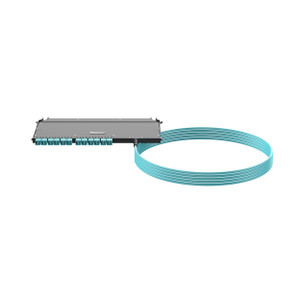
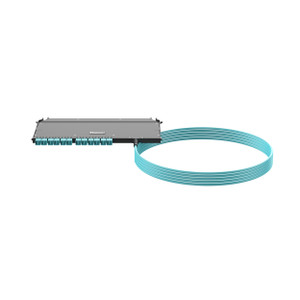
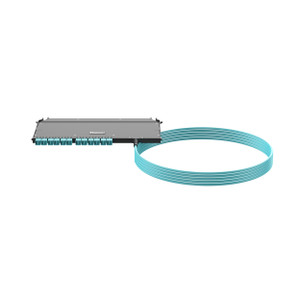
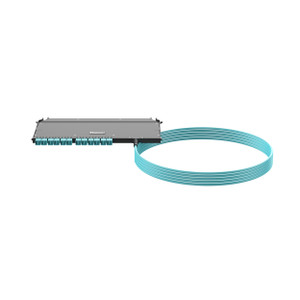
Panduit FSUYP7373KAF215 Opti-Core 24-Fiber OM4+ MPO Trunk Cable
The Panduit Opti-Core FSUYP7373KAF215 is a factory-terminated 24-fiber OM4+ trunk cable designed for high-speed backbone connectivity in mission-critical data centers and telecommunications infrastructure. Pre-terminated with MPO female connectors on both ends, this plenum-rated assembly eliminates field termination labor while delivering insertion loss performance that meets TIA-568.3-D and ISO/IEC 11801 standards. The 215-foot length supports vertical riser runs and cross-floor distribution in multi-tenant buildings, equipment rooms, and colocation facilities where rapid deployment and zero-downtime moves-adds-changes drive infrastructure decisions.
Key Features
- 24-fiber OM4+ multimode (50/125µm) with enhanced bandwidth for 40/100G Ethernet and future 400G migration paths
- Dual MPO female (12-fiber × 2-row MTP-style) connectors with pinned configuration for plug-and-play connectivity to cassettes and breakout modules
- Plenum-rated OFNP jacket compliant with NEC Article 770 for unrestricted installation in air-handling spaces
- Factory-terminated and tested to < 0.35 dB insertion loss per mated pair, eliminating field fusion-splice variability
- 215-foot length engineered for vertical backbone runs between floors in enterprise and colocation environments
- TIA-568.3-D, ISO/IEC 11801-1, and ANSI/TIA-942-B compliant for Tier III/IV data center structured cabling
- Push-pull connector boots with strain relief for secure latching in high-density patch panels and fiber enclosures
- Panduit's Opti-Core quality standard: bend-insensitive fiber and factory insertion-loss testing on every trunk
The FSUYP7373KAF215 uses Panduit's OM4+ fiber specification—an enhanced-bandwidth variant of standard OM4 that extends effective modal bandwidth to support 100-meter 100GBASE-SR4 links and 150-meter 40GBASE-SR4 runs without requiring OM5 wideband fiber. Each of the 24 fibers is 50/125µm laser-optimized multimode with a nominal core diameter of 50 microns and 125-micron cladding, manufactured to IEC 60793-2-10 A1a.2 geometry tolerances. The fiber is arranged in two 12-fiber rows within the MPO ferrule, following the TIA-604-5-D (IEC 61754-7) polarity method for Type A trunk cabling—row 1 carries fibers 1-12, row 2 carries fibers 13-24, with position 1 at the connector key-up orientation.
Both connectors are MPO female (no guide pins), which means they mate with male (pinned) MPO connectors on cassette modules, breakout harnesses, or opposing trunk cables using the standard Method A or Method B polarity schemes. The ferrule end-face is factory-polished to meet IEC 61300-3-35 specifications for geometry (radius of curvature, apex offset, fiber height) and insertion loss testing confirms < 0.35 dB per mated connector pair when coupled to a reference-grade jumper. Return loss exceeds 20 dB at 850 nm and 1300 nm wavelengths, minimizing back-reflection that can degrade VCSEL transmitter performance in 40G/100G optics.
The cable jacket is OFNP-rated (Optical Fiber Nonconductive Plenum), tested per UL 910 Steiner Tunnel flamespread and smoke density requirements for installation in ceiling plenums, raised floors, and HVAC ducts without additional conduit. The jacket material is a low-smoke, flame-retardant compound that meets NFPA 262 (UL 910) with a maximum flame spread index of 5 and peak optical density < 0.5. Unlike PVC-jacketed riser cables (OFNR), OFNP trunks can be pulled through air-return spaces in compliance with NEC 770.113(B), avoiding the cost and schedule impact of metallic conduit or fire-rated pathways.
The 215-foot assembly length is a factory-defined cut optimized for vertical backbone distribution. In a typical deployment, this trunk runs from a main distribution area (MDA) on the building entry floor to an intermediate distribution area (IDA) or horizontal distribution area (HDA) 15-20 floors above, with sufficient slack for routing through cable trays, vertical J-hooks, and zone enclosures. Panduit specifies a minimum bend radius of 10× cable diameter under no-load conditions and 20× diameter under tension during installation—for this 6mm nominal OD trunk, that's 60mm static bend and 120mm dynamic, well within the radius of standard 4-inch ladder rack and vertical wire managers.
This trunk cable is purpose-built for scenarios where horizontal patch cords and field-terminated connectors introduce unacceptable failure risk or labor cost. In colocation and hyperscale data centers, the FSUYP7373KAF215 connects spine switches in a core aggregation layer to leaf switches or optical distribution frames (ODF) in modular pods or rows, supporting 40GBASE-SR4 (4× 10G lanes) or 100GBASE-SR4 (4× 25G lanes) uplinks using QSFP+ or QSFP28 transceivers with MPO/MTP interfaces. A single 24-fiber trunk can support two independent 12-fiber duplex links (e.g., two 40G uplinks with MTP-to-LC breakout cassettes) or one 24-fiber parallel link for future 400GBASE-SR8 migration when paired with appropriate breakout infrastructure.
In enterprise campus environments, it's the backbone between telecommunications rooms (TRs) across floors, carrying aggregated traffic from access switches to a core routing layer. The 215-foot length accommodates 18-20 floor vertical runs in buildings with 10-12 foot floor-to-floor heights, plus 30-40 feet of horizontal routing within TRs and slack loops for future re-termination or panel relocations. Installers typically secure the trunk to vertical J-hooks or D-rings at 4-5 foot intervals using Panduit's PAN-TY releasable cable ties (strap tension < 50 lbs to avoid fiber compression), with transition to horizontal ladder rack or basket tray at floor penetrations.
Polarity management is critical in MPO trunk deployments. Most integrators use TIA-568 Method A (straight-through mapping with key-up to key-down orientation flip) or Method B (reversed pairs with key-up on both ends plus a crossover adapter). The FSUYP7373KAF215 ships as a straight-through trunk—transmit fiber 1 at connector A maps to receive fiber 1 at connector B—so duplex polarity is achieved by pairing it with Type A or Type AF cassettes (Panduit FAP modules) or by using MPO-to-LC breakout modules with A/B key coding. Field technicians label both ends with the same trunk ID and document the polarity method in as-built drawings; many shops also use Panduit's color-coded connector boots (aqua for OM4+, magenta for OM4) to differentiate fiber grades in mixed-environment installations.
The plenum rating is non-negotiable in most commercial construction. Building inspectors and authority-having-jurisdiction (AHJ) reviews routinely verify UL 910 flame-test markings on cable jackets during rough-in and final inspections, and non-plenum cable installed above suspended ceilings is an automatic code violation under NEC 300.22(C) that can delay certificate of occupancy. Riser-rated (OFNR) trunks cost 15-20% less but require metallic conduit when routed through plenums, adding $8-12 per linear foot in EMT material and labor—making the OFNP upcharge negligible on a total-installed-cost basis for vertical backbone runs.
Pre-terminated trunk cables eliminate fusion splicing and field polishing, but they introduce pulling-tension and bend-radius constraints that don't apply to loose-tube or blown-fiber systems. The maximum pulling tension for this trunk is 110 pounds (500 newtons) per Panduit's installation guidelines—exceeding this threshold can deform the MPO ferrule geometry or crack individual fibers within the furcation tube, causing insertion-loss spikes or total link failure that won't surface until acceptance testing.
For vertical riser pulls, installers use a pull sock or Kellems grip attached to the jacket's strength member (aramid yarn layer beneath the OFNP sheath), never gripping the connectors directly. A pull rope with in-line dynamometer monitors real-time tension, keeping peak loads below 80 lbs to maintain a 30% safety margin. Horizontal pulls through overhead cable tray use intermediate support every 4-5 feet to prevent mid-span sag that can exceed bend-radius limits under the cable's own weight—6mm OD 24-fiber trunk weighs approximately 12 lbs per 100 feet, enough to create a 3-inch sag over unsupported 10-foot spans.
The MPO connectors ship with removable dust caps and protective boots. These must stay in place until final mating to prevent ferrule end-face contamination—a single 10-micron dust particle on the ferrule creates a 0.5+ dB insertion loss penalty and potential permanent micro-scratches. After pulling, both ends are coiled with 12-18 inch service loops and secured in fiber enclosures or slack management rings. Many integrators use Panduit's FAP cassette enclosures with built-in MPO adapter panels, allowing the trunk's MPO connectors to mate with cassette-mounted MPO ports while LC duplex connectors break out to individual switch ports or patch panels on the horizontal side.
Acceptance testing per TIA-526-14-C requires insertion loss measurement at 850 nm and 1300 nm using an MPO reference cord and light source, verifying each fiber pair meets the < 0.75 dB channel budget (0.35 dB connectors + 0.10 dB splice or adapter + 0.30 dB for 200m fiber). Panduit ships test reports with each trunk showing factory insertion loss, but field verification is mandatory to confirm no damage occurred during installation.
The FSUYP7373KAF215 is engineered to meet TIA-568.3-D optical fiber cabling component specifications, which define performance requirements for OM4 multimode fiber (minimum 4700 MHz·km effective modal bandwidth at 850 nm), MPO connector geometry per TIA-604-5-D, and channel insertion loss budgets for 40GBASE-SR4 and 100GBASE-SR4 Ethernet. It's also compliant with ISO/IEC 11801-1 generic cabling standards for OM4 fiber (Class OM4 in international nomenclature) and ANSI/TIA-942-B telecommunications infrastructure standard for data centers, which mandates fiber-optic backbone cabling between main distribution areas and horizontal distribution areas in Tier 2 through Tier 4 facilities.
For fire safety, the OFNP jacket meets UL 910 (Steiner Tunnel Test), NFPA 262 (Standard Method of Test for Flame Travel and Smoke of Wires and Cables for Use in Air-Handling Spaces), and NEC Article 770.113(A) listing requirements for optical fiber cables installed in ducts, plenums, and other environmental air spaces. The cable is UL Listed and RoHS 3 compliant (2015/863/EU directive on restriction of hazardous substances), meeting both North American and European environmental regulations for commercial infrastructure products.
Panduit's Opti-Core product line also adheres to IEC 61754-7 (MPO connector family specification) for ferrule geometry, insertion loss, and return loss performance. Each trunk undergoes factory end-face inspection using automated interferometry to verify ferrule radius of curvature (7-25mm), apex offset (< 50µm), and fiber height deviation (< 100nm)—parameters that directly impact insertion loss and long-term reliability. The inspection reports are available on request for projects requiring third-party verification or as-built documentation for ISO 9001 quality management system audits.
In U.S. federal and defense projects, the FSUYP7373KAF215 can be specified under GSA Schedule contracts for structured cabling components, though NDAA Section 889 compliance verification (excluding Chinese-manufactured fiber or connectors) may require a Panduit-issued country-of-origin certificate depending on the procurement authority's interpretation of the rule.
The FSUYP7373KAF215 occupies a specific niche in the Panduit Opti-Core portfolio—long-haul vertical backbone connectivity where plenum rating and 24-fiber density are non-negotiable. It's not the right trunk for horizontal runs under 100 feet (where Panduit's shorter FAP-series cassette jumpers offer lower cost per port) or for OM5 wideband applications requiring SWDM (short-wavelength division multiplexing) support. But for the core use case—connecting distribution frames across 15-20 floors in commercial high-rises, healthcare campuses, or university buildings—it eliminates the three highest-risk variables in fiber deployments: field termination skill variability, on-site polishing quality control, and plenum-compliance documentation gaps.
Pair it with Panduit's FAP1U6WBUDLC or FAP1U6WBUSC cassette modules (12-fiber MTP-to-LC or SC breakout in 1U enclosures) for plug-and-play duplex connectivity, or use with standards-based Method B polarity adapters when interfacing to non-Panduit MPO infrastructure. The 215-foot length is a fixed factory cut; if your vertical run exceeds 200 feet after accounting for slack, specify the next-longer SKU in the FSUYP series or consider transition boxes at intermediate floors to break the trunk into manageable segments that stay within bend-radius limits during installation.