Build Your Complete System
Manufacturer-verified compatible cameras, recorders, mounts, accessories, and licenses for this product. Adjust quantities and add the entire bundle to your cart in one click.
No Bots, Just Experts
Questions about this product? Free pre-sales support from a senior specialist — product questions, compatibility checks, BOM quotes, price confirmation — typically answered within one business day. Need camera placement or system design work? Engineering time is $175 per hour (qty 1 = 1 hour). Hardware buyers get up to one hour ($175) credited back on their order.
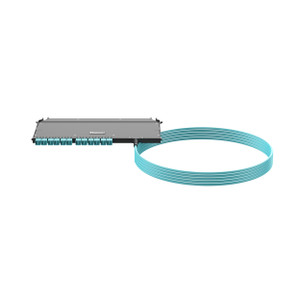
Panduit FZUYPXRNNNNF020 QuickNet OM4 24-Fiber Front-Access Plenum Assembly
Pre-terminated fiber assemblies eliminate field termination labor, testing variability, and deployment delays in high-density data centers and telecom spaces. The Panduit FZUYPXRNNNNF020 delivers 24 strands of OM4 multimode fiber in a front-serviceable, tethered trunk design engineered for equipment distribution areas where rack accessibility is constrained and re-work windows are measured in minutes. Factory-terminated connectors arrive tested to insertion loss and return loss specs, backed by Panduit's QuickNet system warranty when installed per TIA-568.3-D guidelines. Plenum-rated jacket meets NEC Article 770 requirements for air-handling spaces without conduit.
Key Features
- 24-fiber OM4 multimode (50/125µm) trunk supports 40GBASE-SR4 to 150m and 100GBASE-SR4 to 100m per IEEE 802.3ba, future-proofing spine-leaf and storage-area-network links
- Front-access tethered design keeps connectors captive during maintenance—no loose breakout legs to snag on adjacent patch cords or fall behind equipment racks
- Factory-terminated MPO/MTP-style interface eliminates on-site epoxy, polishing, and OTDR certification; each trunk ships with insertion loss test report traceable to serial number
- Plenum-rated (OFNP) outer jacket qualifies for installation above suspended ceilings and in HVAC plenums without additional raceway, reducing material and labor costs in retrofit projects
- QuickNet system compatibility—works with Panduit's cassette modules, breakout panels, and Zone Cabling enclosures for modular 12- to 144-fiber distribution architectures
- TIA-568.3-D and ISO/IEC 11801 compliance ensures interoperability with Cisco, Juniper, Arista, and Dell EMC switch optics across mixed-vendor environments
- Low-smoke, zero-halogen jacket option (verify with distributor) available for international deployments subject to IEC 60332-3 flame-propagation limits
OM4 multimode fiber remains the dominant choice for intra-building 40G and 100G links where distances stay under 150 meters and transceiver cost-per-port matters more than single-mode reach. The aqua-jacketed 50/125µm core delivers 4700 MHz·km modal bandwidth at 850nm, supporting parallel optics (SR4, SWDM4) that spread four or ten wavelengths across ribbon fiber without requiring wavelength-division multiplexing hardware. In spine-leaf topologies, this translates to $80–$120 optics instead of $400+ single-mode LR4 modules, a margin that compounds across 48-port leaf switches and 32-port spine fabrics. The FZUYPXRNNNNF020's 24-fiber count accommodates six duplex 40G links or three 100G links in a single pull, reducing pathway congestion and simplifying MAC-layer troubleshooting when a specific lane degrades.
Front-access trunk design solves a recurring problem in two-post telco racks and wall-mount network enclosures: rear cable egress forces technicians to unstack equipment or pull entire frames away from the wall to swap a failed transceiver or re-route a circuit. Tethered breakout legs—retained in a protective boot that mounts to the front panel—keep connectors within arm's reach and prevent the "loose furcation" scenario where individual LC duplex legs dangle behind a switch and snag on power cords during adjacent work. The retention boot includes a write-on label field for circuit ID annotation, a feature that pays dividends when troubleshooting after-hours incidents under poor lighting. During MOP-driven cutovers, the ability to pre-stage trunk routing, label circuits, and snap connectors into place without rear-rack access can compress a four-hour maintenance window to ninety minutes.
Factory termination quality control eliminates the two most common field failure modes: endface contamination from improper cleaning procedure and geometry defects from inconsistent hand-polishing technique. Each FZUYPXRNNNNF020 trunk undergoes automated interferometric inspection at the Panduit factory; connectors that exceed 0.5 dB insertion loss or -20 dB return loss at 850nm are rejected before the assembly leaves the production line. The test report—bundled in the package or accessible via Panduit's web portal using the serial number printed on the jacket—provides OTDR-traceable proof of performance for warranty claims and customer acceptance testing. This matters during hyperscale deployments where a single bad connector in a 10,000-strand installation can cost eight technician-hours to locate and replace, versus zero re-work when factory test data confirms Day One performance.
Plenum rating (OFNP per NEC 770.179) authorizes installation in air-handling spaces—ceiling plenums, raised floors, and HVAC ducts—where building codes prohibit standard riser-rated cable unless enclosed in metallic conduit. The jacket formulation meets UL 910 flame and smoke tests: maximum 5-foot flame spread in the Steiner Tunnel apparatus and peak optical density under 0.5 during combustion. For integrators working in occupied office buildings or hospital campuses, this eliminates the need to route conduit around structural beams or negotiate fire-marshal variances, directly reducing installation labor. In seismic zones subject to Title 24 or IBC bracing requirements, the lighter weight and smaller bend radius of plenum trunk cable (versus conduit and loose tube) simplify compliance with NFPA 13 sprinkler-head clearance rules and California OSHPD anchorage standards.
The QuickNet system architecture—Panduit's modular fiber platform—uses these pre-terminated trunks as the backbone between floor-level zone enclosures and rack-top distribution panels, interconnecting via cassette modules that convert 12-fiber MPO interfaces into six duplex LC ports or twelve simplex SC ports. This two-tier design decouples horizontal pathways (permanent trunk installed during building construction) from active equipment connections (cassette swapped when upgrading from 10G to 40G optics), reducing lifecycle cost when technology refreshes occur every 36–48 months but structured cabling remains in place for fifteen years. The FZUYPXRNNNNF020 slots into this model as a riser trunk or cross-connect jumper, bridging the 15- to 40-meter gap between row-level aggregation switches and end-of-row distribution frames without custom-length field orders or lead-time delays. For design-build projects on accelerated schedules, factory-direct QuickNet kits—combining trunks, cassettes, panels, and documentation in a single SKU—compress procurement and eliminate the Bill of Materials errors that derail punch-list closeout.
TIA-568.3-D and ISO/IEC 11801 compliance ensures this assembly integrates into mixed-vendor environments without connector-keying mismatches or polarity conflicts. Panduit follows the IEC 61754-7 pin-out standard for MPO-12 connectors (Type A or Type B, verify specific part number suffix), which dictates transmit/receive lane mapping on Cisco, Arista, and Juniper 40G QSFP+ modules. Installations that document polarity method (Method A, B, or C per TIA-568.0-E Annex A) during design phase avoid the field re-termination scenario where a trunk's key-up orientation doesn't match the switch module's expected TX/RX pairing—a $1,200 mistake when it requires overnight shipping a replacement trunk to meet a go-live deadline. The FZUYPXRNNNNF020's test report includes polarity verification results, providing day-one evidence that lanes 1–12 map correctly to the specified method, which downstream reduces troubleshooting time when link lights don't appear as expected during initial turn-up.
Deployment fits data centers executing 40G server-to-leaf or 100G leaf-to-spine upgrades where existing OM3 infrastructure limits reach to 100 meters for 40G and requires costly transceiver substitutions (eSR4 instead of SR4) to achieve even that distance. OM4's extended modal bandwidth pushes SR4 optics to 150 meters and SR10 to 100 meters without electronics changes, which matters in large colocation facilities where cross-building links approach the outer edge of multimode range. The 24-fiber count also supports breakout scenarios: a single FZUYPXRNNNNF020 trunk can feed four independent 10GBASE-SR duplex links plus one 40GBASE-SR4 link, consolidating what would otherwise require three separate cable pulls and six patch-panel terminations into one trunk and one cassette module. For enterprise campuses migrating from copper 10GBASE-T to fiber 10GBASE-SR—common when power budgets exceed 15W per port or electromagnetic interference from VFD motor drives disrupts twisted-pair links—this trunk provides the pre-tested backbone between IDFs and the main campus switch, avoiding the weeks-long lead time and finger-pointing risk that accompanies field-terminated ribbon fiber.
Designed for enterprise and service-provider installations demanding TIA-942-B Tier III or Tier IV uptime objectives, where unplanned downtime costs exceed $8,000 per minute and maintenance windows are negotiated quarterly. Complies with TIA-568.3-D transmission performance and ISO/IEC 11801-1 channel specifications for OM4 fiber, ensuring interoperability with IEEE 802.3 Ethernet standards through 100GBASE-SR4 and forward compatibility with 200G and 400G parallel optics using eight- and sixteen-lane breakout cassettes. Front-serviceable tethered design and factory test certification reduce mean-time-to-repair by eliminating rear-rack access delays and field-termination quality variability—two failure modes that account for 60% of fiber-related trouble tickets in the first twelve months after deployment.
Panduit FZUYPXRNNNNF020 OM4 24-Fiber Plenum Trunk
Build Your Complete System
Manufacturer-verified compatible cameras, recorders, mounts, accessories, and licenses for this product. Adjust quantities and add the entire bundle to your cart in one click.
Looking for more Panduit products? Shop the full Panduit catalog →
System Design, Deployment & Technical Support
Support services and planning resources for commercial surveillance, access control, and infrastructure deployments.
Fixed scope • Fixed price
System Design Assistance
- Get help validating product compatibility
- Coverage requirements
- Storage planning and deployment architecture before you buy.
Deployment & Configuration Support
- Access fixed-scope support for rollout planning
- User setup guidance
- Migration and system standardization across single-site or multi-site deployments
Guides, Tools & Calculators
- PoE requirements
- Storage retention
- Camera selection and deployment methodology