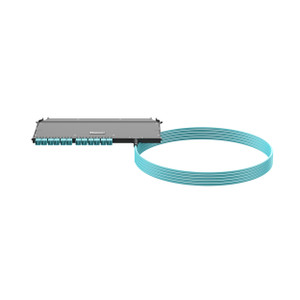
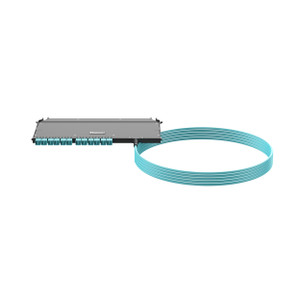
Panduit FZUYBXLNNNNM020 QuickNet™ OM4 24-Fiber Pre-Terminated Trunk Assembly
The Panduit FZUYBXLNNNNM020 is a factory-terminated 24-fiber OM4 multimode trunk cable engineered for high-density datacenter and telecommunications deployments where installation speed, reliability, and regulatory compliance cannot be compromised. This 20-meter (65.6 ft) assembly eliminates field termination labor and variability, delivering tested insertion loss performance and polarity assurance straight from Panduit’s ISO 9001-certified manufacturing facilities. The B2CA fire-performance rating qualifies this trunk for restricted European installations and North American projects specifying low-smoke, low-flame-spread cables in critical pathways. QuickNet™ pre-terminated solutions reduce deployment time by up to 80% compared to field-spliced alternatives while maintaining the mechanical and optical consistency required for 40GBASE-SR4, 100GBASE-SR10, and emerging 400G short-reach applications over OM4’s 50/125µm laser-optimized fiber.
Key Features
- 24-fiber OM4 multimode trunk supporting 10G/40G/100G Ethernet over distances up to 150m (10G), 150m (40G), and 100m (100G SR10)
- Factory-terminated with insertion loss ≤0.35 dB per mated pair and polarity verified to TIA-568.3-D Annex B or C configurations
- B2CA fire performance classification per EN 50575 — low smoke emission, low flame propagation for European CPR compliance and restricted North American installations
- Front-access tethered dust cap design prevents contamination and cap loss during staged installations or MAC (moves, adds, changes) work
- 20-meter overall length ideal for intra-row equipment distribution, meet-me room interconnects, or main distribution area to intermediate distribution area links
- Red OM4-compliant jacket for instant visual identification in mixed-fiber environments
- QuickNet™ factory testing includes end-face geometry inspection, optical loss certification, and mechanical pull-test validation
- TIA-568.3-D, ISO/IEC 11801, and ANSI/TIA-942-B certified for structured cabling system warranties and datacenter Tier III/IV infrastructure deployments
Datacenter migrations to 40G and 100G Ethernet place extraordinary demands on physical-layer infrastructure. Older OM3 fiber limits 40GBASE-SR4 to 100 meters and 100GBASE-SR10 to just 70 meters — distances often inadequate for modern spine-leaf topologies or campus datacenter interconnects. The FZUYBXLNNNNM020’s OM4 fiber extends 40G reach to 150 meters and 100G SR10 to 100 meters, providing the margin required when equipment moves force path-length changes or when future 400G migrations demand backwards-compatible OM4 infrastructure. The 24-fiber count supports twelve duplex LC connections or six MTP-12 breakouts, aligning with common 10G-to-40G migration strategies where parallel optics replace single-lane transceivers. Panduit’s controlled-environment termination process ensures each connector meets sub-0.35 dB insertion loss targets and ≥0.15 dB return loss specifications — performance levels difficult to replicate in the field even with experienced fusion-splicing crews. Factory polarity management eliminates the A-to-B flip errors that cause 30-50% of post-installation troubleshooting calls on site-terminated trunks, and the included test report documents per-fiber loss at 850nm and 1300nm wavelengths for baseline performance records and future troubleshooting reference.
The B2CA fire classification addresses a critical gap in North American and European projects. European Construction Products Regulation (CPR) EN 50575 mandates B2CA-minimum cables in escape routes, public assembly spaces, and high-occupancy buildings — categories that increasingly include colocation datacenters and multi-tenant telecommunications rooms. B2CA cables exhibit ≤50% flame spread in vertical tray tests, smoke production ≤250 m²/s², and limited acid gas emission, reducing life-safety risk during fire events compared to unrated or Euroclass D cables. North American integrators working under stricter authority having jurisdiction (AHJ) interpretations of NFPA 70 (NEC) Article 770 increasingly specify low-smoke cables even when standard OFNP (plenum) rating would technically suffice, particularly in raised-floor datacenters where cable density creates fuel-load concerns. The FZUYBXLNNNNM020’s B2CA rating provides compliance headroom for these projects without requiring costly riser-to-plenum pathway redesigns or dual-specification procurement. The tethered dust cap design — where protective caps remain physically attached to the connector boot via a retaining strap — solves a persistent field problem: loose dust caps fall into cable trays, get vacuumed up during cleanup, or simply disappear between delivery and final connection, leaving connector end-faces exposed to the airborne silica dust, zinc whiskers, and particulate contamination common in active datacenters. Contaminated end-faces cause 70% of fiber link failures per industry studies, and a single 5µm particle on a 9µm core can elevate insertion loss by 0.5 dB or more. Tethered caps stay with the connector throughout staging, overhead routing, and incremental turn-up schedules, maintaining the factory-clean end-face geometry until the moment of final mating.
The 20-meter length suits the 15-25 meter horizontal pathways common in enterprise datacenters and the intra-building backbone distances typical of campus telecommunications rooms. This length supports top-of-rack to end-of-row aggregation switch links in 48-52U cabinet rows, meet-me room cross-connects in multi-tenant colocation facilities, and entrance facility to main distribution area trunks in TIA-942 Tier III deployments. Unlike fixed-length off-the-shelf patch cords that force slack management headaches or custom-length orders that add lead time, the FZUYBXLNNNNM020’s 20-meter specification balances installation flexibility with inventory simplicity — integrators can stock a single SKU that covers 80% of horizontal datacenter trunk applications while maintaining the +10% service loop margin recommended by BICSI DCDC and TIA-942-B for future MAC work. Panduit’s QuickNet™ factory process includes automated pull-testing to 100N (22 lbf) and tap-testing per IEC 61300-2-2 to verify mechanical stability under the cable-tray vibration, thermal cycling, and accidental snag forces encountered during 20-year infrastructure lifecycles. Each trunk ships with a serialized test report listing per-fiber insertion loss at 850nm (the wavelength used by 10G/40G/100G SR optics) and 1300nm (used by some extended-reach OM4 applications), providing the baseline data required for TIA-526-14-B Tier 2 or OLTS (optical loss test set) acceptance testing and future troubleshooting when link budgets degrade. These reports satisfy the documentation requirements of datacenter infrastructure management (DCIM) platforms and structured cabling warranties, and they establish the performance floor for add/move/change projects years after initial installation when original installation crews may no longer be available.
This trunk is TIA-568.3-D certified for polarity Method B (key-up to key-down straight-through pairs) and Method C (array-to-array flipped pairs) configurations, ISO/IEC 11801 Class OM4 permanent link compliant, and ANSI/TIA-942-B qualified for Tier III and Tier IV datacenter structured cabling systems. These certifications ensure compatibility with 25-year extended warranties from Panduit and third-party infrastructure providers, and they meet the procurement specifications of federal integrators working under GSA Schedule contracts or BICSI-certified datacenter projects requiring manufacturer independence and multi-vendor interoperability. Integrators deploying Cisco Nexus, Arista spine-leaf, Juniper QFX, or HPE FlexFabric architectures gain a proven fiber backbone that supports both current 10G access-layer oversubscription and future 40G/100G spine upgrades without physical-layer rework — the OM4 investment protects against the fork-lift refresh cycles that plagued OM1/OM2 datacenters during the 1G-to-10G transition.