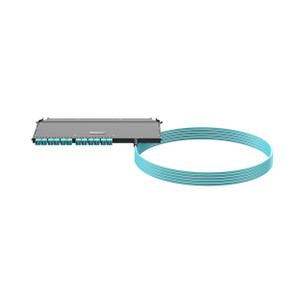
Panduit F1RBZO-2B08-10S OM4 128-Fiber Brocade-Type Pre-Terminated Trunk Assembly
The Panduit F1RBZO-2B08-10S is a 128-fiber OM4 multimode pre-terminated trunk assembly engineered for Brocade-type labeling environments in high-density data centers, telecommunications rooms, entrance facilities, and equipment distribution areas. When your structured cabling plan calls for rapid deployment without field termination, this pre-terminated solution eliminates the variables that come with on-site polishing and connector installation — you pull the trunk, plug in, and move on.
Overview
Built to OM4 50/125µm multimode fiber specification, the F1RBZO-2B08-10S delivers the bandwidth headroom that 40G and 100G parallel optics demand in backbone and horizontal runs alike. Panduit's Brocade-type labeling scheme maps directly to the port identification conventions used in Brocade/Broadcom SAN and Ethernet switching environments, which cuts commissioning time when you're cross-connecting to those platforms. Compliance with TIA-568.3-D, ISO/IEC 11801, and ANSI/TIA-942-B means the assembly meets the cabling standards auditors check for in Tier II through Tier IV data center certifications — important when your customer's facility has to pass a third-party infrastructure audit. Explore the full Panduit structured cabling line for complementary trunks, panels, and enclosures in the same family.
Key Features
- 128-Fiber Count: High fiber density per trunk pull means fewer individual cables to route, label, and manage — directly reducing cable tray congestion and pull labor in high-port-count spine/leaf environments.
- OM4 Multimode (50/125µm): Supports 100G-SR4 and 40G-SR4 parallel optics at the distances typical of intra-facility backbone runs. If your deployment is pushing beyond 150m at 40G or 100m at 100G, OM4 is the floor spec — anything less leaves margin on the table.
- Brocade-Type Labeling: Port identification labels follow the Brocade/Broadcom numbering convention out of the box. Patching into a Brocade ICX or SAN director is a label-match exercise, not a re-mapping exercise.
- Pre-Terminated Factory Assembly: Field termination is the single largest source of insertion loss variation in a fiber plant. Factory-terminated assemblies like this one ship with tested, consistent connector performance — no field polishing, no re-work, no re-test.
- TIA-568.3-D / ISO/IEC 11801 / ANSI/TIA-942-B Compliance: Satisfies the standards cross-referenced in most enterprise and colocation data center cabling specifications, simplifying acceptance testing and documentation sign-off.
- Rapid Deployment Design: Pre-terminated trunks compress installation timelines on structured cabling projects — relevant when you're under a hard cutover deadline in a live data center environment. Browse the full range of fiber optic trunk assemblies to find complementary runs for your topology.
Integration and Compatibility
The F1RBZO-2B08-10S is sized for environments where Brocade-platform switching or SAN infrastructure is the primary termination target. OM4 multimode is compatible with LC-duplex and MPO/MTP parallel optic transceivers used across major switching and SAN platforms. Pair with fiber patch panels and multimode transceivers to complete the end-to-end optical path. For planning fiber density and trunk routing in high-port-count deployments, consult a structured cabling planning guide before finalizing conduit fill and tray assignments.
Frequently Asked Questions
Q: What fiber type does the F1RBZO-2B08-10S use?
A: It uses OM4 multimode fiber (50/125µm), which supports 40G and 100G parallel optic applications at standard intra-facility backbone distances.
Q: Which industry standards does this trunk assembly comply with?
A: The F1RBZO-2B08-10S meets TIA-568.3-D, ISO/IEC 11801, and ANSI/TIA-942-B — the primary cabling standards referenced in enterprise and data center infrastructure specifications.
Q: What does Brocade-type labeling mean for this assembly?
A: Brocade-type labeling means the fiber ports are labeled to match the port identification numbering scheme used on Brocade/Broadcom switching and SAN director platforms, reducing cross-connect mapping effort during commissioning.
Q: How many fibers does this trunk include?
A: This assembly contains 128 fibers, making it suited for high-density backbone infrastructure where minimizing individual cable count in trays and conduits is a priority.
Q: What applications is the F1RBZO-2B08-10S designed for?
A: It is designed for data centers, telecommunications rooms, entrance facilities, and equipment distribution areas requiring pre-terminated fiber infrastructure for rapid deployment.
The F1RBZO-2B08-10S is the trunk I reach for when a project spec calls for Brocade-platform connectivity and the schedule won't tolerate field termination delays. The 128-fiber count in a single pre-terminated assembly compresses what would otherwise be multiple smaller trunks into one pull — and with OM4 50/125µm glass, you have the bandwidth foundation for 40G-SR4 and 100G-SR4 parallel optics without having to revisit the fiber plant when your client upgrades switching hardware.
Technical Highlights:
- 128-Fiber Density: A single trunk replacing what might otherwise require multiple smaller assemblies — fewer pulls, less tray fill, simpler documentation for as-built drawings.
- OM4 50/125µm Glass: Meets the fiber spec required by 40G-SR4 (up to 150m) and 100G-SR4 (up to 100m) parallel optic transceivers — the wavelengths your Brocade ICX and SAN directors will be running.
- TIA-568.3-D / ANSI/TIA-942-B Compliance: Both standards are routinely called out in data center acceptance test plans; having the assembly already certified against them removes a documentation step at project close-out.
Deployment Considerations:
- Verify that the connector type and polarity scheme on the F1RBZO-2B08-10S match your patch panel and switch port configuration before pulling — pre-terminated trunks are not field-reterminated without specialized equipment.
- OM4 multimode is the right call for intra-facility runs, but if any segment of your backbone exceeds the distance limits for your target transceiver type, you need to evaluate single-mode instead — OM4 does not scale past those thresholds.
This trunk is the right specification for a Brocade-platform spine/leaf or SAN director deployment in a colocation or enterprise data center where cabling standards compliance, high fiber density, and commissioning speed are all non-negotiable project requirements.