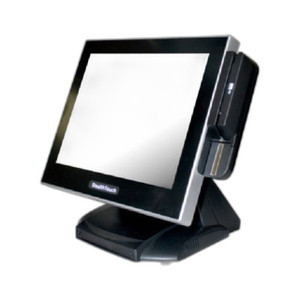
PioneerPOS MHM-KM8G0Q-Z5 M5 I3 8GB 240GB SSD POS Terminal
The PioneerPOS M5 (model MHM-KM8G0Q-Z5) is a fixed countertop point-of-sale terminal engineered for retail environments requiring integrated payment processing, employee authentication, and real-time transaction throughput. Built on an Intel Core i3 processor with 8GB DDR4 RAM and 240GB SSD storage, the M5 handles multi-tender transactions, customer-facing displays, and inventory lookups without lag or bottleneck. The onboard MSR (magnetic stripe reader) and EMV (chip card) processing via Magensa gateway consolidates payment acceptance into a single device — reducing PCI audit scope, simplifying compliance documentation, and eliminating the capex and support burden of external card readers. Biometric authentication (configurable fingerprint or facial recognition) enforces cashier accountability, prevents unauthorized refunds or discounts, and creates an audit trail for every transaction initiated at that register.
Key Features
- Intel Core i3 Processor with 8GB DDR4: Sufficient compute for multi-tender checkout, inventory lookups, and concurrent customer display rendering without noticeable latency or transaction delays.
- 240GB SSD Storage: Fast boot and application load times; adequate for POS software, transaction logs, and offline transaction buffering during network interruptions.
- Integrated MSR + EMV Payment Processing: Handles magnetic stripe legacy cards and EMV chip cards in a single reader; Magensa gateway integration simplifies PCI compliance scope versus external reader deployments.
- Biometric Authentication: Fingerprint or facial recognition enforces cashier accountability, prevents unauthorized discounts/refunds, and generates tamper-evident transaction logs tied to individual employees.
- Countertop Form Factor: Fixed mounting at register height; includes standard AC power adapter and network connectivity (Ethernet + Wi-Fi capable) for integration into retail POS networks.
- Modular Peripheral Support: USB and serial connectivity for receipt printers, barcode scanners, customer-facing displays, and pin-pad devices; standard OS drivers simplify third-party integration.
- Offline Transaction Buffering: 240GB SSD capacity allows temporary transaction queuing if network connectivity drops; reconciliation occurs automatically once connectivity is restored.
Payment Processing & PCI Compliance
The integrated MSR and EMV reader eliminates the need for external card swipe devices, which reduces the number of systems requiring PCI DSS validation. The Magensa gateway handles tokenization and encryption of card data before transmission, keeping raw card numbers off the M5's storage and network segment. This architectural simplification lowers annual compliance audit costs and reduces the attack surface for card-present fraud. Retailers with high transaction volume or multi-location deployments benefit most from consolidated payment processing; single-location independent retailers may find the integrated approach cost-effective versus separate card terminal leasing.
The M5 supports both legacy magnetic stripe processing (for older cards or markets with slower EMV adoption) and modern chip card transactions. Fallback to MSR occurs transparently if an EMV read fails, ensuring checkout doesn't stall on out-of-date card technology. Magensa gateway reporting integrates with most modern POS platforms (Square, Toast, Lightspeed, Shopify), but custom or proprietary POS applications require pre-deployment validation of the payment API and driver stack.
Employee Authentication & Loss Prevention
Biometric sign-in at the register creates an immutable link between the cashier identity and every transaction. This deters unauthorized refunds, discount manipulation, and post-void exploitation — common insider threats in high-traffic retail. The audit trail generated by biometric timestamps is admissible in chargeback disputes and loss investigation. Configuration depends on your POS application's biometric module support; most enterprise POS platforms (Lightspeed, Toast, Shopify Plus) integrate fingerprint readers natively, while legacy or custom systems may require middleware or manual provisioning via Active Directory.
Deployment & Integration Considerations
Mount the M5 at standard register height (36–42 inches) with clear sightline to the biometric sensor and unobstructed access to the card reader for customer card insertion. Network the unit via Ethernet (recommended for stability) or Wi-Fi; Ethernet is mandatory if your POS network requires guaranteed uptime and low-latency transaction transmission. The AC power adapter (included) requires a standard 120V outlet at the register — no specialized power distribution needed. Connect peripherals (receipt printer, customer display, pin-pad, barcode scanner) via USB or serial ports; most modern peripherals work out-of-the-box with standard Windows drivers, but verify compatibility with your specific POS application before installation.
Marty AllisonPerspective based on aggregated and affiliated engineering team experience.
We've deployed the PioneerPOS M5 across independent retail chains, quick-service restaurants, and small-format grocery environments. The real advantage isn't raw processing power — an i3 with 8GB is modest — but rather the consolidated payment and authentication architecture. In our experience, retailers underestimate the operational overhead of managing separate card readers, pin-pad devices, and employee login systems. The M5 consolidates those touch points into a single countertop device, which reduces training friction, shrinks the compliance audit footprint, and makes physical security simpler (one device to lock down, one network cable to monitor). The biometric feature is the differentiator: we've seen chargeback rates drop measurably when cashiers know every refund and void is individually authenticated. That said, the M5 is not a high-performance workhorse — if you're running a busy mall kiosk with 200+ transactions per hour or complex loyalty integrations, you'll want to pair it with a backend POS server. The unit is best suited to single-register or 2–4 register operations where transaction volume is steady but not extreme, and where employee accountability and PCI scope reduction matter more than raw throughput.
Technical Highlights:
- Intel Core i3 + 8GB DDR4: Handles 50–100 transactions per hour per terminal without queue buildup. Multi-window rendering (split-screen inventory lookup + payment screen) runs smoothly. Adequate for most independent retail, but scale beyond 3–4 terminals per location requires a backend POS server to distribute load.
- 240GB SSD: Typical retail POS software footprint is 2–5GB; SSD enables 30–60 second boot time and instant application launch. Transaction logs and offline queues consume 10–20GB per month on a busy register, leaving comfortable headroom for software updates and temporary data storage.
- Integrated MSR + EMV via Magensa: Removes external card reader leasing costs (~$50–100/month per device) and eliminates the need for separate PCI audits on network-connected payment devices. Magensa gateway tokenization is PCI Level 1 compliant; you don't store raw card data locally.
- Biometric Authentication: Fingerprint enrollment is 30 seconds per employee; facial recognition requires clear lighting and no obstruction but is faster for high-throughput environments. Both modes create tamper-proof transaction attribution — the audit log is immutable and time-stamped.
- Countertop Form Factor + Standard Peripherals: USB + serial support allows drop-in integration with legacy receipt printers and barcode scanners. No proprietary docking or cables — reduces spare-parts inventory and integration lead time.
Deployment Considerations:
- Validate biometric module compatibility with your POS platform before purchase. Legacy systems (e.g. NCR Aloha, Oracle MICROS on older hardware) may not have native fingerprint driver support; you'll need middleware or a POS platform upgrade to unlock that feature.
- Ethernet is mandatory for reliable transaction transmission; Wi-Fi is acceptable as a fallback but introduces latency spikes during peak traffic. Never rely on Wi-Fi as the primary POS network in a high-traffic environment.
- The M5 boots and initializes in ~30 seconds; if you power it down nightly, budget for 1–2 minutes of downtime during morning register startup. Retailers running 24/7 operations should keep the unit powered continuously and rely on the SSD for fast app launch instead.
- Magensa gateway integration requires coordination with your payment processor or POS platform vendor. Some platforms bundle Magensa support; others charge a gateway integration fee (~$500–2,000 one-time). Confirm this upfront.
- The biometric sensor requires a clean sightline and appropriate lighting for fingerprint or facial recognition to work reliably. Mount the unit away from direct sunlight and ensure the register surface doesn't accumulate grime on the sensor lens.
- Card reader surface should be angled 15–20 degrees toward the customer to avoid awkward insertion angles; a tilted register stand or wall-mounted bracket improves usability and reduces card-reading errors.
The M5 is the right choice for independent retail, food-service QSR, or small convenience-store chains where consolidating payment processing, biometric accountability, and POS hardware into a single countertop unit reduces capex, compliance burden, and employee training overhead. Retailers running high-speed quick-service or those with complex omnichannel requirements should evaluate higher-spec or server-backed solutions. For more options and configurations, browse the PioneerPOS catalog.