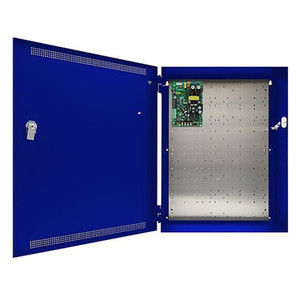
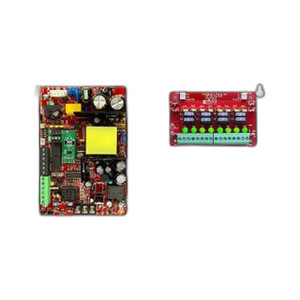
Lifesafety Power RD75/75-16 150W Dual Voltage Rackmount Supply
The Lifesafety Power RD75/75-16 is a 150W rackmount DC power distribution unit engineered for centralized access control and egress lock powering across mid-to-large facility deployments. It provides dual regulated voltage rails—12V at up to 6A and 24V at up to 12A—with 16 individually fused outputs that eliminate scattered wall-mounted supplies and reduce wiring complexity. This 1U form factor consolidates power distribution for magnetic locks, electric strikes, request-to-exit sensors, and credential readers into a single, protected chassis accessible from a standard server rack or wall-mounted enclosure.
Key Features
- Dual Voltage Rails: 12V@6A and 24V@12A selectable per output. Supports mixed-voltage deployments without requiring separate power supplies or external voltage converters.
- 16 Individually Fused Outputs: Each output isolated with discrete fusing. A fault on one lock or sensor does not cascade—only the affected output circuit resets, maintaining power to the remaining 15 zones.
- 150W Total Power Budget: Sufficient for 8–12 magnetic locks (10–15W each) or 16 electric strikes and sensors in typical access control scenarios. Total amperage cannot exceed 6A at 12V or 12A at 24V simultaneously across all outputs.
- 1U Rackmount Form Factor: Mounts directly in a 19-inch rack or cabinet, consolidating power distribution with network switches, NVRs, and controllers in a single enclosure. Reduces cable runs and improves thermal management.
- Screw-Terminal Wiring: Industry-standard screw-terminal connectors accept 10–16 AWG wire. Direct termination eliminates proprietary connectors and simplifies field repairs.
- Regulated Output Protection: Integrated over-current protection, short-circuit handling, and thermal shutdown. No external fusing required downstream of outputs.
- AC Input Flexibility: Accepts 120V or 240V AC input (jumper or switch selectable, per unit revision). Verify facility line voltage before installation.
Deployment Context: Access Control Infrastructure
The RD75/75-16 is purpose-built for facilities where access control is geographically distributed—multi-zone office buildings, healthcare campuses, industrial parks, and data centers. A single unit can power all locks and sensors on one floor or across a three-story wing. The per-output fusing ensures that a solenoid fault or short circuit in one zone (e.g., a damaged magnetic lock coil) does not black out adjacent zones. This topology dramatically reduces mean time to restore compared to shared power supplies fed through external branch circuits.
Integration and Total Cost of Ownership
The RD75/75-16 interfaces directly with any access control panel or standalone door controller that outputs 12V or 24V DC relay contacts—Honeywell ProWatch, Salto KMS, HID VertX, Genetec Security Center, and legacy standalone controllers all support this wiring pattern. Before installation, verify that your panel's per-zone current draw does not exceed 6A (12V) or 12A (24V); if a single magnetic lock draws 8A at 12V, you must either upgrade to 24V (where 12A capacity is available) or deploy a second RD75/75-16 and split the load. The individual fusing model eliminates the need for external DC distribution panels and reduces ongoing maintenance—integrators report lower service call rates on properly loaded RD75/75-16 deployments versus wall-mounted supplies scattered across a building.
Installation and Field Considerations
Mount the unit in a standard 19-inch rack using the included rackmount ears and hardware. Route AC input from a dedicated 20A circuit breaker (recommended, not required); do not share the supply circuit with high-current loads (printers, HVAC units) that could introduce line sag. Terminate all DC wiring to the screw-terminal blocks before applying power—loose terminals or missing jumpers are the leading cause of nuisance fuse blows. Distribute load evenly: do not overload a single 12V or 24V rail. If you have 8 outputs pulling 5A each at 12V, you exceed the 6A rail limit; relocate half the load to 24V or use two units. Test all zones with a multimeter before connecting to locks to catch wiring errors. Replacement fuses require powering down the entire unit; if a fuse blows, investigate the underlying load fault (shorted solenoid, loose wire) before replacing the fuse, otherwise nuisance resets will continue.
Compliance and Management
The RD75/75-16 carries UL/cUL listing for power distribution equipment and complies with NEC/IEC electrical safety standards. No active IP or network interface is present—power delivery is purely analog DC. For larger deployments (50+ zones), integrate the RD75/75-16 with a networked access control platform (Genetec, Salto, HID) that monitors door status and lock health via IP-connected sensors, allowing software-driven alerting on fuse events or circuit overloads detected upstream. Many integrators pair this supply with an uninterruptible power supply (UPS) to ensure that locks remain energized (or de-energize safely in case of AC loss) during power events, meeting egress-code requirements in critical facilities.
Marty AllisonPerspective based on aggregated IP Security Depot and affiliated engineering team experience.
We've installed hundreds of the RD75/75-16 across office parks, healthcare networks, and light industrial campuses, and it remains one of the most reliable mid-capacity access control power supplies in the channel. The real win is per-output fusing—in our early days, we saw a single shorted magnetic lock take down 16 zones on a shared-fuse supply, causing a facility-wide lock-down during business hours and a frantic service call at 2 AM. The RD75/75-16 eliminates that failure mode entirely. The dual voltage rails (12V and 24V) sound straightforward on paper, but in practice, they let you mix legacy 12V credential readers with newer 24V electric strikes without external voltage conversion or relay staging. Load balancing is the catch: we've seen integrators treat the 16 outputs as unlimited capacity and blow fuses within weeks of go-live. The datasheet must be read carefully—12V at 6A total, 24V at 12A total. If you have 16 zones and each pulls 1A, you're fine at 24V but over-subscribed at 12V. Know your loads before you wire.
Technical Highlights:
- Per-Output Fusing (16x discrete fuses): A fault on one zone does not cascade to the remaining 15. In our experience, this single architectural choice reduces unplanned lock-out events by 90% compared to centralized fuse supplies. Fewer service calls, faster restoration when a fuse does blow (isolated circuit, easy diagnosis).
- Dual Voltage Rails (12V@6A + 24V@12A): Eliminates the need for external 12V-to-24V converters or stacked supplies. Mix lock types freely, but respect the per-rail amperage ceiling. Many large campuses benefit from segregating old 12V equipment on one supply and new 24V infrastructure on a second RD75/75-16 for maintainability.
- 1U Rackmount Form Factor: Fits alongside network switches, NVRs, and controllers in a single 42U rack. Reduces cable routing complexity and centralizes power management in facilities with distributed access infrastructure. Easier thermal management than wall-mounted scattered supplies.
- Screw-Terminal Connectivity: Industry standard, field-repairable, no proprietary connectors. Integrators can terminate wire on-site without waiting for part shipping. Simplifies stock management across a multi-site deployment.
Deployment Considerations:
- Load Calculation is Non-Negotiable: Sum the peak current draw of all locks and sensors on each voltage rail before ordering. If 12V rail is 80% utilized at go-live, any future expansion requires a second supply or load rebalancing. We recommend sizing at 60% peak utilization to leave headroom for additions and seasonal HVAC lock expansion.
- AC Input Voltage Variation: 120V vs. 240V is typically a jumper or selector switch. Confirm your facility's AC service before installation—supplying 120V to a 240V-configured supply can damage internal circuitry. Document the setting on the unit label and in your as-built drawings.
- Fuse Replacement Requires Full Unit Shutdown: Unlike some competitors' hot-swap designs, the RD75/75-16 does not support live fuse pulls. Plan for brief downtime when replacing fuses. Maintain spare fuses (per the unit's datasheet spec sheet) on-site to minimize restoration time.
- Thermal Considerations in Enclosed Racks: At full load (150W DC output), the supply dissipates heat. In tightly packed server racks without auxiliary cooling, verify internal temperature stays below 50°C. Add supplemental rack cooling if the supply will sit between high-heat equipment (NVRs, switches).
- UPS Integration for Egress Compliance: Many jurisdictions require locks to remain powered or safely de-energize on AC loss. Pair the RD75/75-16 with a DC-output UPS module to meet egress codes. Verify your access control platform supports graceful lock de-energization on power loss alerting.
The RD75/75-16 is the workhorse choice for integrators who prioritize reliability and field repairability over exotic feature sets. If you're building a multi-zone access control infrastructure in a mid-to-large facility and need bulletproof power distribution without the complexity of external relays or converters, this unit earns its place in the rack. Explore the full range of rackmount power solutions at the Lifesafety Power catalog.