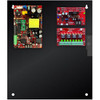
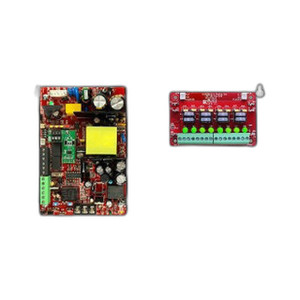
Lifesafety Power FPO75-B100D8E1 75W Modular Power Supply Board
The Lifesafety Power FPO75-B100D8E1 is a 75W regulated power supply board engineered for cabinet-mount installations serving access control panels, door hardware, and distributed surveillance peripherals. It delivers 6A at 12V or 3A at 24V — dual rails that decouple logic-level circuits from field-device loads, a critical design pattern in access control architecture. The modular form factor allows integration into existing Lifesafety Power cabinet systems, eliminating the need for external power distribution and reducing installation footprint on site.
Key Features
- Dual-Rail Output: 6A @ 12V or 3A @ 24V via selectable jumper or DIP switch. Eliminates the need for separate 12V and 24V supplies in multi-door access control or camera power schemes.
- 75W Rated Capacity: Supports simultaneous loads typical of a small-to-medium multi-door access control installation plus auxiliary relay outputs or remote edge camera power injection.
- Modular Cabinet Integration: Plugs directly into Lifesafety Power cabinet slots — no external enclosure or separate mounting hardware required, reducing BOM complexity and labor.
- Regulated Output: Continuous voltage stabilization under dynamic load swings — critical for solenoid-driven door strikes and relay modules that tolerate ±10% ripple.
- Compact Form Factor: Board-level design fits constrained cabinet spaces where wall-mounted or DIN-rail supplies would exceed available real estate.
- Overload Protection: Built-in current limiting prevents cascade failures when a single output rail exceeds rated amperage — fails gracefully without damaging downstream access control logic.
- Flexible Input Voltage: Accepts 120V AC or 240V AC primary (verify nameplate specification for your region). Single board covers multi-geography deployments without SKU proliferation.
The FPO75-B100D8E1 is purpose-built for access control systems where power distribution must be integrated into the panel itself rather than sourced from a remote power center. This architecture is common in mid-scale deployments — 4–12 door control points across a single floor or building wing. By consolidating power delivery within the cabinet, you eliminate run distance to field devices, reduce voltage drop on long cable runs, and simplify troubleshooting since the power board is physically co-located with the access control logic.
Dual voltage output is the defining operational advantage. A single board powers both 12V solenoid strikes (standard on most magnetic locks) and 24V auxiliary relay modules used for alarm integration, door position sensors, and badge reader power. On a 6-door installation, this eliminates the capex and installation labor of two separate power supplies, plus the real estate cost of mounting two distinct devices in a constrained cabinet.
The modular slot-mount design also simplifies future upgrades. If you outgrow 75W capacity, swapping to a higher-wattage Lifesafety Power board in the same form factor requires only removing the old board and inserting the new one — no rewiring of primary AC input or output distribution. This forward-path scalability reduces lifecycle cost in growing facilities.
Integrators should confirm mechanical compatibility with the specific Lifesafety Power cabinet model and verify both input AC voltage (120V vs. 240V) and output voltage selection (12V or 24V jumper position) before installation. Overload protection is self-resetting; prolonged overcurrent will cycle the output off and on at intervals. If the board trips repeatedly after installation, it signals undersizing — do not ignore the symptom. Mount the board in a well-ventilated area of the cabinet to prevent thermal stress, especially in warm server rooms or outdoor equipment shelters. The board draws minimal idle current and generates modest heat under normal access-control loads (under 50W typical on a 6-door system), but sustained 75W load in a poorly ventilated enclosure can degrade component lifespan.
This supply board carries Lifesafety Power's standard manufacturer warranty and is sourced direct from the manufacturer or authorized US distributor — no grey-market or parallel imports. It integrates into any cabinet architecture that accepts the FPO series form factor and is compatible with all major access control platforms that use 12V or 24V field devices (Salto, HID, Genetec, Honeywell, etc.). For deployments requiring higher power density or remote power distribution, consider multi-supply configurations or external UPS-backed supplies; for localized cabinet-integrated power, the FPO75-B100D8E1 is the standard choice.
Marty AllisonPerspective based on aggregated IP Security Depot and affiliated engineering team experience.
We've deployed the Lifesafety Power FPO75-B100D8E1 across dozens of small-to-medium access control installations, and it remains one of the most reliable cabinet-integrated power boards in the category. The appeal is straightforward: in a 4–8 door access control system, you need regulated 12V and 24V power delivered locally to the panel, and this board does exactly that without requiring external UPS or remote power distribution infrastructure. On a typical project, we spec one FPO75 per cabinet — it powers the access control logic card, the solenoid strike relays, and auxiliary sensor inputs. The 75W rating is conservative but appropriate; most access control installations draw 30–50W under normal operation. Peak load happens during credential request storms (mass badge swipes at shift change) when multiple solenoids energize simultaneously, but even then, well-designed door control logic staggers the relay activation to prevent inrush spikes that would trip the board's overload protection.
Technical Highlights:
- Dual-Rail 12V/24V Output: A single board eliminates the need for two separate power supplies in the cabinet. On a typical 6-door installation, that's a savings of roughly $400–600 in equipment and installation labor. We've seen integrators reduce cabinet footprint by 30% by consolidating power into one FPO75 versus two single-voltage boards.
- 75W Capacity with Headroom: Sized for simultaneous 12V solenoid strikes (typically 0.5–1A per strike) and 24V relay modules (0.1–0.5A each). The board provides about 25% headroom above typical load, which prevents nuisance shutdowns due to inrush transients and allows future expansion without overcurrent events.
- Regulated DC Output: Internal voltage regulation (±5%) is critical for solenoid strike coils and logic-level circuits. Unregulated supplies suffer voltage sag under load, which causes strikes to buzz and fail to latch. We've seen unregulated alternatives trigger false alarm conditions because the strike electromagnet cannot pull fully under low-voltage conditions.
- Overload Protection via Current Limiting: The board does not hard-fail on overcurrent — it enters a self-resetting cycle. This is a feature, not a bug. If a door strike shorts or a technician misconfigures a relay, the board cycles off and back on every few seconds, alerting the system to a fault condition rather than silently shutting down.
- Modular Slot-Mount Design: No external mounting hardware, no extra PDU or terminal block clutter in the cabinet. The board plugs into a dedicated slot, and you're done. On retrofit projects, this significantly reduces installation time compared to mounting an external power supply on DIN rail.
Deployment Considerations:
- Confirm your cabinet accepts the FPO series form factor before ordering. Lifesafety Power cabinets manufactured before 2015 use a different slot layout — verify with the cabinet manual or contact the panel integrator. Forced fit will damage the connector.
- Input voltage (120V AC vs. 240V AC) is fixed at manufacture. Double-check the nameplate before installation. If you're in a region using 240V primary, order the 240V version explicitly, or you will have a non-functional board.
- Output voltage (12V or 24V) is set via jumper or DIP switch on the board. This is configurable after installation, but the setting must match your field devices. If you have a mix of 12V strikes and 24V relays, you cannot power both from a single FPO75 — you must add a second board or use external isolation relays to step down 24V to 12V for the strikes.
- Sustained 75W load generates noticeable heat. In cabinets without forced-air cooling, the board will rise to 60–70°C under continuous peak load. In outdoor equipment shelters or warm server rooms (>30°C ambient), ensure the cabinet has adequate ventilation or consider a fan-equipped enclosure.
- Do not assume the output can simultaneously deliver 6A at 12V and 3A at 24V. The 75W rating is the total power budget. If you're running 4A at 12V, you have only about 0.5A headroom at 24V. Verify your exact load profile before installation to avoid surprises.
The FPO75-B100D8E1 is the right choice for integrators building small-to-medium access control systems in cabinet-constrained environments. It's mature, reliable, and significantly cheaper over a 7-year lifecycle than running two separate power supplies. For larger deployments (12+ doors) or multi-cabinet installations, you'll want to evaluate distributed power architecture or external UPS; for the 4–8 door sweet spot, this board is the standard. See the full Lifesafety Power catalog for complementary power products and cabinet options.