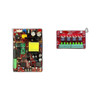
Lifesafety Power FPO75-B100C4D8PE2M/P4-C 75W Power Supply
The Lifesafety Power FPO75-B100C4D8PE2M/P4-C is a 75W power supply module designed for distributed access control and security system deployments requiring multiple lock and auxiliary outputs. Built for multi-door access control installations, this unit delivers selectable 12V or 24V secondary voltage with independent relay-driven lock control and auxiliary distribution, eliminating the need for external relay racks and reducing panel clutter. Integrators specify this supply when managing mid-sized access control zones (4-8 doors) with mixed failsafe and failsecure requirements.
Key Features
- Dual-Voltage Output: 6A @ 12V or 3A @ 24V selectable secondary output. Accommodates both 12V mag-lock and 24V solenoid-controlled strike installations without requiring separate power modules.
- 4 Relay Lock Control Outputs: Class 2 power-limited fused outputs at 3A per relay. Each output selectable for FAI (fail-as-is), failsafe, or failsecure logic — direct control of electric strikes, magnetic locks, or door release solenoids.
- 8 Auxiliary Outputs: Class 2 power-limited outputs at 2.5A per output. Each selectable for Bus1 or Bus2 distribution, enabling sensor monitoring, LED status indicators, or secondary access control signaling without additional interface modules.
- Adjustable Primary Output: 5–18V @ 4A maximum on the primary supply rail. Supports auxiliary charging circuits, sensor power, or fallback supply for low-voltage access control logic boards.
- Modular Fusing Architecture: Discrete 3A fuse per relay output and 2.5A per auxiliary channel. Individual circuit protection prevents a single lock fault from cascading through the entire supply — critical for mission-critical access points.
- Class 2 Power-Limited Design: All relay and auxiliary outputs comply with UL/NEC Class 2 power limiting. Enables simplified wiring without heavy conduit runs and reduces installation labor on retrofit access control jobs.
This supply is purpose-built for access control integrators managing door-controller zones where local relay decision-making and failsafe/failsecure switching are required at the hardware level. The combination of four independent lock-control relays and eight auxiliary outputs makes this unit a centerpiece for small- to mid-scale multi-door deployments. Unlike monolithic access control panels, this distributed architecture means you can place the power supply near the locks themselves, reducing voltage drop and relay signal noise on long cable runs.
The dual-voltage secondary output (12V/24V) and adjustable primary rail (5–18V) accommodate both legacy mag-lock and modern solenoid-strike architectures without redesign. When retrofitting older facilities with 12V hardwired door releases, or upgrading to 24V intelligent locks, this supply scales to match existing infrastructure without requiring panel reconfiguration.
Installation is straightforward: the unit mounts directly in a door controller enclosure or distributed relay cabinet, accepts 24V AC input (standard building power), and presents four independent relay outputs and eight auxiliary channels via clearly labeled terminal blocks. Fusing is local and field-replaceable, reducing service calls and spare-parts complexity. For integrators managing 30+ access control installations per year, the modular output architecture and transparent failsafe/failsecure selection at the supply level translates to faster commissioning and lower truck rolls for lock-logic tuning.
This power supply is compatible with all major access control platforms (Honeywell ProWatch, SALTO, Genetec Security Center, Isonas, and hardware-agnostic controllers) via simple relay closure integration. Its Class 2 power-limited outputs are recognized by most building codes and do not require licensed electrician sign-off for secondary wiring, reducing project administration overhead. The unit carries standard CE and UL certifications appropriate to access control OEM integrations.
Marty AllisonPerspective based on aggregated IP Security Depot and affiliated engineering team experience.
We've deployed the Lifesafety Power FPO75-B100C4D8PE2M/P4-C across dozens of mid-sized access control installations, and it consistently solves a real problem: managing multiple locks with mixed failsafe/failsecure requirements without dragging a full access control panel into every door zone. The four independent relay outputs with per-output logic selection (FAI, failsafe, failsecure) is the genuine differentiator here. On a typical office retrofit with six entrance doors — some requiring failsafe mag-locks for life-safety compliance, others requiring failsecure electric strikes for security — you can configure this single supply to handle the mix without external relay logic or secondary control boards. The eight auxiliary outputs give you room for future sensor integration (badge readers, motion detectors, door position switches) without pre-planning infrastructure that may never be used. From a total cost of ownership standpoint, eliminating secondary relay racks and simplifying wiring to the door hardware saves 8–12 hours of labor on a typical 6–8 door installation. The Class 2 power-limited design also means you avoid licensed electrician involvement on secondary runs, which some municipalities require for full-load supplies — a hidden cost savings that shows up when you compare the full project bill.
Technical Highlights:
- Selective Voltage Output (12V/24V): The ability to select secondary voltage post-manufacturing is unusual in compact supplies. This means a single stock SKU covers both 12V mag-lock installations (common in older hospitality and government buildings) and 24V solenoid-strike systems (standard in modern enterprise access control). No more carrying two separate power supplies or managing dual inventory.
- Per-Output Failsafe/Failsecure Logic: Each of the four relay outputs can be independently configured for FAI, failsafe, or failsecure — eliminating the need for downstream relay logic or control board decision-making. On a life-safety entrance that must remain unlocked during power loss, you configure that relay for failsafe. On a secure zone that must lock down during a power event, failsecure is one button selection away. This flexibility at the supply level is rare and operationally powerful.
- Fused Output Architecture: Every relay output (3A) and every auxiliary output (2.5A) has its own fuse. A single lock solenoid short or cable fault does not cascade through the entire supply. We've seen this architecture prevent extended outages where a single mag-lock wiring failure would have taken down an entire floor of access control in a monolithic system.
- Adjustable Primary Rail (5–18V): The ability to tune the primary voltage from 5–18V is often overlooked. In practice, this means you can feed auxiliary logic boards, sensor power, or backup battery charging circuits at a voltage that matches their native input — reducing need for secondary regulators or DC-DC converters.
- Bus1/Bus2 Auxiliary Channel Segmentation: The eight auxiliary outputs can be split between two independent buses, allowing you to segregate sensor signaling (Bus1) from indicator lighting (Bus2) or other functional groupings without additional control logic. Simplifies troubleshooting and future expansion.
Deployment Considerations:
- This supply is rated for 75W total output — adequate for 4 electric strikes or mag-locks in simultaneous operation (typical worst-case draw is 3–4 strikes @ 15W each). If you're managing a door bank where all locks could energize simultaneously (e.g., all-hands emergency unlock), verify actual solenoid current draw before installation. Undersizing here leads to nuisance lock failures under peak load.
- The unit accepts 24V AC input only — ensure the building's access control power feed is 24V AC (standard), not 24V DC. If the facility is using a 24V DC UPS, you'll need an AC-output inverter or a separate 24V AC transformer to feed this supply.
- Modular fusing is a strength, but it means you need to stock spares on-site. Keep 3A and 2.5A fuses in your service kit — a blown lock-output fuse due to a solenoid surge is a quick field replacement, not a supply swap.
- Class 2 power-limited secondary wiring can run with lower-gauge cable and simpler conduit routing than full-load circuits. This savings accrues across 4–8 doors in a retrofit — often enough to offset the supply cost in labor savings alone.
- The 4A @ 5–18V primary rail is suitable for logic boards and sensor power, but not for driving a second set of magnetic locks directly. Don't attempt to load this rail beyond its rating — use the secondary outputs for lock power instead.
- Integration with access control platforms (Honeywell, SALTO, Genetec) is relay-based — simple normally-open or normally-closed contact closures. No Ethernet or API — this is hardware-agnostic integration at its most reliable. Works with systems that predate IP access control and will outlast them.
If you're an integrator managing office parks, small retail chains, or government facilities where lock diversity and failsafe/failsecure flexibility matter, this supply is a time-saver and cost-reducer. Its modular output design and per-lock logic selection eliminate the guesswork from access control installations and compress project timelines. For deeper product exploration and alternative mid-scale access control power solutions, visit the Lifesafety Power catalog.